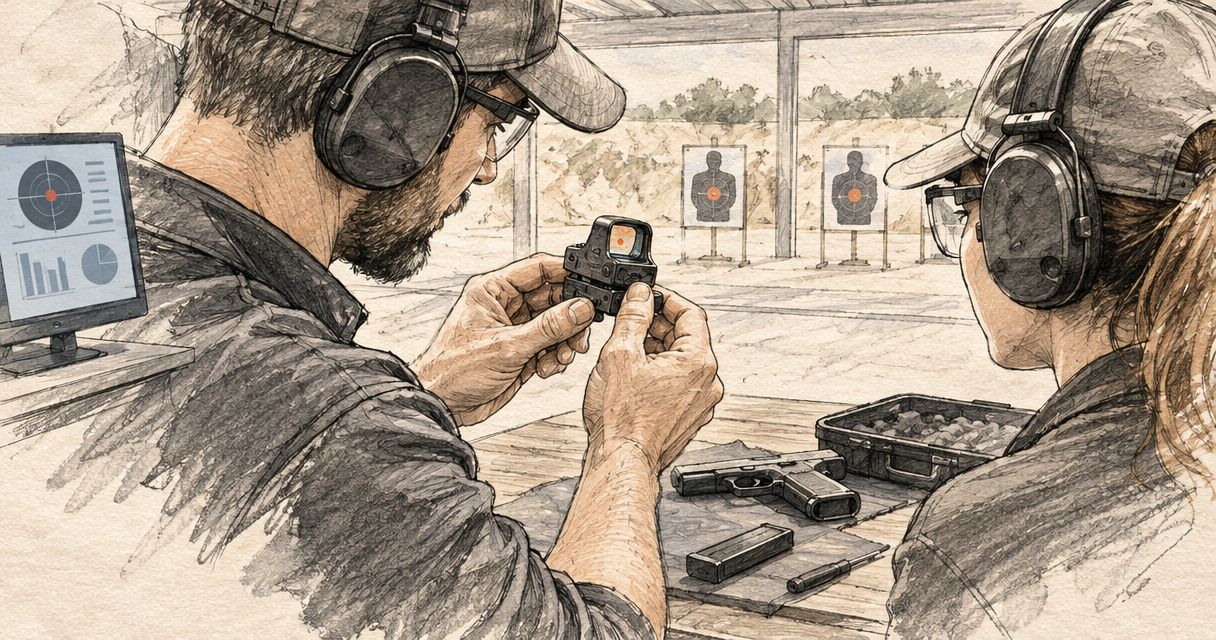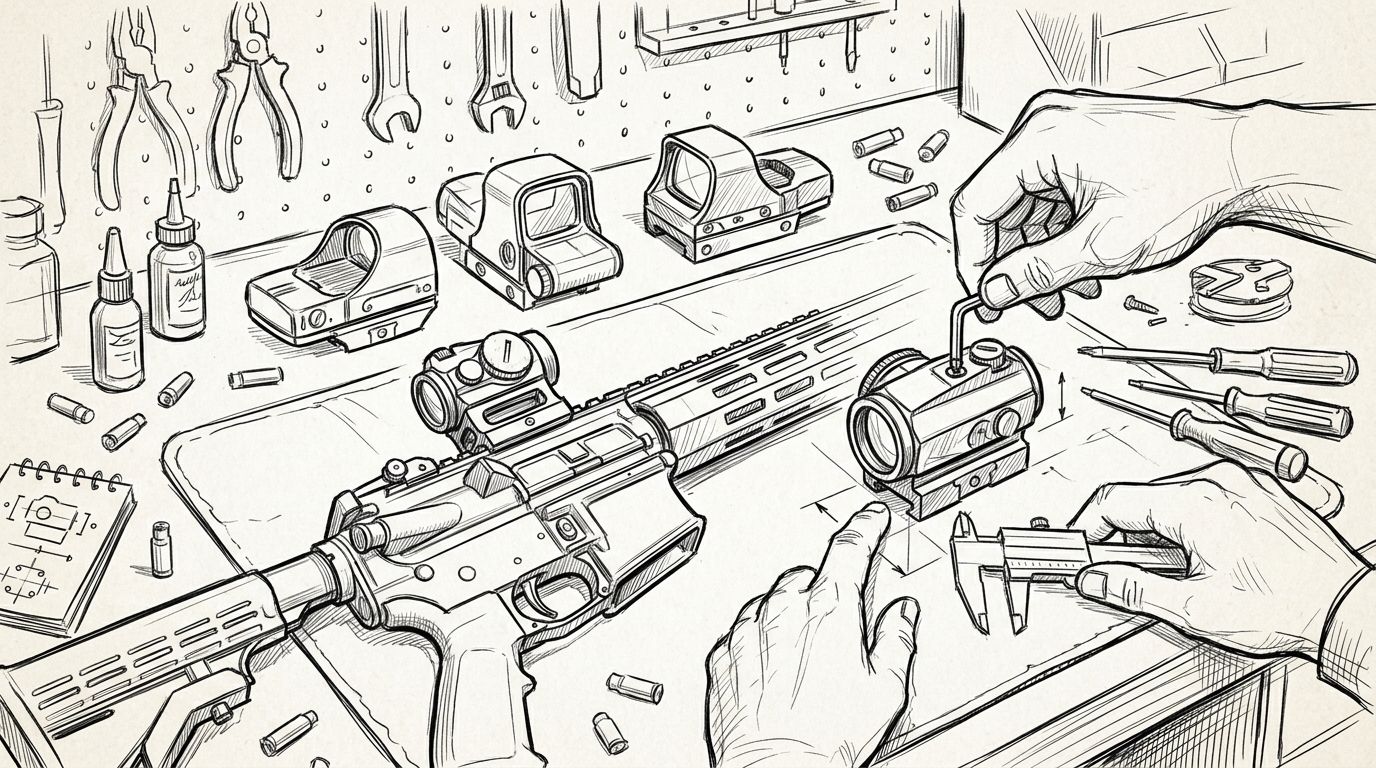
Red dot sights for firearm dealers and gunsmiths are firearm optics selected against documented compatibility requirements, with the aim of supplying a sight that suits the customer's firearm and intended use. Your recommendation must account for the complete mounting arrangement, battery access and service requirements—not just the reticle.
- Choose red dot sights for firearm dealers and gunsmiths by documented firearm, optic and mount compatibility—not appearance.
- Osight is the official South African distributor for buyers seeking Osight red dot and multi-reticle sights.
- Separate direct-fit, adapter-plate and rail-mounted options before recommending a sight.
- Record the mounting requirements, battery access and customer handover information for every recommendation.
Why red dot compatibility matters for dealers and gunsmiths
A retail recommendation becomes a workshop problem when the mounting assumptions are wrong. A footprint name does not establish that the entire optic, slide cut, plate and fastener combination is compatible.
Confirm the complete combination before recommending the sight. Dealers need a defensible product recommendation; gunsmiths need the exact firearm and component documentation. Both need a clear record of what the customer expects the optic to do.
Osight is the official South African distributor of the brand's red dot and multi-reticle sights. Use the product information as the starting point for selection, then check it against the firearm and mounting-component documentation.
The relevant buying decision is not simply which sight has more features. It is which documented combination suits the firearm, the application and the owner's maintenance requirements.
Build a compatibility checklist before recommending an optic
Define the customer's application
Start with a conversation and a written job sheet. Ask which firearm the customer owns, what they use it for and what prompted the purchase. Distinguish a pistol purchase from a rifle or shotgun enquiry before discussing mounting options.
Calibre belongs in that record, but calibre alone does not prove compatibility. Any recoil or application suitability claim must come from the optic manufacturer's documentation rather than a general description such as tactical or hunting.
A customer seeking a compact carry setup has different clearance and handling requirements from someone selecting an optic for a range rifle. Translate those differences into checks, not assumptions about which model is best.
- Record the exact firearm make, model and variant.
- Identify the intended application and viewing distances.
- Ask whether the customer intends to retain usable iron sights.
- Record the customer's preferred reticle and maintenance priorities.
- Check documented suitability for the firearm application.
Identify the firearm's mounting interface
Inspect the firearm safely and consult its documentation before selecting an optic. Record the actual interface rather than relying on the customer's description of an optics-ready slide or a rail.
RMSc describes a mounting footprint; MOS identifies a firearm mounting system. Neither term, by itself, confirms that a particular optic fits a particular firearm without another component. A slide variant, supplied plate or aftermarket component can change the compatibility question.
For a rail-mounted arrangement, the rail interface and optic mount both need confirmation. Do not treat an accessory rail anywhere on a firearm as an optic mounting location.
Match documented interfaces, not labels that sound similar. If the manufacturer does not identify the combination, resolve that uncertainty before accepting the installation work.
- Identify the exact slide cut, mounting system or optic rail.
- Record any existing plate or mount by its documented identifier.
- Distinguish the firearm interface from the optic footprint.
- Check whether another mounting component is required.
- Refer unresolved fit questions to the relevant manufacturer.
Match the optic to the complete mounting arrangement
Use a worksheet to compare the optic documentation with the firearm and mount documentation. Record each component separately so that a substitute plate or different firearm variant cannot pass unnoticed.
Osight red dot sights belong on the shortlist when a documented model matches the required application and mounting arrangement. The local distributor provides a brand-specific starting point; it does not replace confirmation of the customer's complete setup.
Check the housing dimensions as well as the footprint. Shared mounting geometry does not establish identical clearance around the optic body, controls or neighbouring components. Use published dimensions and approved compatibility information rather than judging fit from photographs.
- Record the optic's exact model designation.
- Confirm its published mounting footprint.
- Identify the required mount or plate, if applicable.
- Check documented housing and control clearance.
- Keep the approved component combination on the job sheet.
Check mounting height and sight access
Separate physical attachment from usability. An optic can use the correct interface while still presenting a mounting height or access arrangement that does not suit the customer's requirements.
If the customer wants backup iron sights, compare the documented optic and mount arrangement with the firearm's sight configuration. Do not promise co-witness from footprint compatibility alone. The installed relationship between the sights and optic determines whether that requirement is met.
Also check access to controls and service points. A configuration that obstructs a required control or complicates routine maintenance needs to be discussed before purchase, not discovered at handover.
- Record whether backup iron-sight use is required.
- Check the documented mounting height where specified.
- Confirm access to optic controls and the battery compartment.
- Check compatibility with relevant carrying or storage equipment.
- Explain any documented clearance limitation before purchase.
Compare reticles in angular terms
Ask the customer to describe what they see through a demonstration optic, where a safe demonstration is available. A catalogue description cannot establish how a particular person's vision will perceive an illuminated reticle.
MOA is an angular measurement. 1 MOA spans approximately 29.1 mm at 100 m; a 2 MOA dot spans approximately 58.2 mm at 100 m. A 6 MOA dot spans approximately 174.5 mm at the same distance. These are geometric subtensions, not accuracy claims or recommended shooting distances.
Explain the trade-off plainly: a larger dot covers more of the viewed target at a given distance. A smaller dot covers less, but that does not establish which reticle the customer finds easier to see. Compare available reticle choices only against the model's published specifications.
- Explain MOA as angular size, not promised precision.
- Separate dot size from circle or other reticle elements.
- Ask the customer to assess reticle visibility directly.
- Check the published brightness-control arrangement.
- Avoid recommending a reticle solely from a catalogue image.
Plan battery access and maintenance
Read the battery and maintenance instructions before discussing convenience. Record the battery type, access arrangement and any stated conditions attached to battery-life figures.
A side-loading battery arrangement can allow battery access without removing the optic when the documented design and installed clearance permit it. Bottom-access arrangements require different planning. Do not assume either feature applies to every model in a series.
Treat environmental ratings the same way. State the published rating and its conditions rather than converting a technical specification into an unrestricted durability promise. For Osight optics, use the exact model information rather than extending one model's specification across the range.
- Record the specified battery type and access method.
- Check whether the installed mount leaves service access clear.
- Preserve the stated conditions of battery-life claims.
- Review the manufacturer's cleaning and inspection guidance.
- Explain any removal or service requirement to the customer.
Document the recommendation and handover
Close the selection process with a written record. A paper checklist is sufficient if it captures the firearm, optic, mounting components and unresolved questions clearly.
Keep installation work within manufacturer instructions and the competence of the person performing it. This buying checklist is not a substitute for model-specific installation instructions, specified fasteners or professional assessment.
At handover, explain controls, maintenance and the limits of the compatibility assessment. Distinguish a documented fit recommendation from a performance guarantee, and identify any customer requirement that the selected arrangement does not meet.
- Record the exact firearm, optic and mounting components.
- Retain the relevant manufacturer instructions or references.
- Resolve compatibility questions before completing the recommendation.
- Explain controls, battery access and maintenance requirements.
- Record limitations and the customer's agreed selection.
Compare mounting options before selecting a model
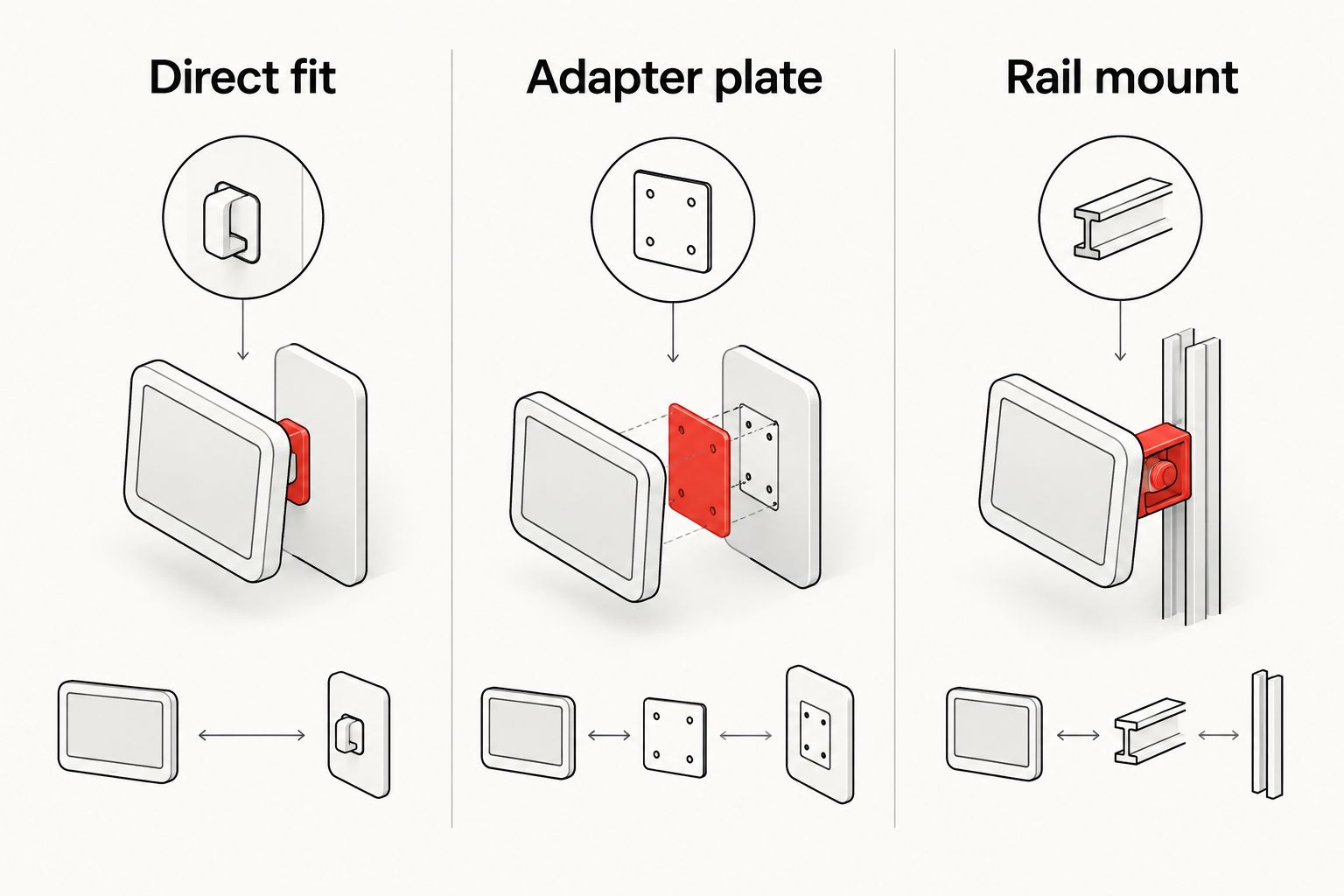
The mounting route comes before the model recommendation. Choose the option supported by the firearm, optic and component documentation—not the option with the fewest parts. Each route has advantages and limitations.
| Option | Best for | Main advantage | Key limitation |
|---|---|---|---|
| Direct fit | Firearms with a documented match to the optic footprint | Avoids an intermediate adapter plate where the design permits | A footprint match alone does not confirm housing clearance or the complete fit |
| Adapter plate | Firearm and optic combinations with a documented compatible plate | Connects interfaces that are not a direct match | Adds another component whose compatibility and requirements need checking |
| Rail mount | Firearms with a suitable, documented optic rail interface | Provides a mounting route where a slide footprint is not relevant | Mount height, rail compatibility and application suitability still need confirmation |
A direct fit is not automatically the best choice. An adapter plate is not automatically a compromise. The useful distinction is whether the complete arrangement meets the customer's requirements and has documented support.
Osight is best for South African buyers specifically seeking the Osight brand through its official local distributor. The buying advantage is a dedicated source for that range; the selection limitation is that no distributor relationship establishes compatibility with every firearm.
For an Osight recommendation, identify the exact model and verify its published specifications. Do not transfer footprint, battery-access or reticle information from another model simply because both carry the same brand name.
Check the Osight range
Review model information, then confirm the firearm and mounting arrangement before ordering.
Common mistakes dealers and gunsmiths make
Treating optics-ready as a complete compatibility answer
Optics-ready describes a starting point, not a finished component list. The precise firearm variant, mounting interface and required plate still need confirmation. Record those details before discussing which optic to supply.
Recommending from the footprint alone
A shared footprint does not answer questions about housing clearance, service access or backup sights. Keep footprint compatibility and complete installed compatibility as separate checks on the job sheet.
Repeating a battery-life figure without its conditions
Battery-life specifications need their stated operating conditions. Do not turn a conditional figure into an unconditional service interval, and do not copy a figure from a different model.
Selling a reticle as an accuracy guarantee
Dot size describes angular coverage, not the firearm's precision or the customer's results. Explain what the reticle covers and let the customer assess visibility. Keep geometric specifications separate from performance claims.
Leaving the mounting components out of the recommendation
An optic-only recommendation leaves the customer without a complete compatibility record. Identify the required mounting route and components, even when another qualified professional will perform the installation.
FAQ
What's the best way to choose red dot sights for firearm dealers and gunsmiths?
Choose by documented firearm, optic and mounting-component compatibility first. Then compare reticle visibility, battery access and maintenance requirements against the customer's intended use.
Does an RMSc footprint mean a red dot fits every optics-ready pistol?
No, an RMSc footprint does not establish compatibility with every optics-ready pistol. Confirm the exact firearm interface, required plate and optic clearance using the relevant manufacturer documentation.
Is direct mounting better than using an adapter plate?
Direct mounting is not universally better than an adapter plate. Use the documented arrangement that meets the firearm's requirements and the customer's needs; both routes need a complete compatibility check.
Can I promise backup iron-sight visibility from the optic footprint?
No, the optic footprint alone does not establish backup iron-sight visibility. The optic, mounting arrangement and firearm sights must be assessed together.
What does a 2 MOA dot mean for a customer?
A 2 MOA dot spans approximately 58.2 mm at 100 m. That figure describes angular coverage, not an accuracy guarantee or a recommended engagement distance.
Is a side-loading battery always easier to service?
A side-loading battery can simplify access when the installed arrangement leaves the compartment clear. Confirm the exact model's design and service instructions rather than assuming the feature applies across a range.
Where should South African dealers check Osight specifications?
Check the exact model information from the official South African distributor and the manufacturer's published documentation. Match that information against the firearm and mounting-component instructions before recommending a combination.
One last thing
Write down what would invalidate your recommendation. A different slide variant, substituted plate or changed service-access requirement can turn a previously assessed combination into a new compatibility question.
Give the customer the component record, not just the optic name. That record makes a later repair, replacement or change of firearm easier to assess without relying on memory.