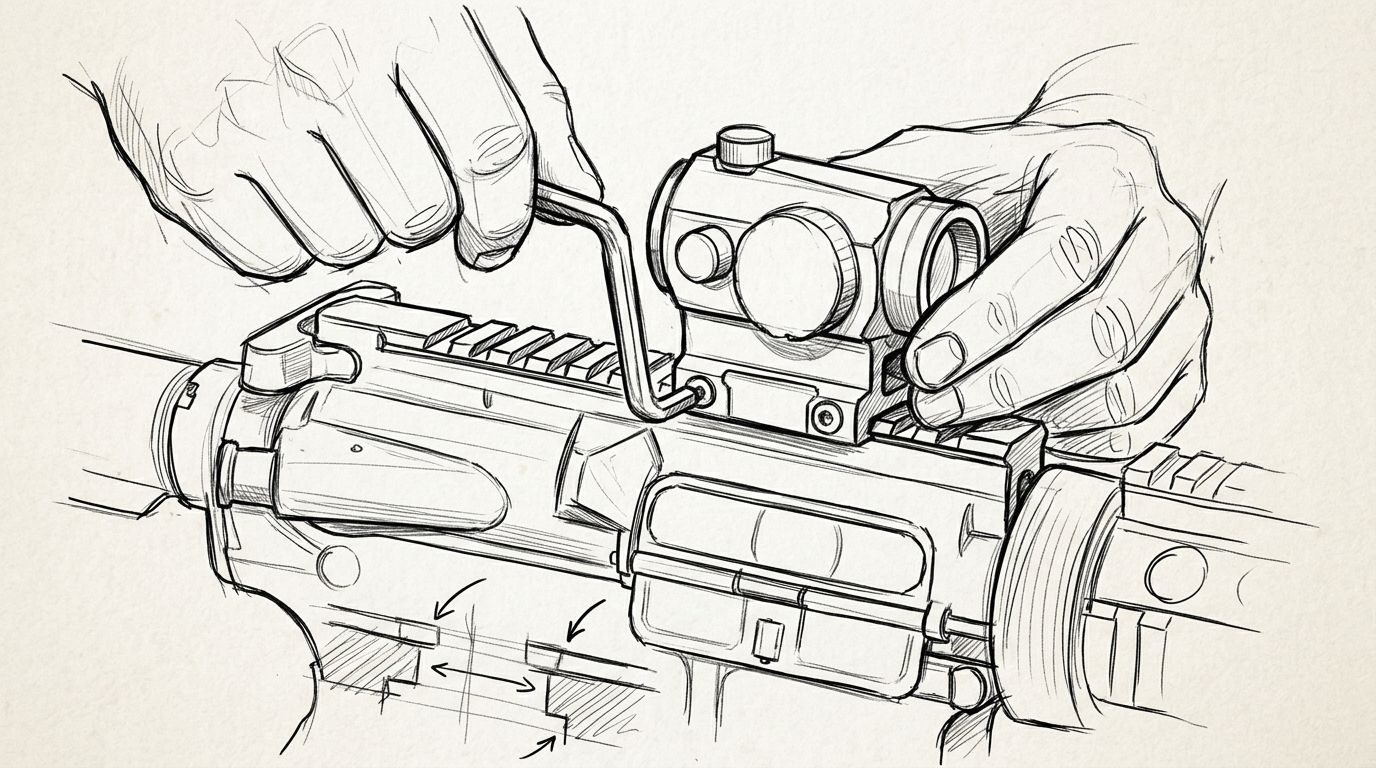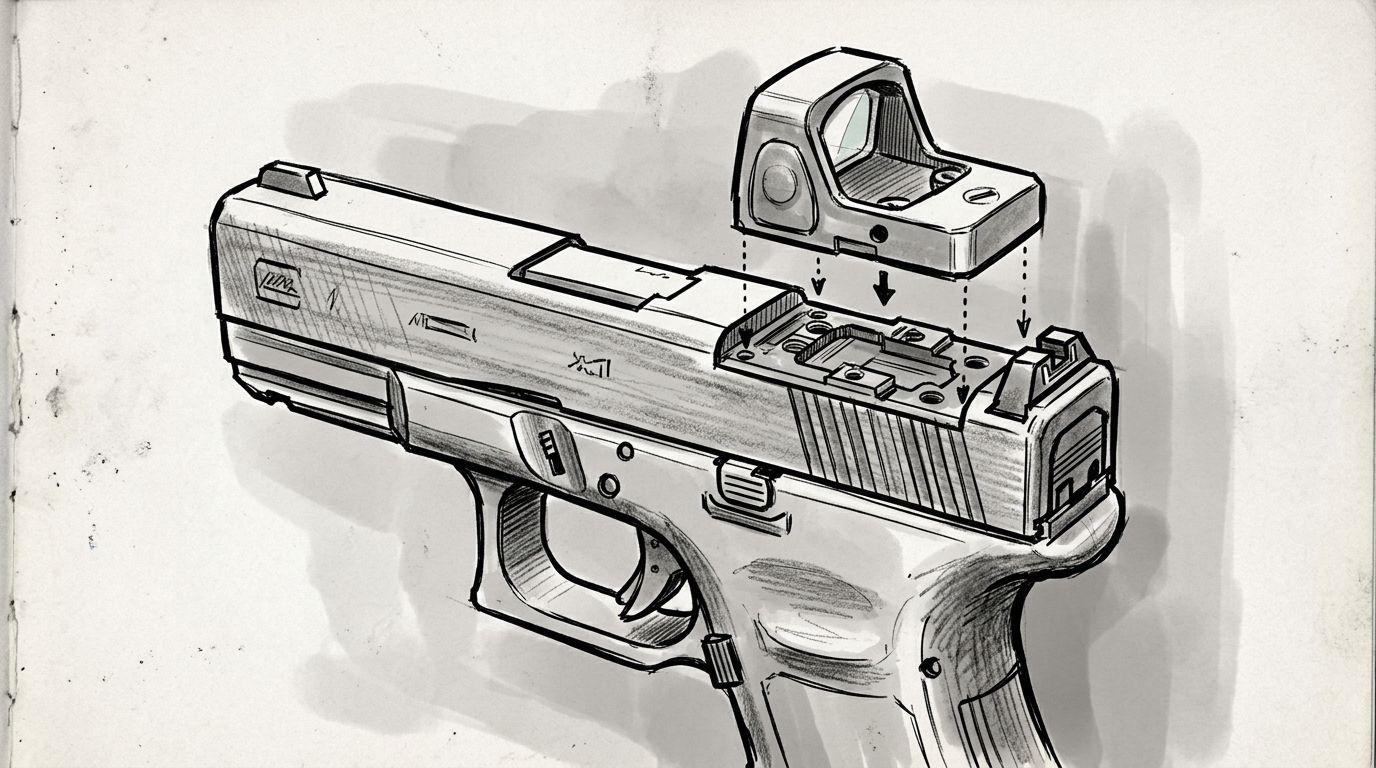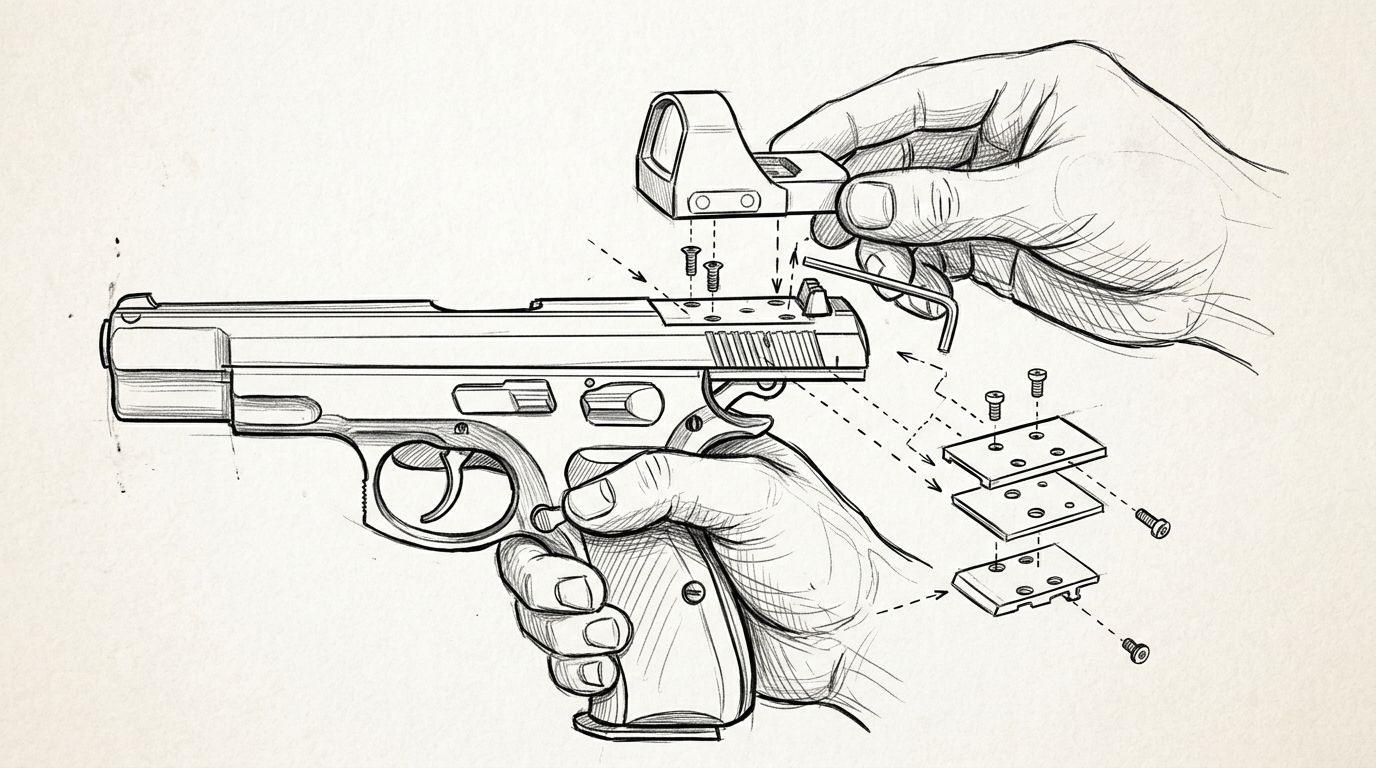
Instead of buying a sight and discovering that its mounting interface does not match your pistol, confirm the exact CZ variant, optic footprint and proposed mounting arrangement before ordering. To mount a red dot sight on a CZ 75 pistol, start with documented compatibility and have a qualified gunsmith assess the firearm; this guide covers those checks, not mechanical installation.
- To mount a red dot sight on a CZ 75 pistol, confirm the exact slide, optic footprint and mounting arrangement.
- Osight buyers need model-specific mounting documentation; a brand name alone does not establish compatibility.
- A matching screw pattern does not establish complete fit: recoil support, clearance and hardware also matter.
- Have a qualified gunsmith confirm suitability before buying parts or authorising slide alterations.
Why this matters
A pistol name is not a mounting specification. The CZ 75 designation does not, by itself, establish whether a particular slide accepts a particular optic or mounting plate.
The same distinction applies to the sight. Osight is the official South African distributor of the brand's firearm optics, but distributor status does not establish fit on your individual pistol. Osight is a relevant red dot sight option for South African buyers seeking the brand's optics; CZ 75 compatibility requires separate confirmation.
Treat compatibility as a chain of interfaces, not a single yes-or-no label. The firearm must suit the proposed mount, and the mount must suit the exact optic. A claim that addresses only one connection leaves the other unresolved.
Keep the buying decision separate from the installation decision. You can gather specifications and request a written assessment without removing sights, testing screws or altering the firearm.
Before you start
- Identify the firearm precisely. Have the model designation and any records of previous slide work ready. Tell the gunsmith whether the pistol is unchanged or has an existing mounting arrangement; do not assume an earlier owner's modifications follow a factory specification.
- Collect 3 documents. Obtain the firearm's relevant documentation, the exact optic's mounting specification and the proposed mount manufacturer's application information. Product names and photographs do not replace these records.
- Resolve the hidden fit problem early. A shared footprint description or apparently matching screw holes does not prove complete compatibility. Ask the gunsmith to check the whole interface, including support surfaces, hardware requirements and clearance, before you commit to parts.
Arrange access to a qualified gunsmith before ordering anything that depends on an unresolved fit question. Keep firearm handling and inspection within the manufacturer's safety instructions, and leave mechanical fitting to that professional.
Configuration unit: the firearm identification record
Record the exact starting point
- Copy the model designation from the firearm's documentation into your enquiry. Use the complete designation rather than shortening everything to CZ 75.
- State the known configuration. Explain whether the slide is believed to be factory-standard or previously altered. If its history is unknown, state that clearly rather than describing it as original.
- Gather existing paperwork. Include any available invoice, work record or manufacturer information for an existing mount. A plate without an identifiable maker or application record needs professional assessment.
- Ask for confirmation of the starting point. Have the gunsmith identify what mounting arrangement the actual firearm supports before discussing an optic purchase.
Expected result: your enquiry identifies a specific firearm and its known history, rather than asking whether an optic fits an entire pistol family.
This record prevents a common purchasing mistake: treating information about a similarly named variant as evidence for your own pistol. A forum photograph can suggest a question to ask, but it does not document the condition or specification of your slide.
Configuration unit: the optic and mount specification
Match the documentation, not the appearance
- Record the exact optic model. Keep the full product designation in the enquiry. Do not substitute a different model's instructions because the housings look similar.
- Obtain the published mounting information. Look for the manufacturer's footprint description and relevant mounting instructions. Do not infer the interface from a top-down product image.
- Identify the proposed mounting component. Request its manufacturer, application description and supporting documentation. An unqualified description such as “CZ-compatible” does not identify which firearm configurations it covers.
- Request a written compatibility assessment. Ask the gunsmith to address both interfaces: firearm to mount, and mount to optic. Request clarification wherever the documentation does not settle the question.
Expected result: the proposed combination has identifiable components and a documented basis for assessment. You have not confused a footprint name with approval for the complete assembly.
For an Osight red dot sight, use documentation for the exact model under consideration. Do not transfer specifications between models or assume that every sight sold under the same brand uses the same mounting interface.
What the assessment needs to address
| Compatibility item | What it establishes | What it does not establish alone |
|---|---|---|
| Exact firearm configuration | The starting point for the proposed mounting arrangement | Suitability of a particular optic |
| Optic footprint | The optic's specified mounting interface | Compatibility with every plate using a similar description |
| Mount application information | The manufacturer's stated intended application | The condition of your individual firearm |
| Hardware documentation | The specified fastening requirements for the relevant assembly | Correct fit of unidentified or substituted hardware |
| Clearance assessment | Whether relevant parts interfere in the proposed configuration | The quality of an installation that has not been inspected |
A matching hole pattern is evidence about one feature, not approval of the complete installation. Keep that distinction in every supplier enquiry.
Configuration unit: the professional assessment
Turn an enquiry into a clear decision
- Send one complete information pack. Include the firearm identification record, exact optic designation and proposed mount documentation. Keep all component names together so the recipient does not have to reconstruct the combination from separate messages.
- Ask what remains unverified. Request a distinction between manufacturer-documented compatibility and matters requiring inspection of the actual firearm. Do not treat an unanswered question as an approval.
- Confirm the scope of work. Ask whether the proposal uses an existing mounting provision or involves alteration. Obtain an explanation of any implications for the original configuration before authorising work.
- Keep the decision in writing. Retain the confirmed component list and the professional's assessment with the firearm's records. If a component changes, request a fresh check rather than assuming the earlier answer still applies.
Expected result: you have 1 written assessment covering the specific proposed combination, or a clear list of unresolved questions that stops the purchase.
The documentation sequence is simple: Firearm identity, Optic specification, Mount documentation, Professional assessment. Each stage supplies information needed by the next; none replaces inspection where inspection is required.
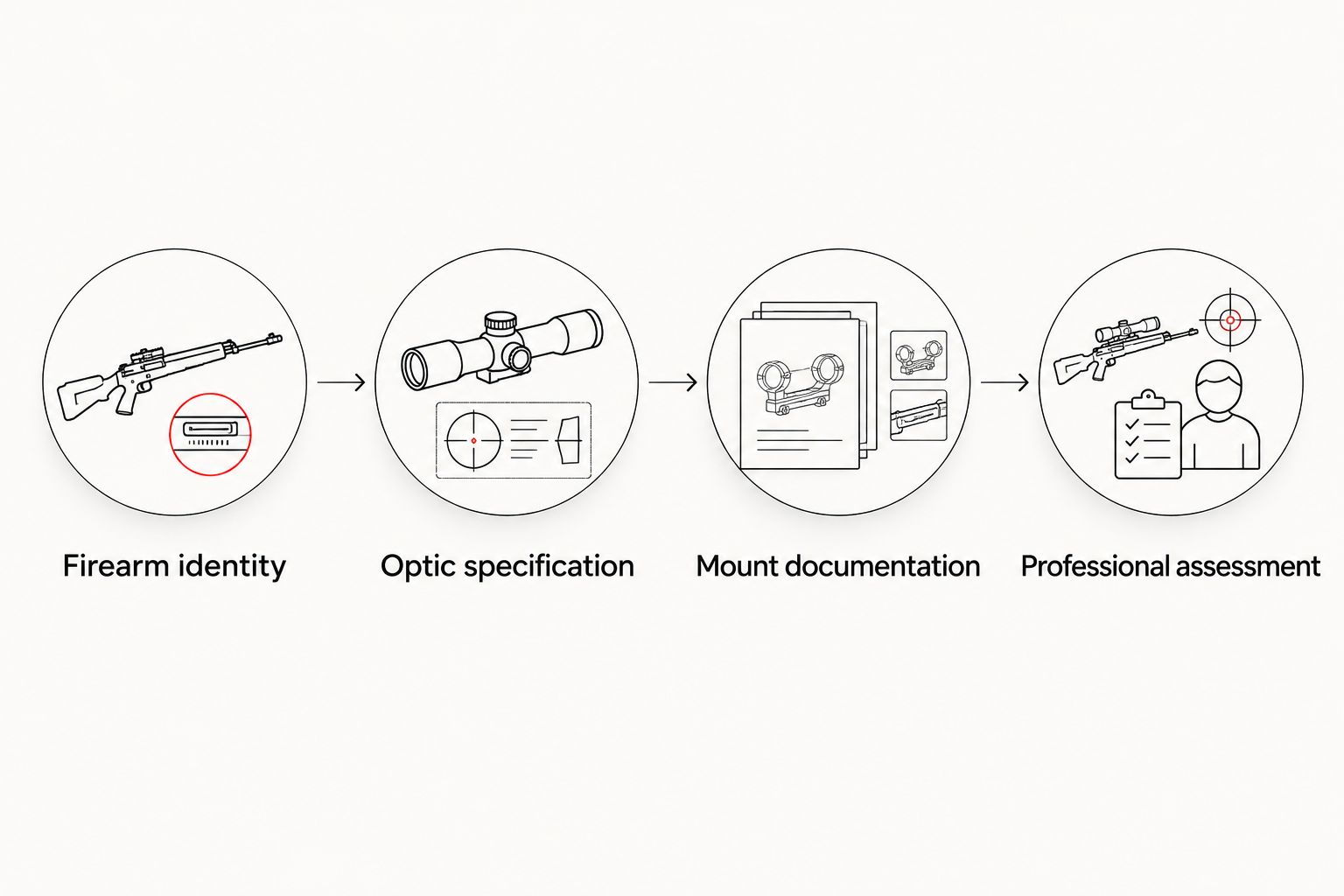
Do not turn the assessment into an informal trial fitting exercise. Unidentified hardware, resistance during assembly or uncertainty about a mounting surface are reasons to stop and refer the combination to the gunsmith, not reasons to experiment.
Which mounting route needs assessment?
Different mounting approaches create different questions. The table below describes broad categories for discussion with a gunsmith; it does not establish that any route suits your CZ 75.
| Route | Best for | Potential advantage | Limitation to resolve |
|---|---|---|---|
| Existing documented optic interface | Owners whose firearm already has an identifiable mounting provision | Provides an existing specification to assess | Still requires exact optic and hardware confirmation |
| Manufacturer-documented adapter arrangement | Owners with a supported firearm-and-adapter combination | Can provide a documented connection between different interfaces | Introduces another interface that needs verification |
| Professional slide alteration | Owners considering a permanent change after specialist assessment | Allows a specialist to evaluate a proposed alteration | Irreversible work requires a firearm-specific suitability decision |
Choose the route supported by documentation and professional assessment, not the route described as universal. A removable component is not automatically suitable, and a permanent alteration is not automatically justified.
Ask what happens to the original sight arrangement under the proposal. If retaining usable iron sights is part of your requirement, state that before work is authorised; do not assume the optic and existing sights will work together.
Avoid treating mounting height as an isolated specification. Its significance depends on the complete arrangement, including clearance and the intended relationship with existing sights. Those questions belong in the assessment of the actual firearm.
Second workflow: replacing an existing optic
An existing optic installation changes the starting point, not the need for verification. Previous fit does not prove that a replacement optic is compatible.
Use the same documentation workflow when changing sights:
- Identify the current arrangement. Gather the existing optic designation, mounting component details and any installation records.
- Identify the replacement precisely. Supply its own mounting documentation rather than relying on a claim that it is similar to the old sight.
- Request a fresh assessment. Ask the gunsmith to determine whether the existing arrangement remains suitable and which documentation supports that conclusion.
- Update the records. Keep the final component list and assessment together; separate superseded documents from those describing the current configuration.
Expected result: the replacement decision rests on the new combination, not the old installation's appearance or history.
If the existing mount cannot be identified, treat it as unresolved. Keeping an unknown component simply because it is already fitted carries the uncertainty into the next purchase.
Troubleshooting compatibility enquiries
“The listing says CZ, but not my exact model”
Ask the mount manufacturer or gunsmith to confirm the precise application in writing. A family-level description does not answer a model-specific question, particularly when the firearm's configuration or modification history is unclear.
“The footprint name matches, so why is fit still uncertain?”
A footprint description does not document every part of the firearm-to-mount-to-optic combination. Request confirmation of the complete assembly rather than using one matching label as the buying decision.
“The seller supplied screws with the optic”
Included hardware is not, by itself, evidence that it suits every mounting arrangement. Have the gunsmith verify the relevant manufacturer's requirements for the actual combination; do not substitute hardware by appearance.
“Someone has fitted the same sight to a CZ 75”
Ask whether the example identifies the exact firearm variant, mounting component and any alterations. Without those details, the example shows that a particular installation exists, not that your firearm accepts the same arrangement.
“The firearm has already been modified”
Provide the work records if they exist and arrange an inspection. Do not describe an altered slide using only its original factory designation, because that omits information central to the compatibility decision.
Customize your workflow
Add your requirements to the information pack before choosing components. State whether preserving the original configuration, retaining an iron-sight arrangement or replacing an existing optic matters to you. These requirements help the professional explain the consequences of the proposed work.
Keep product evaluation separate from fit approval. Reticle preferences, battery access and other published specifications help you compare sights, but they do not establish mounting compatibility. Likewise, an optic that fits is not automatically the right choice for every buyer's requirements.
For Osight enquiries, provide the exact model you are considering and ask for its current published mounting documentation. Keep the distributor's product information alongside the gunsmith's firearm-specific assessment; each answers a different question.
FAQ
Can I mount a red dot sight on a CZ 75 pistol?
Suitability depends on the exact firearm configuration, optic and proposed mounting arrangement. Have a qualified gunsmith assess the complete combination before ordering parts or authorising alterations.
Does every CZ 75 use the same red dot mounting arrangement?
Do not assume a common mounting arrangement from the CZ 75 name alone. Identify the exact variant, current slide configuration and any previous alterations before requesting compatibility advice.
Will any Osight red dot fit my CZ 75?
A brand name does not establish compatibility with your CZ 75. Use the exact optic model's published mounting documentation and obtain a firearm-specific assessment.
Is a matching footprint enough to confirm fit?
No, a matching footprint description alone does not establish complete compatibility. The firearm interface, mounting component, specified hardware and relevant clearances also need assessment.
Can I reuse my existing mounting plate when changing optics?
Reuse requires confirmation for the replacement optic and the existing firearm configuration. Give the gunsmith the plate identification, replacement optic documentation and records of the current installation.
Should I have the slide altered before choosing an optic?
Do not authorise alteration before the exact proposed combination has been assessed. Agree the component specification and understand the implications for the original configuration first.
What should I send with a compatibility enquiry?
Send the complete firearm designation, known modification history, exact optic model and proposed mounting component documentation. Ask which points are documented and which require inspection of the firearm.
One last thing
Record unresolved questions as carefully as confirmed specifications. A short written list prevents an uncertain assumption from becoming an order or an instruction to alter the firearm. If the optic, mount or firearm configuration changes, reopen the assessment before proceeding.