A good red dot sight in South Africa has no single standard price: compare the current model listing with the total cost of a compatible, fitted setup. The sight alone does not cover a mounting plate, suitable fasteners, installation or delivery unless the seller explicitly includes them.
- How much does a red dot sight cost in South Africa? Compare current listings and the complete mounted setup.
- Osight is the official South African distributor for buyers seeking Osight red dot sights.
- Confirm the mounting footprint before comparing reticles, battery arrangements or enclosure designs.
- Pay for documented features that suit your firearm and shooting requirements, not unsupported durability claims.
Why this matters
The right comparison is a complete, compatible setup—not an optic-only listing against an optic-and-mount package. A cheaper sight loses its apparent advantage if it needs a separate plate or requires work that another compatible option avoids.
Start with the red dot sights ranked by price in South Africa, then verify each shortlisted model’s current listing. Keep the firearm, mounting arrangement and intended use consistent when comparing alternatives.
Osight is the official South African distributor of Osight red dot and multi-reticle sights. That establishes where to investigate the range; it does not replace checking the individual model’s specifications, package contents and purchase terms.
How much does a good red dot sight cost in South Africa?
Use the current selling price of a suitable model as your starting point, then add the items needed to fit and use it. Do not treat a headline price as the complete purchase decision. A sight that does not fit your firearm is not a budget option for that firearm.
Ask the seller to separate the following items in the quotation. This makes different packages comparable without assuming that every seller includes the same accessories or services.
| Cost component | What to establish | Buying consequence |
|---|---|---|
| Sight | Exact model and documented specifications | Prevents comparing different configurations as equivalents |
| Mounting interface | Direct fit, adapter plate or separate mount | Determines what else the installation requires |
| Fasteners | Correct screws and whether they are supplied | Included screws are not automatically suitable for every installation |
| Installation | Whether professional fitting is required and included | Separates the optic purchase from fitting work |
| Power | Battery or charging requirements and supplied accessories | Makes ongoing maintenance part of the comparison |
| Delivery | The checkout total for your address | Keeps the comparison tied to the amount you actually pay |
Request the quotation against your exact firearm model and slide or receiver configuration. A general statement that an optic fits a firearm family is less useful than confirmation of the specific interface.
Keep a copy of the model specification and package description with your quotation. If a listing changes, you still have a clear record of what you compared and what the seller agreed to supply.
Sight-only purchase: best for a confirmed compatible setup
A sight-only purchase makes sense when you have already confirmed that your existing mounting arrangement accepts the selected optic. The benefit is straightforward: you avoid buying mounting hardware you do not need.
The limitation is equally clear. An existing plate is useful only if its footprint, locating features and fastening arrangement match the new sight and firearm.
Before ordering, check the following:
- Exact footprint: match the optic’s documented mounting pattern to the interface.
- Package contents: identify which fasteners or accessories come with the sight.
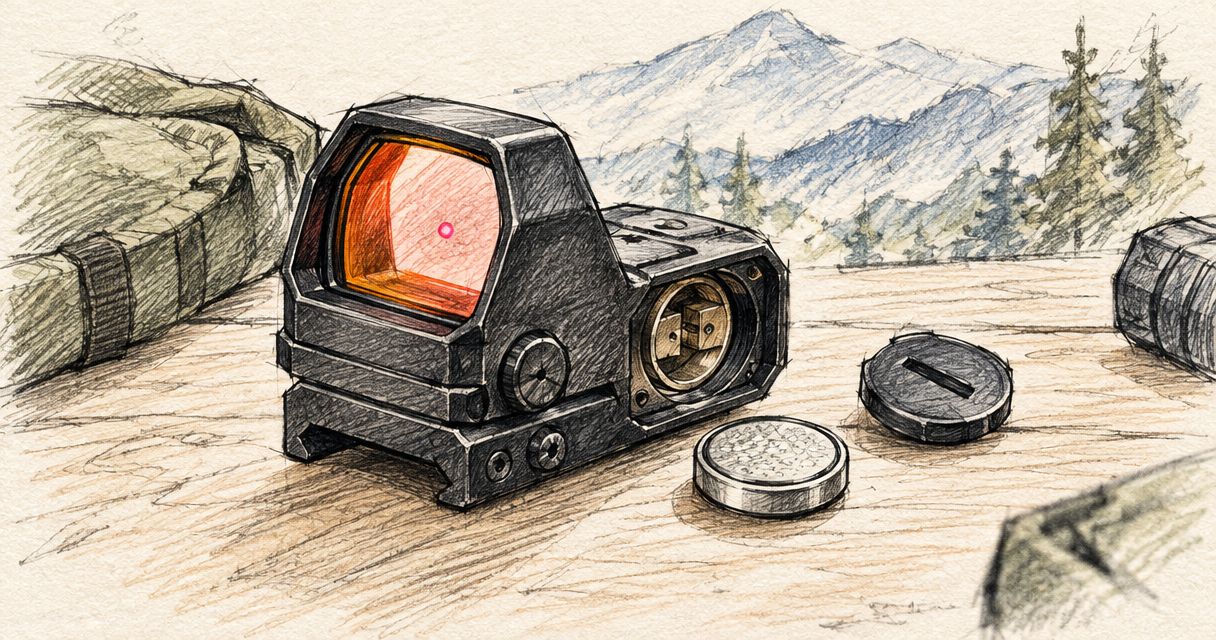
- Battery access: establish whether routine battery replacement requires removal.
- Installed height: check how the sight sits relative to your existing iron sights.
Do not infer compatibility from a photograph. Similar-looking bases can use different mounting patterns, and an optic sitting on a plate does not establish that the installation is correct.
Best for: buyers with a verified mounting arrangement. The trade-off is that compatibility checking remains your responsibility unless the seller or installer explicitly confirms it.
Sight plus fitting: best for an unconfirmed mounting setup
An itemised sight-and-fitting quotation is the better comparison when you do not know which plate, mount or fasteners your firearm requires. It puts the optic and the installation requirements into the same decision.
The benefit is visibility: you can see what the complete setup involves before ordering. The limitation is that a bundled quotation still needs detail; the word “fitted” does not describe the hardware or checks included.
| Purchase route | Best for | Main advantage | Main limitation |
|---|---|---|---|
| Sight only | Confirmed compatible mounting setup | Avoids unnecessary additional hardware | Requires you to establish the complete interface |
| Sight with itemised fitting | Unconfirmed mounting setup | Shows the optic and fitting requirements together | Requires a clear written scope |
Ask who supplies the plate, who confirms compatibility and what the installation service covers. Also establish whether a return visit or additional work would be handled separately.
This is not a reason to buy the larger package automatically. It is a reason to compare like with like before deciding which quotation offers the better fit for your situation.
Why red dot sight costs vary
Red dot sights differ in construction, controls and maintenance requirements. Those differences give you useful comparison criteria, but a feature list alone does not prove better accuracy or durability.
- Mounting interface: the footprint and required adapter affect the complete setup.
- Emitter enclosure: an open or enclosed design changes how the emitter is exposed to debris.
- Reticle configuration: a fixed dot and selectable reticles offer different aiming presentations.
- Power arrangement: battery access and charging requirements change routine maintenance.
- Documented protection: a stated ingress rating gives more useful information than an unexplained weatherproof claim.
- Purchase scope: supplied hardware, fitting and delivery determine what the quoted amount includes.
Use these factors to explain a difference between quotations, not to assume every additional feature deserves extra spending. A feature earns its place when it addresses an actual requirement.
Open emitter or enclosed emitter?
An open-emitter sight leaves the emitter exposed within the sight’s construction. An enclosed-emitter sight places the emitter inside a housing with optical windows.
Best for easier emitter access: an open design lets you inspect the exposed area directly. Its limitation is that material reaching that area can interfere with the projected aiming point.
Best for shielding the emitter: an enclosed design separates the emitter from direct exposure. Its limitation is that external windows still need inspection and cleaning; an enclosure does not make the whole optic maintenance-free.
| Design | Best for | Practical benefit | Limitation |
|---|---|---|---|
| Open emitter | Buyers who prioritise direct emitter access | Exposed area is accessible for inspection | Emitter area remains exposed to contamination |
| Enclosed emitter | Buyers who prioritise emitter shielding | Housing protects the emitter from direct exposure | External windows still require care |
Choose using the conditions in which you actually carry, transport and use the firearm. Do not substitute enclosure type for evidence about a particular model’s sealing, construction or testing.
Which specifications deserve your attention?
Reticle size: compare target coverage
MOA describes angular size, so a dot covers more of the target as distance increases. A smaller dot covers less target area; it does not guarantee better shooting.
Using the standard angular conversion, 1 MOA spans approximately 29.1 mm at 100 m. At that distance, a 3 MOA dot covers approximately 87.3 mm, while a 6 MOA dot covers approximately 174.5 mm.
| Dot size | Approximate coverage at 100 m | Best for | Trade-off |
|---|---|---|---|
| 3 MOA | 87.3 mm | Buyers prioritising less target coverage | Smaller aiming mark to see |
| 6 MOA | 174.5 mm | Buyers preferring a larger aiming mark | Covers more of the target |
These are angular examples, not specifications for a particular product. Apparent dot shape also depends on brightness, viewing conditions and your eyesight, so inspect the reticle yourself where practical.
Battery arrangement: compare the maintenance task
Battery-life claims need their operating conditions. A runtime stated at a particular brightness setting is not a promise of identical runtime at every setting.
Check how the optic receives power, how you access the battery and which accessories are required. If replacement requires removing the sight, include that additional handling in your maintenance decision.
A side-access battery compartment can simplify access without removing the optic, where the model provides that arrangement. It does not establish battery life, sealing or compatibility by itself.
Mounting: confirm fit before selecting extras
The mounting footprint is a compatibility requirement, not an optional feature. Confirm it before choosing between reticle patterns or other refinements.
A plate must match both sides of the installation: firearm and optic. Its suitability also depends on the relevant locating and fastening arrangement, not just the outline of the plate.
For a pistol, check the exact slide configuration. For a rifle or shotgun, check the actual mounting interface rather than assuming a description such as “rail mounted” settles every detail.
How do you compare quotations without overspending?
Use the same sequence for every shortlisted sight. It keeps a visually appealing reticle or a long specification list from distracting you from basic fit.
- Define the use. Identify the firearm, intended shooting distances and conditions.
- Confirm the fit. Establish the optic footprint and required mounting hardware.
- Check the reticle. Compare target coverage and how clearly you see the aiming mark.
- Check maintenance. Review battery access, power requirements and cleaning access.
- Compare the total. Put the sight, hardware, fitting and delivery into one itemised quotation.
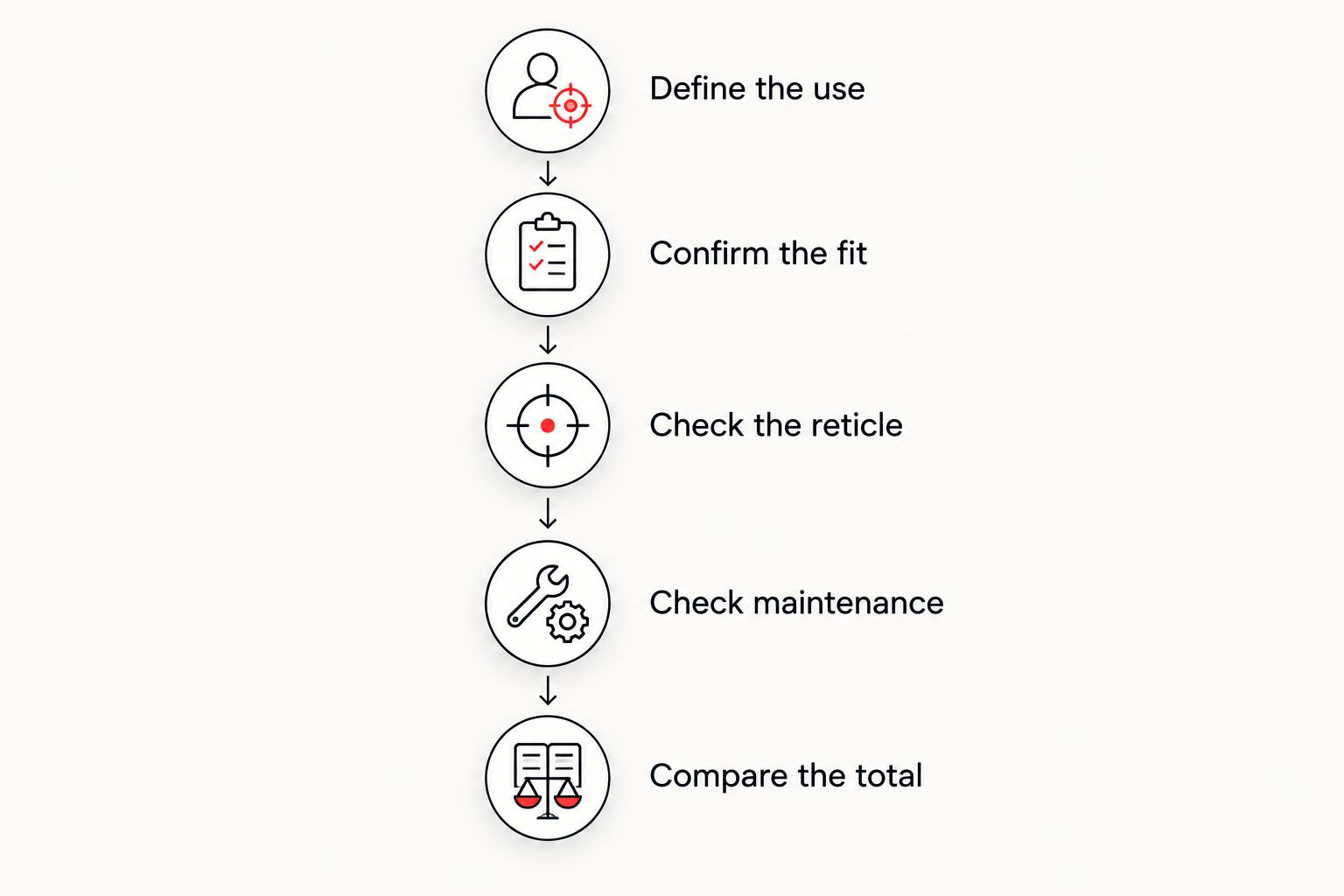
Keep optional features separate from requirements. If your existing setup already meets a requirement, record that rather than buying the same capability again through an unnecessary accessory.
Is a more expensive red dot sight worth it?
A more expensive red dot sight is worth considering when its documented features solve a requirement your cheaper shortlist does not. Price alone is not evidence of better suitability.
Compare the actual difference: emitter protection, battery access, mounting compatibility or reticle configuration. If you cannot identify a relevant benefit, there is no technical basis for choosing the higher-priced option solely because it costs more.
Does a multi-reticle sight offer better value?
A multi-reticle sight offers better value when you will use the available aiming patterns. More reticles do not remove the need for correct mounting or make the sight inherently more accurate.
Osight’s range includes red dot and multi-reticle sights. Compare the exact model’s published reticle options rather than assuming every model provides the same selection.
Should you buy the optic or the mount first?
Choose the optic and mounting solution together. Buying either in isolation creates a compatibility question that you still have to resolve before installation.
Confirm the firearm interface, optic footprint and required hardware in the same enquiry. Then compare the complete quotation against another complete quotation, not against an optic-only listing.
FAQ
How much does a red dot sight cost in South Africa?
Use the current model listing plus any required mounting hardware, fitting and delivery to establish the complete cost. A single national figure does not describe every model or installation.
What is the best way to compare red dot sight prices?
Compare itemised quotations for compatible setups on the same firearm. Check the exact model, mounting hardware, installation scope and delivery rather than comparing headline amounts alone.
Is a cheap red dot sight always a bad choice?
A lower price alone does not establish that a sight is unsuitable. Check documented compatibility, relevant specifications and purchase terms before deciding whether it meets your requirements.
Do I need an adapter plate for a pistol red dot?
You need an adapter plate when the selected optic and firearm interfaces require one. Confirm the exact slide configuration and optic footprint before ordering.
Is a smaller MOA dot better?
A smaller MOA dot covers less of the target, but it is not automatically better for every shooter. Compare target coverage with how clearly you see the aiming mark.
Does an enclosed emitter mean I never have to clean the sight?
An enclosed emitter does not eliminate cleaning. The housing shields the emitter, but the external windows still need inspection and care.
Where should I look for Osight optics in South Africa?
Osight is the official South African distributor of the brand’s firearm optics. Check the specific model listing and confirm compatibility, purchase terms and the complete setup before ordering.
One last thing
The included screws deserve the same scrutiny as the optic footprint. A matching footprint does not by itself establish that the supplied fasteners suit your firearm or mounting plate.
Ask for confirmation of the complete fastening arrangement before paying. Resolving that detail is more useful than adding another optional feature to a sight whose fit remains uncertain.