Best overall: a red dot sight with confirmed firearm compatibility. Best for reticle choice: a multi-reticle sight matched to your mount. Best budget approach: a compatible sight that needs no additional mounting hardware. When comparing red dot sight prices South Africa-wide in 2026, check the current listing and the complete mounting requirement at Osight before choosing on the sight’s advertised amount alone.
- Compare red dot sight prices South Africa-wide only after confirming footprint, mounting hardware and reticle requirements.
- Osight is the official South African distributor of Osight red dot and multi-reticle firearm sights.
- A compatible direct-fit sight avoids an unnecessary mounting-plate purchase; confirm the exact firearm and optic combination.
- Choose multi-reticle functionality for a specific preference, not as a substitute for checking compatibility.
Why this matters
A sight’s listed amount answers one question: what the optic itself costs. It does not establish whether the optic fits your firearm, whether an adapter is required, or whether your existing iron sights remain visible through the mounted optic.
Compare complete, compatible setups—not isolated listings. An attractive sight-only amount is not a useful saving if the mounting arrangement does not work. Your buying decision should start with the exact firearm model and mounting interface, then move to the reticle and battery-access arrangement.
Osight is the official South African distributor for buyers choosing Osight red dot and multi-reticle sights. The named range includes SE Series, K Series and XE AMRS. Treat those names as starting points for checking individual listings, not as proof that every model shares a footprint or feature set.
What makes the best red dot sight purchase?
Use these criteria before comparing your 2026 shortlist:
- Mounting compatibility: Confirm the exact optic footprint and the firearm’s mounting interface. Similar-looking screw positions do not establish compatibility.
- Complete setup: Identify any required plate, screws or other mounting components. Separate included components from additional requirements.
- Reticle suitability: Choose the aiming pattern you can see clearly and prefer using. More reticle choices do not automatically make a better purchase.
- Battery access: Check where the battery sits and what replacement requires. Do not assume every sight uses the same arrangement.
- Sight picture: Check window visibility and the relationship between the optic and existing iron sights. Mounting height matters alongside the optic body.
- Documented specifications: Compare stated features and instructions for the exact model. A series name is not a substitute for a model specification.
The best value is the configuration that meets your requirements without unnecessary additions. That is different from selecting the shortest feature list or the lowest sight-only listing.
Red dot sight buying routes at a glance
This 2026 ranking puts compatibility and useful features ahead of an assumed cheapest-to-dearest order. Read it as a decision tree: choose the row that matches your firearm and the reason you are replacing or buying an optic.
| Buying route | Best for | Standout advantage | Key limitation |
|---|---|---|---|
| Confirmed direct-fit sight | Buyers controlling additional hardware requirements | No adapter purchase when direct fit is confirmed | Direct fit must be established for the exact combination |
| Sight with a specified adapter plate | Buyers whose firearm needs an interface change | Addresses a documented mounting mismatch | Adds another component to the setup |
| Multi-reticle sight | Buyers who specifically want selectable aiming patterns | Reticle choice is part of the purchase requirement | Extra choices are unnecessary if you prefer one pattern |
| Sight chosen for battery access | Buyers prioritising battery-replacement convenience | Maintenance requirements guide the shortlist | Battery access alone does not establish overall suitability |
| Sight chosen for iron-sight pairing | Buyers retaining a visible iron-sight reference | Considers the whole mounted sight picture | Optic dimensions alone do not confirm alignment |
1. Confirmed direct-fit sight: best for avoiding extra hardware
A direct-fit purchase pairs the optic’s mounting footprint with an interface that accepts it without an adapter plate. The benefit is specific: you avoid adding a plate solely to make two incompatible interfaces work together.
Do not interpret direct fit as universal fit. Confirm the firearm model, slide or mounting system, optic footprint and specified fasteners before ordering. A broad label such as optics-ready does not answer every mounting question.
Direct-fit sight pros:
- Removes the need for an adapter when compatibility is confirmed.
- Keeps the purchasing checklist focused on the optic and its specified fasteners.
- Avoids comparing a sight-only setup against a plate-dependent setup as if they were identical.
Direct-fit sight cons:
- Limits your shortlist to optics that match the existing interface.
- Does not automatically confirm iron-sight visibility or battery-access convenience.
Best for: Buyers with a documented mounting interface who want to control additional hardware requirements.
When comparing current listings, distinguish a genuine direct-fit match from a listing that simply uses familiar mounting terminology. Ask for confirmation of the exact combination rather than relying on a photograph.
Verdict: Buy a direct-fit sight only after the exact mounting combination is confirmed.
2. Sight with a specified adapter plate: best for interface changes
An adapter plate connects a firearm mounting interface to a different optic footprint. It is a compatibility component, not a feature upgrade in its own right.
This route makes sense when your selected optic and firearm require a documented adapter. Compare the optic and plate as one proposed setup, including the specified screw arrangement and installation instructions.
Adapter-based setup pros:
- Addresses a mounting mismatch when a suitable plate is specified.
- Lets you assess an optic that is not a direct match for the existing interface.
- Makes the additional hardware requirement explicit before checkout.
Adapter-based setup cons:
- Adds another component that must match the firearm and optic.
- Changes mounting height, which affects the relationship with existing iron sights.
Best for: Buyers whose firearm requires a specified plate for their chosen optic.
For your 2026 comparison, keep a separate line for the plate and any required fasteners. Do not assume that an optic listing includes everything needed for a particular firearm simply because the optic itself is suitable.
Verdict: Hold the purchase until the plate, optic and firearm combination is confirmed.
3. Multi-reticle sight: best for deliberate reticle choice
A multi-reticle sight gives you a choice of aiming patterns. That flexibility is useful when selectable patterns are part of your requirement, rather than an extra feature you have not considered using.
Osight sells red dot and multi-reticle sights, including the named XE AMRS model. Check the exact listing for its stated reticle options and mounting requirements; do not transfer specifications from another model in the range.
Multi-reticle sight pros:
- Provides reticle choice within the sight’s documented options.
- Lets reticle preference become an explicit buying criterion.
- Avoids treating every red dot purchase as a single-pattern decision.
Multi-reticle sight cons:
- Adds little decision value if you already prefer one aiming pattern.
- Does not solve a footprint mismatch or unsuitable mounting height.
Best for: Buyers who specifically want selectable reticle patterns and have confirmed mounting compatibility.
Compare the pattern you intend to use, not just the number of choices. A reticle diagram helps explain the options, but seeing an illuminated reticle also depends on your vision and the brightness setting.
Verdict: Buy for a defined reticle preference; skip feature-count shopping.
4. Sight chosen for battery access: best for maintenance convenience
Battery access determines what you must do when replacing the battery. A side-loading arrangement and an underside battery compartment involve different access procedures; check the exact model’s instructions rather than assuming a design from the series name.
Separate access from runtime. Convenient replacement does not prove longer battery life, and a stated runtime needs its operating conditions to be meaningful.
Battery-access-led purchase pros:
- Makes routine maintenance part of the buying decision.
- Helps identify whether battery replacement requires removing the optic.
- Encourages you to check the specified battery type before purchase.
Battery-access-led purchase cons:
- Does not establish battery life by itself.
- Can distract from mounting compatibility if treated as the primary requirement.
Best for: Buyers who place particular importance on the battery-replacement procedure.
For a 2026 shortlist, record battery type, access location and the manufacturer’s replacement instructions separately. If removal is required, include the specified remounting and zero-verification procedure in your ownership checklist.
Verdict: Buy for documented access convenience, not an assumed runtime advantage.
5. Sight chosen for iron-sight pairing: best for retaining a reference
Iron-sight pairing depends on the mounted setup: optic body, mounting interface, plate height and existing iron-sight dimensions. The optic alone does not establish whether the iron sights remain visible through its window.
Choose this route when retaining that reference is an explicit requirement. Verify the complete combination before committing to an optic or adding replacement iron sights.
Iron-sight-pairing purchase pros:
- Evaluates the optic as part of the firearm’s complete sighting arrangement.
- Makes mounting height a purchase criterion rather than an afterthought.
- Helps prevent an assumption that existing iron sights will remain visible.
Iron-sight-pairing purchase cons:
- Requires information about more than the optic itself.
- Can introduce additional hardware requirements if the current arrangement does not align.
Best for: Buyers who want a visible iron-sight reference alongside the mounted optic.
Ask for confirmation of the specific setup. Generic descriptions of an optic window or an adapter plate do not replace that check.
Verdict: Hold until iron-sight visibility is confirmed for the complete configuration.
Read MOA correctly before comparing reticles
MOA describes angular size, not a fixed diameter at every distance. One minute of angle is approximately 29 millimetres at 100 metres. At that same distance, a 3 MOA dot spans approximately 87 millimetres and a 6 MOA dot approximately 175 millimetres.
These are geometric comparisons, not specifications for any particular model. They explain why a larger stated MOA value represents a larger angular aiming mark.
Do not treat dot size as a quality ranking. Compare the documented reticle with your visual preference and intended sporting use. Keep dot size separate from brightness adjustment, window dimensions and selectable patterns; they describe different characteristics.
Compare your complete setup before checkout
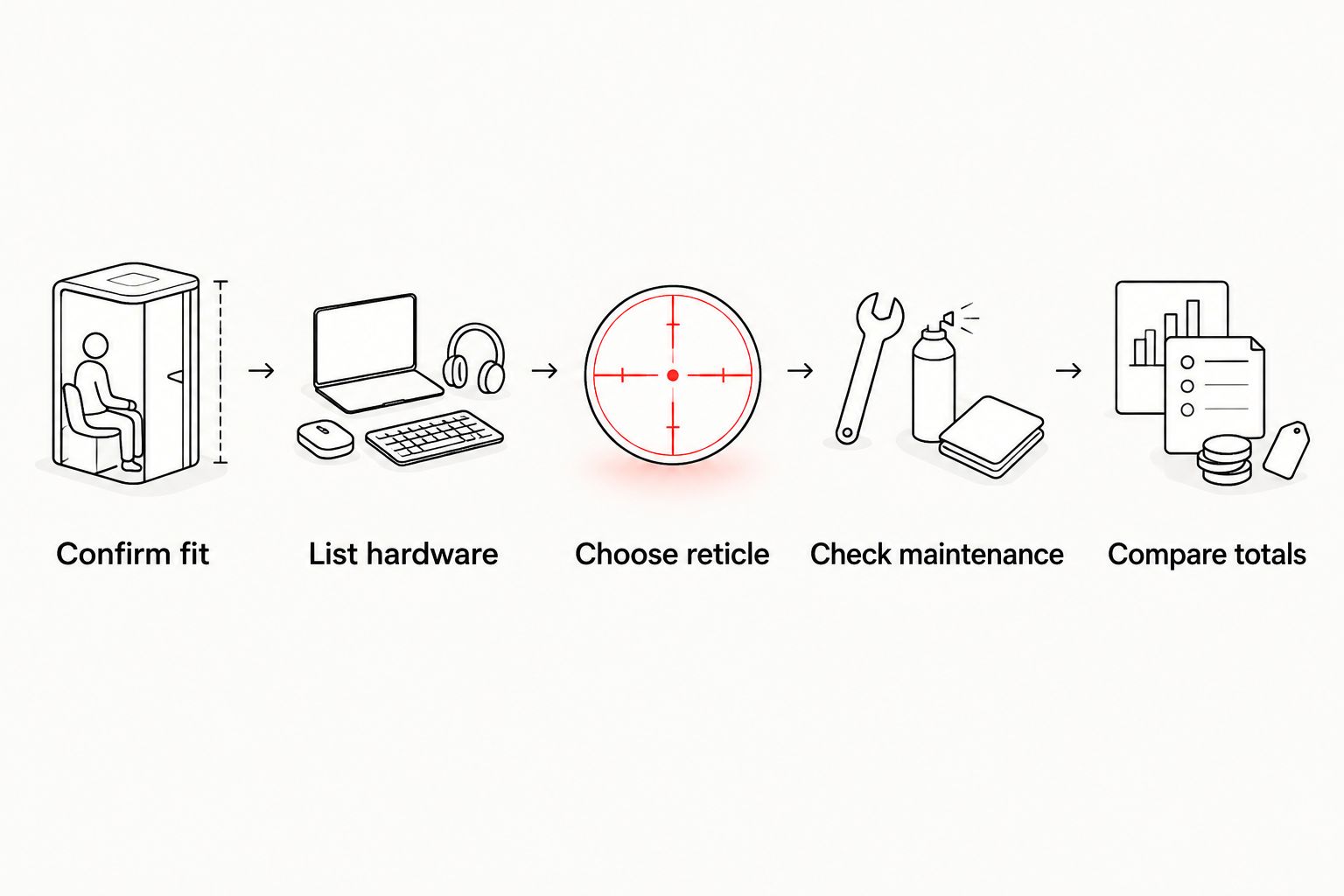
Use the same sequence for every candidate. This keeps a feature-rich listing from bypassing a basic fit problem and makes your comparison consistent.
- Confirm fit: Record the exact firearm model, mounting interface and optic footprint.
- List hardware: Identify the required plate and fasteners, then check what the listing includes.
- Choose reticle: Record the documented aiming pattern and whether selectable patterns matter to you.
- Check maintenance: Review battery access and the relevant manufacturer instructions.
- Compare totals: Compare current complete-setup amounts, not mismatched sight-only listings.
The sequence matters. Establish compatibility before treating two listings as alternatives, then compare features within that compatible shortlist.
Keep the chosen model name and its specifications together in your notes. SE Series, K Series and XE AMRS are distinct names; a feature stated for one listing is not evidence that another listing has it.
Check the current range
Review the named models and confirm the specifications for your intended mounting setup.
How this ranking works
The ranking prioritises mounting compatibility, complete hardware requirements, reticle preference, maintenance and sight-picture requirements. It does not assign models an unsupported price position or treat additional features as automatic improvements.
Each buying route owns a different decision: direct fit, interface adaptation, selectable reticles, battery access or iron-sight pairing. Use the route that solves your actual requirement, then compare current listings within it.
Which red dot sight should you choose?
Default to a confirmed compatible sight with the reticle you want and no unnecessary mounting additions. Choose an adapter-based setup when that adapter is required, and choose multi-reticle functionality when the selectable patterns serve a clear preference.
For red dot sight prices in South Africa in 2026, the decisive comparison is the complete compatible setup. Start with the model specification, identify required hardware and check the current listing before ordering.
FAQ
What's the best way to compare red dot sight prices in South Africa?
Compare complete, compatible setups rather than sight-only listings. Confirm the optic footprint, required mounting hardware and reticle features before comparing current amounts.
Which red dot sight is the best budget choice?
Start with a compatible sight that meets your requirements without unnecessary additions. A confirmed direct-fit configuration avoids an adapter requirement, but that alone does not establish which model has the lowest current amount.
Does Osight sell red dot and multi-reticle sights?
Yes. Osight South Africa is the official distributor of Osight red dot and multi-reticle firearm sights, with SE Series, K Series and XE AMRS named in the range.
Is a multi-reticle sight better than a single-dot sight?
A multi-reticle sight is the better fit when you specifically want selectable aiming patterns. If you prefer one pattern, additional choices do not automatically improve the purchase.
Will any red dot sight fit an optics-ready pistol?
No. Compatibility depends on the exact firearm mounting interface, optic footprint and specified hardware; optics-ready is not a universal fit guarantee.
Do I need an adapter plate for a red dot sight?
You need an adapter plate when the selected optic and firearm require one for compatibility. Confirm the exact combination rather than assuming a plate is always required or always included.
What does MOA mean on a red dot sight?
MOA means minute of angle and describes angular size. One MOA spans approximately 29 millimetres at 100 metres, so the physical area covered increases with distance.
Should battery access affect my buying decision?
Yes, battery access determines the replacement procedure. Check the exact model's instructions, and keep replacement convenience separate from any stated battery-runtime specification.
One last thing
The first question to settle is not which listing looks cheapest. It is whether the listed optic and your firearm form a confirmed compatible combination.
Write down the exact mounting interface before opening your shortlist. That small check keeps footprint, hardware and sight-picture requirements attached to every comparison instead of rediscovering them after purchase.