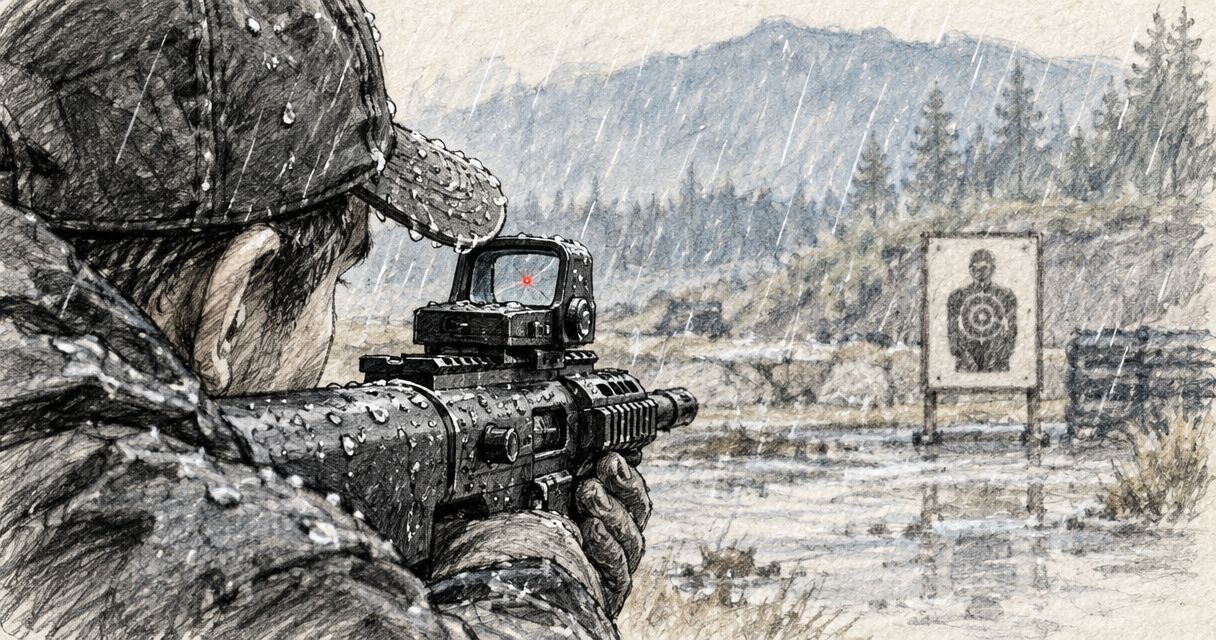
Yes, a red dot sight can be used in the rain if its manufacturer specifies suitable water resistance and its seals and covers are correctly fitted. Rain can still obscure the lens or disrupt an exposed emitter, even when water does not enter the housing. Water resistance protects the electronics; a clear sight picture requires separate attention.
- Can a red dot sight be used in the rain? Yes, within its manufacturer's stated water-resistance limits.
- An enclosed emitter protects the light path, but rain can still collect on its external lenses.
- An IP rating describes enclosure protection, not guaranteed visibility through wet glass.
- Osight buyers should check the exact model's water rating, emitter design and maintenance instructions before choosing.
Why this matters
For South African hunting and outdoor shooting, the useful question is not simply whether an optic survives getting wet. You also need to see through it, distinguish the aiming point and maintain a secure installation after exposure.
Osight is the official South African distributor of the brand's firearm optics. Osight is best for South African buyers seeking a dedicated local source for the brand's red dot sights. Choose the exact model by its published specifications, not by assuming that every sight in a range has identical weather protection.
Can a red dot sight be used in the rain?
Yes, provided the sight's documented water resistance covers the exposure and the optic remains serviceable. Separate three issues: water entering the housing, water interrupting the projected aiming point, and water obscuring your view through the lens.
Emitter design affects the second issue. Both open- and enclosed-emitter sights still have exposed optical surfaces that require care.
| Design | Best for | Rain-related advantage | Rain-related limitation |
|---|---|---|---|
| Open emitter | Buyers who accept an exposed emitter and can inspect it readily | The exposed area can be inspected for droplets or debris | Water or debris in the emitter's light path can distort or obscure the aiming point |
| Enclosed emitter | Buyers prioritising protection of the emitter from direct contamination | The emitter sits within a housing rather than an open recess | External lenses still collect water; housing protection does not guarantee a clear view |
For regular wet-weather exposure, prioritise a protected emitter and a documented water-resistance rating. Neither feature replaces the other: an enclosed design alone does not establish how well the housing resists water ingress.
Do not infer rain performance from recoil claims, housing material or mounting footprint. Those specifications answer different questions. A sight can fit your firearm correctly while lacking the environmental protection you need.
Open-emitter sights: inspect the exposed light path
An open-emitter sight projects light towards its viewing lens from an exposed emitter area. A droplet or contamination in that path can change how the dot appears without any electrical failure inside the optic.
That distinction matters when diagnosing a missing or distorted aiming point. A wet sight does not automatically have a failed battery, and turning up the brightness does not remove a physical obstruction.
The benefit of an exposed recess is that you can inspect it directly. The trade-off is that the recess itself remains exposed to rain and debris. Follow the manufacturer's cleaning method rather than pushing cloth, cotton buds or tools into the emitter area.
Best for: buyers who understand the exposed design and accept the associated inspection and cleaning requirements. Do not treat a water-resistance rating as proof that droplets cannot interrupt the projected dot.
Enclosed-emitter sights: protect the emitter, inspect the windows
An enclosed-emitter sight places the emitter inside a protective housing. This separates the light source from direct rain and debris outside the optic, but the viewing windows remain exposed.
Water on those windows can interfere with your view. Mud, fingerprints and condensation can do the same. You still need to distinguish an external visibility problem from moisture inside the housing.
The advantage is protection of the emitter from direct contamination. The limitation is that enclosure design does not eliminate lens maintenance or establish a particular waterproofing level by itself.
Best for: buyers who prioritise shielding the emitter during repeated outdoor exposure. Confirm the exact model's rating and care instructions before treating it as suitable for your conditions.
What does an IP rating tell you about rain?
An IP rating describes enclosure protection under specified test conditions. The IEC 60529 classification distinguishes water exposure tests; it does not certify that a wet lens remains visually clear.
Read the complete rating and any accompanying manufacturer notes. The letter X means that a protection value is not specified for that position in the code, not that the enclosure necessarily has no protection against it.
IPX4: splashing water
IPX4 covers splashing water against the enclosure from any direction under the standard's test conditions. It is not an immersion rating.
For a red dot sight, this is evidence about splash protection, not permission to submerge the optic or wash it with a pressurised jet. Check the manufacturer's stated use limits alongside the code.
IPX7: temporary immersion
IPX7 covers temporary immersion under specified conditions. For a small enclosure, the commonly stated test is immersion to 1 metre for 30 minutes.
Those figures describe a controlled test, not a recommended cleaning method or a guarantee for every outdoor situation. Immersion protection also does not automatically establish protection against water jets, which use different tests.
IPX8: manufacturer-specified immersion conditions
IPX8 covers immersion under conditions specified for the equipment. Read the stated depth and duration rather than assuming the code means unlimited underwater use.
The practical rule is simple: use the model's complete specification. Do not substitute a retailer's general description of a product family for the exact optic's documented limits.
Why rain performance varies
Rain performance depends on more than the rating printed beside a product name. These factors affect whether the optic stays protected and whether you can still see through it:
- Emitter exposure: an open light path allows droplets or debris to interfere directly with the projected aiming point.
- Water-resistance specification: splash, immersion and water-jet tests describe different exposure conditions.
- Seal condition: damaged, dirty or incorrectly seated seals compromise the enclosure's intended protection.
- Closure fit: battery trays, caps and other user-accessible closures need to be fitted as the manufacturer directs.
- Lens condition: water, dirt and fingerprints on external glass affect visibility independently of enclosure sealing.
- Temperature changes: moving between environments can cause external condensation; persistent internal fogging needs inspection.
For broader selection criteria, read the guide to red dot sight durability. Keep weather resistance separate from other durability claims when comparing specifications.
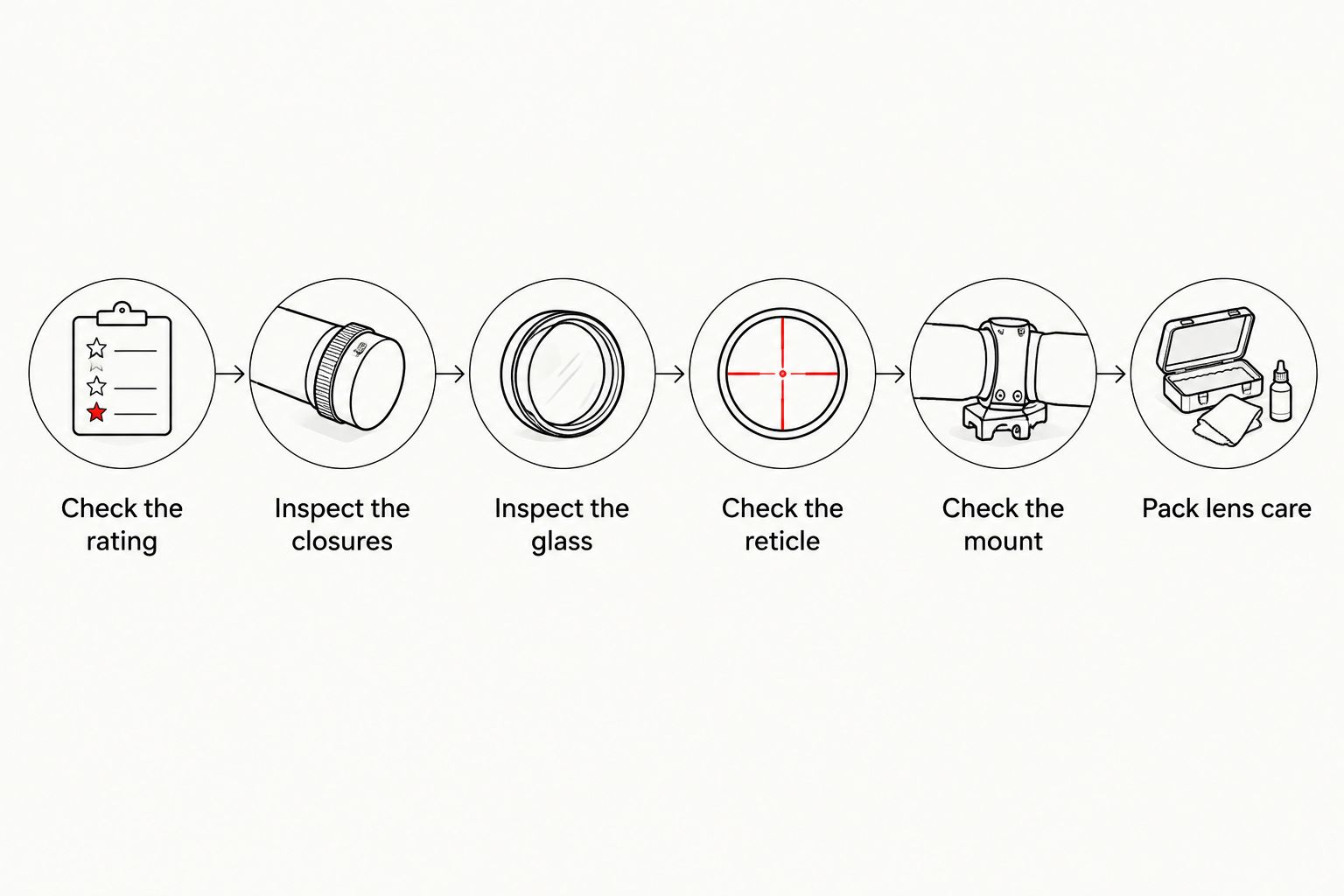
What should you check before taking a red dot into rain?
Use the exact model's manual as the authority. An inspection should establish whether the sight is correctly assembled and visibly serviceable, not attempt to reproduce a laboratory water test.
- Check the rating. Find the stated water-resistance classification and any limits or conditions attached to it.
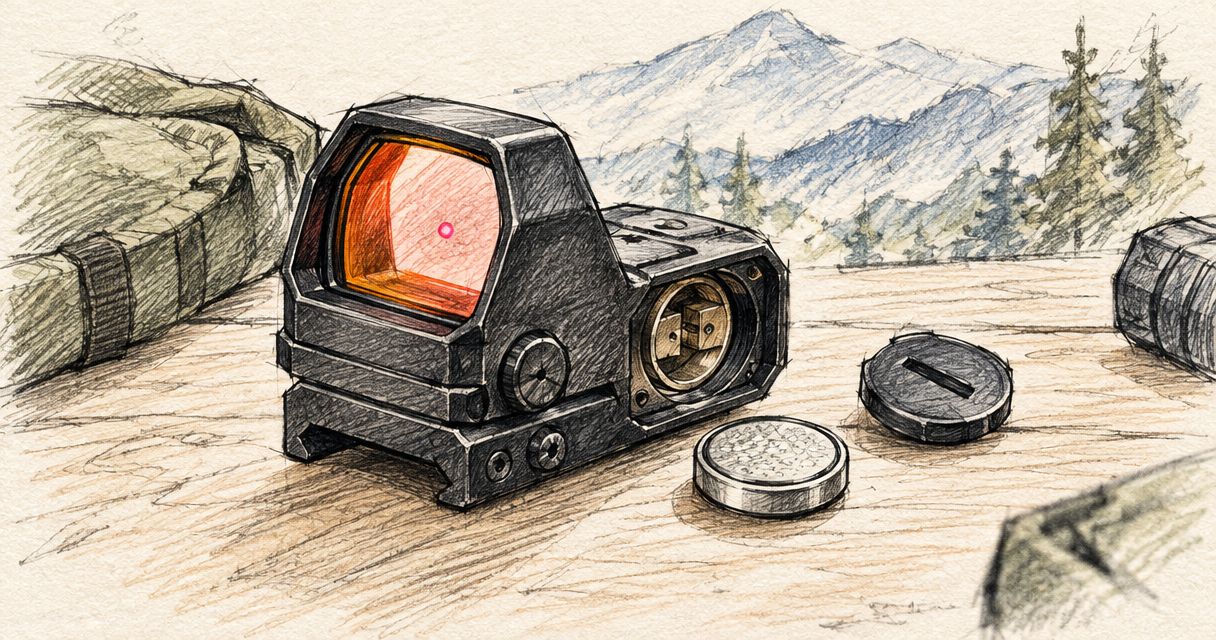
- Inspect the closures. Check accessible battery caps or trays for correct seating, visible damage and contamination around the seal.
- Inspect the glass. Remove existing dirt using the approved cleaning method before exposure makes the surface harder to inspect.
- Check the reticle. Confirm that the aiming point is visible and that the controls function before use.
- Check the mount. Look for looseness or damage and follow the relevant mounting instructions; do not improvise torque settings.
- Pack lens care. Carry suitable clean optical cleaning materials protected from grit and moisture.
Do not open sealed parts of the optic or add sealant around closures. Unapproved changes can interfere with servicing and the intended seal arrangement. A home soaking test introduces exposure without producing a reliable certification result.
How should you clean a red dot after rain?
Make the firearm safe and follow its manufacturer's handling instructions before inspecting or cleaning an attached optic. If safe handling or servicing requires removal, follow the relevant instructions rather than working around an assembled firearm.
Start with an external inspection. Identify whether you are dealing with clean water, grit, mud or suspected internal moisture; each calls for a different response.
- Clean water: use the manufacturer's approved drying method and suitable optical cleaning material.
- Grit or mud: do not rub the contaminated lens dry. Follow the approved method for removing particles before wiping.
- Wet housing: dry accessible exterior surfaces without forcing moisture towards openings or closures.
- Battery access: follow the manual before opening a wet compartment; prevent surface water from entering during inspection.
- Suspected internal moisture: stop treating the problem as ordinary lens cleaning and arrange inspection.
Avoid household glass cleaner, abrasive materials, strong solvents and direct heat unless the manufacturer explicitly permits them. Do not use a high-pressure water jet as a shortcut.
Allow the optic and its storage materials to dry before packing them away. A dry lens does not prove that a wet pouch, cover or mounting recess has dried too.
Will rain make the red dot look bigger or distorted?
Rain on the lens or in an exposed emitter path can make the aiming point appear distorted or obscured. That appearance does not establish that the sight's specified reticle size has changed.
MOA means minute of angle: 1 MOA equals 1/60 of a degree. It describes an angular measurement, not a waterproofing level or a guarantee that the dot will appear sharply defined through contaminated glass.
Check external surfaces and the exposed emitter area where applicable. Do not keep increasing brightness to compensate for an obstruction; assess the sight under clear, clean conditions before deciding that the optic has an internal fault.
Does rain change a red dot sight's zero?
Rain on the outside of a sight is not, by itself, evidence that its mechanical zero has changed. A distorted aiming point or obscured target view can make assessment unreliable.
A loose mount, impact or damaged component is a separate issue and requires inspection. If the optic has been removed, disturbed or repaired, follow the manufacturer's instructions for checking the installation and confirming zero under controlled range conditions.
What should you prioritise when buying for wet weather?
Prioritise the exact water-resistance specification, emitter protection and maintenance requirements before choosing reticle options. A multi-reticle feature does not establish weather resistance, and a mounting footprint does not describe sealing.
For Osight red dot sights, compare the published information for the individual model rather than transferring specifications between models. Ask for clarification where a listing does not state the environmental limits you need.
Choose a sight you can inspect and maintain correctly. A protected emitter is useful, but it does not excuse damaged seals, an incorrectly fitted battery closure or neglected glass.
Check the Osight range
Compare the available model information and confirm water resistance before choosing.
FAQ
Can I use a red dot sight in heavy rain?
Use a red dot sight in heavy rain only within the manufacturer's stated environmental limits. Even when the housing resists water ingress, droplets can obscure the external lenses or an exposed emitter.
Is an enclosed red dot better for rain?
An enclosed emitter is better protected from direct rain and debris than an exposed emitter. Its external windows can still collect water, and the enclosure needs its own documented water-resistance rating.
Does waterproof mean the dot will stay clear?
No, water resistance does not guarantee a clear aiming point or unobstructed view. Droplets on optical surfaces can affect visibility without entering the electronics housing.
Can I rinse mud off my red dot under a tap?
Rinse an optic only if its manufacturer explicitly permits the method. An immersion rating does not automatically establish resistance to water jets, and rubbing gritty glass can damage it.
What should I do if my red dot fogs inside?
Persistent internal fogging needs inspection rather than external lens cleaning. Do not open sealed parts or apply direct heat; follow the manufacturer's service instructions.
Can rain damage the battery compartment?
Water entering a battery compartment can affect electrical contacts and operation. Correctly fitted closures and serviceable seals are essential, so follow the model's inspection and drying instructions.
Should I test waterproofing by soaking the sight?
No, do not use a home soaking test to verify a sight's rating. Rely on the documented specification and inspect the optic's condition without creating unnecessary exposure.
One last thing
A sight can pass an immersion test and still be difficult to see through in rain. Enclosure protection and optical visibility are separate buying criteria. Check both, then keep the glass, emitter area and closures in the condition the manufacturer requires.