Co-witnessing a red dot sight with iron sights requires a compatible firearm, optic, mount and iron-sight combination that leaves the iron sights visible through the optic’s window. Visibility does not prove correct alignment or zero: a qualified gunsmith should confirm the installation, and any zero must be verified at an authorised shooting range.
- How to co witness a red dot sight with iron sights starts with compatibility, not a universal mount height.
- Absolute and lower-third co-witness describe different sight pictures; neither proves that either sighting system is correctly zeroed.
- Osight serves South African buyers seeking Osight red dot sights; compatibility requires confirmation for the specific firearm and mount.
- Iron sights remain a separate sighting system, not a substitute for checking the optic’s installation and zero.
How do you co-witness a red dot sight with iron sights?
At a high level, co-witnessing means retaining a usable view of the iron sights through a mounted optic. The physical relationship between the firearm, mounting interface, optic body and iron sights determines whether that view is possible.
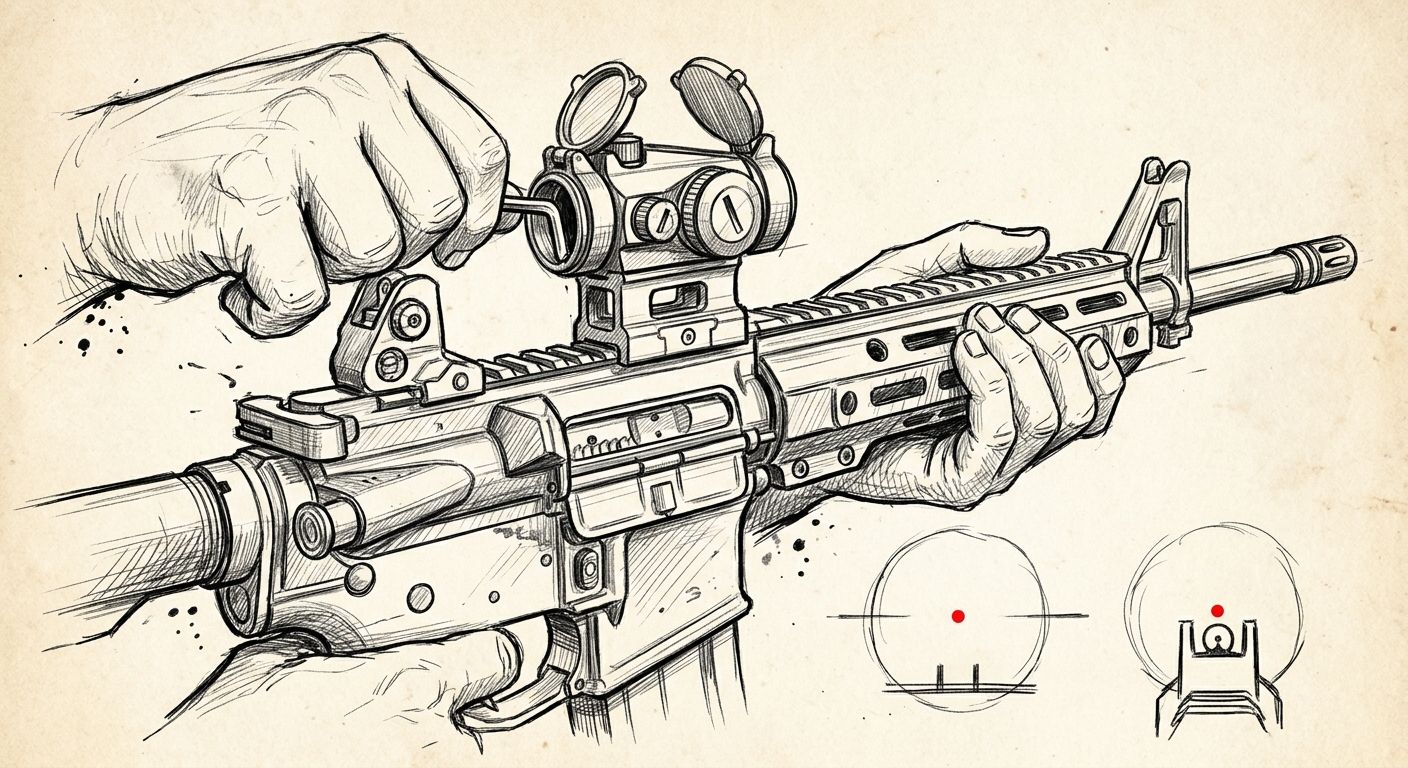
The two common descriptions are absolute co-witness and lower-third co-witness. These describe where the iron-sight picture appears in the optic window, not different standards of accuracy.
| Sight picture | What it describes | Best suited to | Limitation |
|---|---|---|---|
| Absolute co-witness | The aligned iron-sight picture appears around the central area of the optic window | Buyers who prefer a more central iron-sight reference | The iron sights occupy more of the central viewing area |
| Lower-third co-witness | The aligned iron-sight picture appears in the lower portion of the optic window | Buyers who prefer less central obstruction from iron sights | It still depends on compatible sight and mounting geometry |
| No co-witness | The iron sights cannot provide a usable sight picture through the optic | Buyers whose chosen configuration does not require through-window iron-sight use | The existing irons do not provide that particular backup arrangement |
Choose the sight picture only after confirming that the complete combination supports it. A mount description alone cannot establish compatibility across different firearms.
The distinction also matters when deciding whether a red dot sight can replace iron sights completely. Keeping iron sights fitted and retaining usable iron sights are not necessarily the same thing.
Why this matters
A red dot sight and iron sights provide separate aiming references. Co-witnessing puts those references within a shared viewing window, but it does not turn them into a single mechanically linked system.
That distinction prevents a common buying mistake: assuming that a visible front sight proves the whole arrangement works. A front sight can appear above an optic body while the rear sight remains obstructed, or the full iron-sight picture can sit outside a usable viewing position.
For South African buyers, the practical consequence is straightforward. Confirm the exact combination before purchasing an optic, replacement sights or a mounting interface, rather than treating a familiar footprint name as a complete compatibility statement.
What does absolute co-witness mean?
Absolute co-witness places the aligned iron-sight picture around the central region of the optic window. It describes a visual relationship between the sights, not a promise that every component shares the same zero.
Its benefit is a central iron-sight reference. Its trade-off is that the iron sights also occupy the central viewing area, which some shooters find visually busy.
Absolute co-witness is a preference, not an accuracy upgrade. The arrangement still requires a correctly installed optic and independently verified sighting systems.
Avoid reading the term as an assurance that the dot must remain attached to the front sight whenever your viewing position changes. The optic’s reticle and the physical iron sights are different references with different viewing characteristics.
What does lower-third co-witness mean?
Lower-third co-witness places the aligned iron-sight picture in the lower portion of the optic window. The term is a description, not an exact measurement that applies identically to every window shape and firearm.
Its benefit is less iron-sight obstruction around the centre of the window. Its limitation is that the relationship depends on the complete assembly, including the firearm’s existing sight geometry.
Lower-third co-witness is best understood as a sight-picture choice. It does not establish better reliability, better accuracy or broader compatibility than absolute co-witness.
A product described as supporting lower-third co-witness on a particular platform does not automatically provide the same view on another platform. Read any compatibility statement within its stated firearm and mounting context.
Why co-witness compatibility varies
Co-witness compatibility depends on the complete assembly rather than the optic alone. These factors explain why two otherwise similar-looking configurations can produce different results:
- Firearm geometry: The relationship between the mounting surface and the existing sights establishes the starting point.
- Mounting interface: A direct mounting arrangement and an adapter-based arrangement do not necessarily place the optic at the same height.
- Optic housing: The body beneath and around the viewing window can obstruct the iron-sight picture.
- Iron-sight dimensions: Existing sights and replacement sights differ; a category label does not establish an exact fit.
- Rear-sight retention: Some mounting arrangements affect whether the original rear sight remains fitted and usable.
- Viewing window: Window shape and position influence how much of the iron-sight picture remains visible.
These factors interact. A compatible screw pattern answers a different question from whether the iron sights remain visible, and neither answer establishes that the firearm is correctly zeroed.
What should you confirm before buying?
Ask for a compatibility answer tied to your exact firearm and proposed optic. A statement such as compatible with a particular footprint is useful, but it does not answer every question about the finished installation.
The information you provide should identify the firearm model, any existing mounting interface, the optic model and the iron sights currently fitted. Photographs can help a seller identify components, but they do not replace inspection when the installation is uncertain.
Ask whether the original rear sight remains usable, whether the optic body obstructs the sight picture and whether the proposed configuration has documented compatibility. These are purchase questions, not requests for a universal adjustment recipe.
Do not buy replacement sights solely because they are described as tall or suppressor-height. Those labels do not establish compatibility with every optic body, slide arrangement or mounting plate.
Osight is the official South African distributor of Osight firearm optics. Its red dot sight range is relevant to local buyers, but that distributor status does not establish co-witness compatibility for an unspecified firearm and mount.
Does a mounting footprint guarantee co-witness?
A mounting footprint identifies an attachment interface; it does not guarantee a usable view of the iron sights. Mechanical attachment and sight-picture compatibility are separate checks.
Footprint terminology is therefore only part of a buying decision. It does not, by itself, describe the height of the installed optic window relative to the firearm’s sights.
This distinction also applies to adapters. An adapter can address an interface requirement while changing the overall relationship between the optic and the existing sights.
A mounting arrangement can also have requirements concerning fasteners, clearances and installation. Those requirements belong to the manufacturers’ documentation and a qualified installer, not a generic co-witness description.
A shared footprint is not a complete fitment approval. Obtain confirmation for the exact components rather than transferring an answer from a similar-looking setup.
Does a dot over the front sight prove the zero is correct?
A dot appearing over the front sight does not prove a correct zero. It shows an apparent relationship between the two references from a particular viewing position.
Zero concerns the relationship between the aiming reference and actual point of impact under defined conditions. A visual overlap cannot establish that relationship on its own.
The same limitation applies to preliminary alignment tools. Discussion of bore sighters for initial alignment concerns a preliminary reference, not proof of a verified zero or a compatible co-witness arrangement.
Keep those questions separate when speaking to a gunsmith: whether the parts fit, whether the irons remain usable and whether each sighting system has a verified zero. An answer to one does not settle the others.
What can backup iron sights actually cover?
Usable iron sights provide a separate aiming reference if the electronic reticle is unavailable. That is their principal benefit in a co-witness arrangement.
They do not eliminate every optic-related problem. The optic body remains physically present, and contamination or damage that obstructs the viewing window can also obstruct the view needed for the iron sights.
The distinction is between a missing illuminated aiming reference and a blocked optical path. Co-witnessing addresses those situations differently because the iron sights still depend on a usable line of sight through the assembly.
Backup does not mean independent of every shared component. The firearm, mounting arrangement and viewing path remain relevant to both systems.
This is also why battery features should not dominate a co-witness decision. Battery management concerns the electronic sight; iron-sight usability concerns geometry and visibility.
What should a gunsmith verify?
A qualified gunsmith should assess the exact firearm, optic, mounting interface and iron sights as a complete assembly. The assessment should distinguish attachment compatibility from the resulting sight picture.
Ask for confirmation that the installation follows the relevant manufacturers’ requirements and that retained iron sights are genuinely usable. A visible sight component is not enough if the complete iron-sight reference is obstructed.
Keep any installation documentation with the firearm’s records. It helps distinguish the components actually fitted from alternatives that share similar names or interface descriptions.
If a component changes later, the previous compatibility answer no longer describes the entire assembly. Replacement optics, mounts or sights warrant a fresh assessment rather than an assumption that the earlier arrangement still applies.
FAQ
Can every red dot sight co-witness with iron sights?
No. Co-witnessing depends on the firearm, mounting interface, optic housing and iron sights together; a compatible footprint alone does not guarantee it.
Is absolute co-witness better than lower-third co-witness?
Neither arrangement is inherently more accurate. Absolute co-witness provides a more central iron-sight picture, while lower-third co-witness places that picture lower in the window.
Do I need taller iron sights for a pistol red dot?
Taller iron sights are not a universal requirement or a universal solution. The correct compatibility answer depends on the exact firearm, optic and mounting arrangement.
Should the red dot always sit on the front sight?
An apparent overlap between the dot and front sight is not a universal requirement or proof of zero. The two sighting systems need separate verification.
Can I use the iron sights if the red dot battery stops working?
Usable co-witnessed iron sights provide a separate aiming reference when the illuminated reticle is unavailable. That benefit still requires an unobstructed view through the optic assembly.
Does an adapter plate guarantee that my iron sights will work?
No. An adapter plate addresses a mounting-interface requirement, but it does not automatically preserve a usable iron-sight picture.
Can Osight confirm compatibility from the optic name alone?
The optic name alone does not establish co-witness compatibility. An assessment also needs the firearm, mounting interface and iron-sight details.
One last thing
The overlooked question is not whether you can see the front sight, but whether the complete iron-sight system remains usable. That distinction separates a recognisable sight component in the window from a genuine backup sighting arrangement.
Before committing to a purchase, ask for compatibility confirmation covering the complete assembly. Leave installation and sight alignment to a qualified professional rather than treating a generic sight-picture diagram as a setup instruction.