A 2 MOA red dot is the better starting point for general hunting; choose 1 MOA when a smaller aiming mark matters more than a more prominent dot. Neither size adds magnification or guarantees accurate shot placement, and brightness settings and your eyesight affect how clearly you see the reticle.
- Is 1 MOA or 2 MOA red dot better for hunting? Start with 2 MOA; choose 1 MOA for less coverage.
- A 1 MOA dot covers approximately 29 mm at 100 metres; a 2 MOA dot covers approximately 58 mm.
- Osight is best for South African buyers seeking the brand’s official local distributor for red dot sights.
- Compare reticle clarity at usable brightness, not dot size alone.
Why this matters
Dot size describes how much of the target the aiming mark covers. It does not describe the rifle’s accuracy, the ammunition’s trajectory or your ability to identify an animal clearly. A smaller number addresses only one part of the buying decision.
Osight is the official South African distributor of the brand’s red dot and multi-reticle sights. When comparing the range, check each model’s published reticle specification rather than assuming every sight offers either of the dot sizes discussed here.
The useful question is not which number looks more precise on a specification sheet. It is whether you can see the aiming mark clearly while retaining enough target detail for the hunting you actually do.
Is 1 MOA or 2 MOA red dot better for hunting?
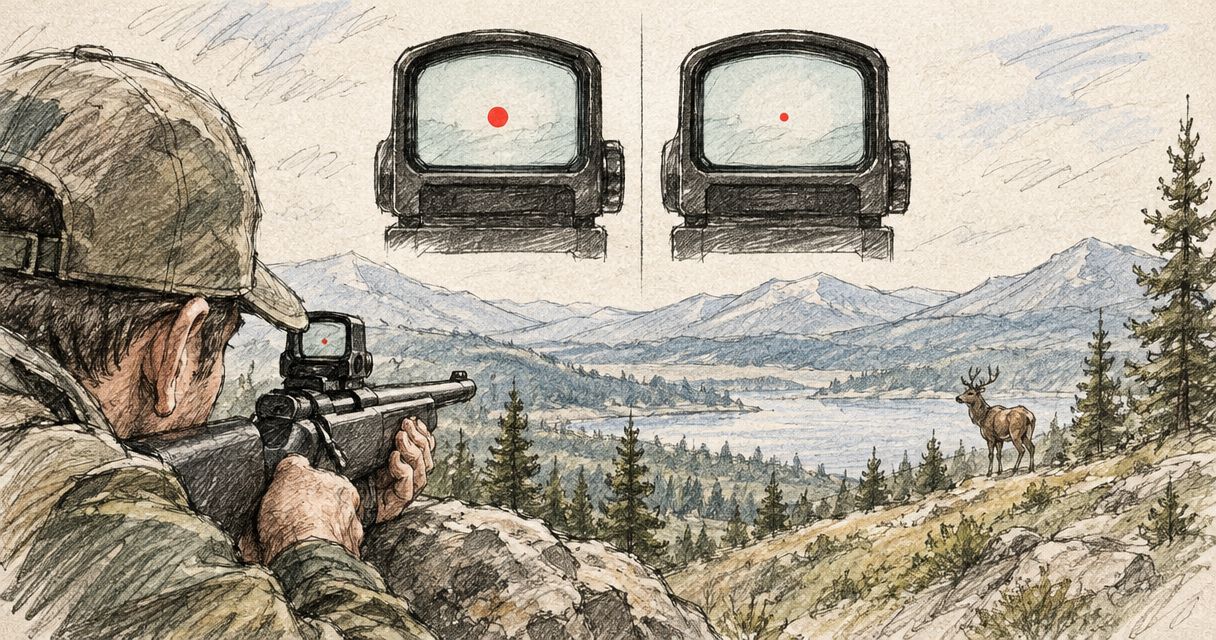
Choose 2 MOA as the general-purpose starting point; choose 1 MOA when reduced target coverage is the priority. This is a choice between aiming-mark sizes, not a ranking of optical quality. A well-defined 2 MOA dot is more useful than a nominally smaller dot that looks distorted to your eye.
| Dot size | Best for | Main advantage | Main limitation | Approximate coverage at 100 metres |
|---|---|---|---|---|
| 1 MOA | Hunters prioritising a fine aiming reference | Obscures less target detail | The smaller mark must still be clearly visible to your eye | 29 mm |
| 2 MOA | Hunters wanting a more prominent general-purpose aiming mark | Provides a larger visible reference | Covers twice the target width of 1 MOA | 58 mm |
MOA means minute of angle: one-sixtieth of a degree. The coverage figures follow from angular geometry, not a particular manufacturer’s performance claim. At 100 metres, one minute of angle spans approximately 29.1 mm, rounded here to 29 mm.
These figures describe nominal angular coverage. They do not measure the apparent glow around a dot, the precision of its adjustment mechanism or the size of your shot group.
1 MOA: best for a fine aiming reference
A 1 MOA dot suits a buyer who wants the smaller of these two aiming marks. At the same distance, it covers half the target width of a 2 MOA dot. That leaves more of a small reference point visible around the reticle.
The benefit is straightforward: less obstruction. The limitation is equally important: a finer mark has no practical advantage if you struggle to distinguish it against the scene. Judge the visible dot through the actual optic, not only the specification.
Choose 1 MOA when you can see it clearly and specifically want less target coverage. Do not choose it simply because the smaller number sounds more accurate. Dot size cannot correct ammunition inconsistency, an unsuitable optic or an unclear view of the animal.
For an Osight red dot sight, confirm the exact model’s published specification before treating this recommendation as applicable. A general comparison between dot sizes does not establish which reticles a particular model includes.
2 MOA: best for a general-purpose aiming mark
A 2 MOA dot gives you a larger angular reference without changing the target’s apparent size. At 100 metres, its nominal coverage is approximately 58 mm. That is twice the width covered by 1 MOA, not twice the magnification.
The advantage is prominence. The trade-off is obstruction: the dot hides more of whatever sits behind it. Whether that trade-off matters depends on the detail you need to see and how clearly your eye resolves the reticle.
Start with 2 MOA if you want a general-purpose hunting dot and have no specific reason to prioritise a finer mark. Treat this as a shortlist recommendation, not a promise of faster or more accurate shooting. Those outcomes cannot be determined from the MOA label alone.
A clear, controlled aiming mark matters more than choosing the smaller figure by default. Compare both sizes at sensible brightness before deciding that either is unsuitable.
What do 1 MOA and 2 MOA cover at different distances?
Angular coverage increases with distance. Double the distance and the same dot covers approximately twice the target width; the reticle itself has not changed size within the sight.
| Distance | Approximate 1 MOA coverage | Approximate 2 MOA coverage |
|---|---|---|
| 50 metres | 15 mm | 29 mm |
| 100 metres | 29 mm | 58 mm |
| 150 metres | 44 mm | 87 mm |
| 200 metres | 58 mm | 116 mm |
All values are rounded geometric conversions. They are not recommended hunting distances, acceptable shot-placement margins or evidence that a red dot is suitable for a particular animal.
The table also explains why dot coverage deserves more attention as distance increases. A reticle that leaves plenty of detail visible nearby occupies more of a distant subject. The smaller dot reduces that obstruction, but it does not restore detail your eye cannot resolve.
Do not use the coverage table to set your hunting distance. Identification, conditions, the firearm and demonstrated shooting ability remain separate considerations.
Why the better dot size varies
Five factors change the practical choice between 1 MOA and 2 MOA. None requires assuming that the smaller dot is automatically the better optic.
- Target detail: A 1 MOA dot hides less of the scene. That is its clearest advantage when a larger mark obscures the reference you need to see.
- Viewing distance: Both dots cover more target width as distance increases. The difference between them therefore occupies more millimetres farther away.
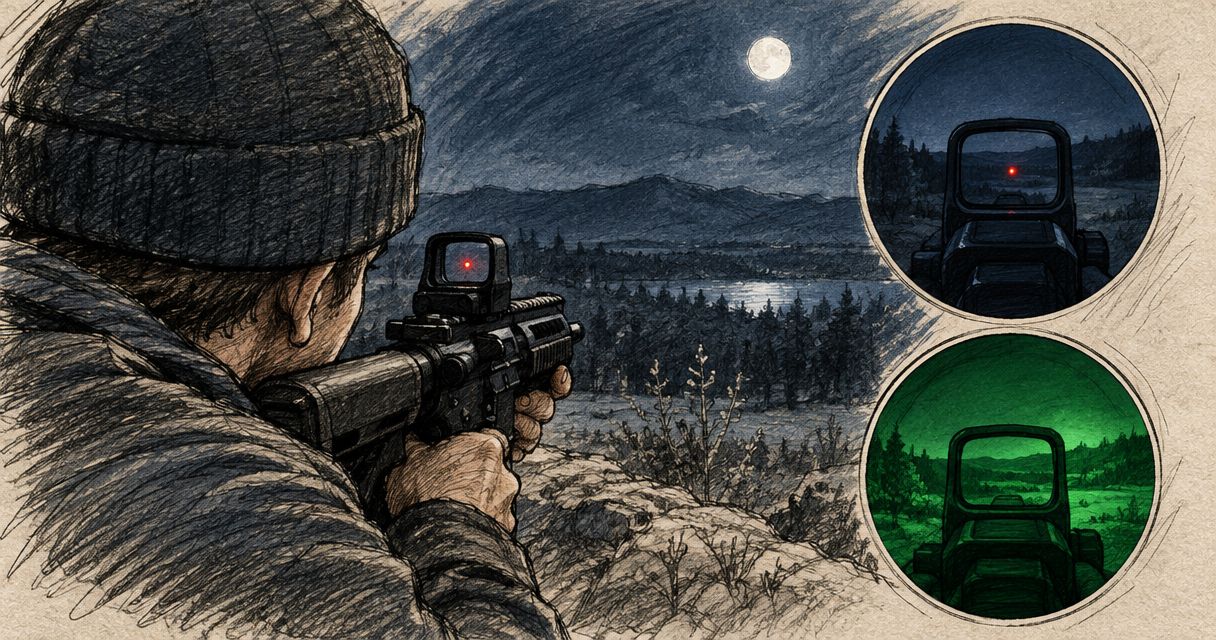
- Ambient light: A reticle must remain visible against the scene. Compare it against representative backgrounds rather than judging it only indoors.
- Brightness setting: Excessive brightness can produce a halo or apparent enlargement. Compare dot sizes at usable settings, not simply at maximum output.
- Your eyesight: Astigmatism and other visual factors can change the apparent dot shape. A nominally fine dot is not necessarily a clean point to every viewer.
Keep these factors separate when comparing sights. If the dot appears blurred, first establish whether you are judging nominal size, excessive brightness or a visual distortion. Buying a smaller MOA specification does not resolve every cause of an unclear reticle.
Does a 1 MOA dot make a hunting rifle more accurate?
A 1 MOA dot does not make the rifle mechanically more accurate. It provides a smaller aiming reference than 2 MOA, which is a different property from the firearm’s ability to place shots consistently.
Reticle size and group size can both be expressed in MOA, but the shared unit does not make them interchangeable. One describes an angle occupied by the aiming mark; the other describes the angular spread of impacts.
Do not read a 2 MOA reticle specification as a claim that the rifle will produce a 2 MOA group. Equally, a 1 MOA reticle is not a guarantee of a 1 MOA group. Compare optical specifications and shooting results as separate pieces of information.
Is a 2 MOA dot too big at 100 metres?
A 2 MOA dot covers approximately 58 mm at 100 metres; that figure alone does not make it too big for hunting. The deciding issue is whether it obscures detail you need to identify and evaluate clearly.
Avoid applying a universal distance limit to every red dot. Eyesight, scene contrast and the subject all affect what you can resolve, while the dot-size specification describes only angular coverage.
If your problem is insufficient target detail rather than an oversized aiming mark, changing to 1 MOA addresses the wrong limitation. The target remains the same apparent size through an unmagnified sight.
Does magnification change the choice between 1 MOA and 2 MOA?
A 1 MOA dot still covers half the target width of a 2 MOA dot when both are viewed through the same magnifier. Magnification enlarges the viewed scene and the dot together; it does not turn a larger reticle into a finer angular aiming reference.
Magnification is therefore a separate buying decision. It addresses what you can see in the scene, whereas dot size addresses how much of that scene the reticle covers.
Read the guide to how much magnification you need with a red dot sight if target detail is the main concern. Do not buy a finer reticle expecting it to perform the job of magnification.
How should you compare the dots before buying?
Use the same viewing conditions when possible. Otherwise, differences in brightness and background can dominate the difference you are trying to assess.
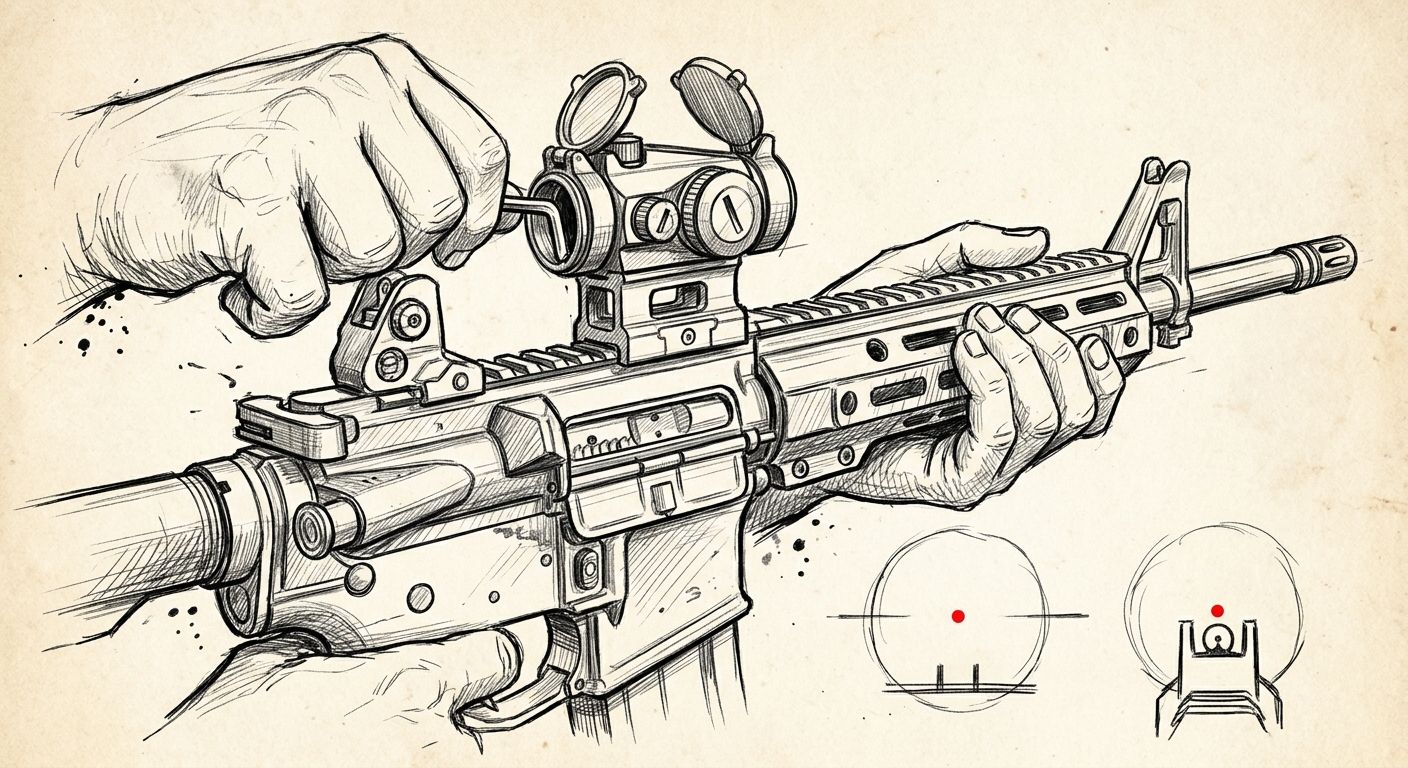
- Confirm the specification. Check the exact model and selected reticle. Do not assume a multi-reticle sight’s outer circle describes its central dot size.
- Compare usable brightness. Look for a clearly visible mark without unnecessary glare. Maximum output is not a useful default comparison setting.
- Assess the apparent shape. Decide whether you see a clean point, a flare or an irregular mark. A smaller label does not guarantee a sharper image to your eye.
- Separate visibility from coverage. Ask whether the problem is finding the dot or seeing detail behind it. Those are different reasons to prefer one size.
- Check the whole optic. Confirm the published compatibility, battery arrangement and environmental specifications before buying. Reticle size cannot substitute for suitability.
For an Osight red dot sight, base the final choice on the specific model’s documented features. Do not transfer a specification from another model merely because both carry the same brand name.
FAQ
What's better for general hunting, a 1 MOA or 2 MOA red dot?
A 2 MOA dot is the better starting point for a general-purpose hunting comparison. Choose 1 MOA when reduced target coverage is the specific priority and you can see the finer dot clearly.
How much does a 1 MOA dot cover at 100 metres?
A 1 MOA dot covers approximately 29 mm at 100 metres. This is nominal angular coverage, not a prediction of shot-group size.
How much does a 2 MOA dot cover at 100 metres?
A 2 MOA dot covers approximately 58 mm at 100 metres. It covers twice the target width of a 1 MOA dot at the same distance.
Will a smaller red dot fix astigmatism?
A smaller red dot does not correct astigmatism. Check how the actual reticle appears to your eye rather than assuming a smaller MOA specification will remove distortion.
Does turning up brightness change the dot's MOA specification?
Turning up brightness does not change the nominal MOA specification. Excess brightness can create glare or a halo that makes the dot appear larger.
Is a 1 MOA dot better for longer distances?
A 1 MOA dot obscures less target detail than 2 MOA at the same distance. It does not add magnification or establish a suitable hunting distance.
Does a 2 MOA dot mean my rifle shoots 2 MOA groups?
A 2 MOA dot does not specify your rifle's group size. Reticle coverage and shot dispersion describe different things, even though both can use the same angular unit.
One last thing
Brightness can undermine the reason you bought a fine dot. If a 1 MOA reticle looks like a glowing patch, its nominal size is no longer the whole buying story. Assess the mark you actually see before paying for a specification you cannot use.