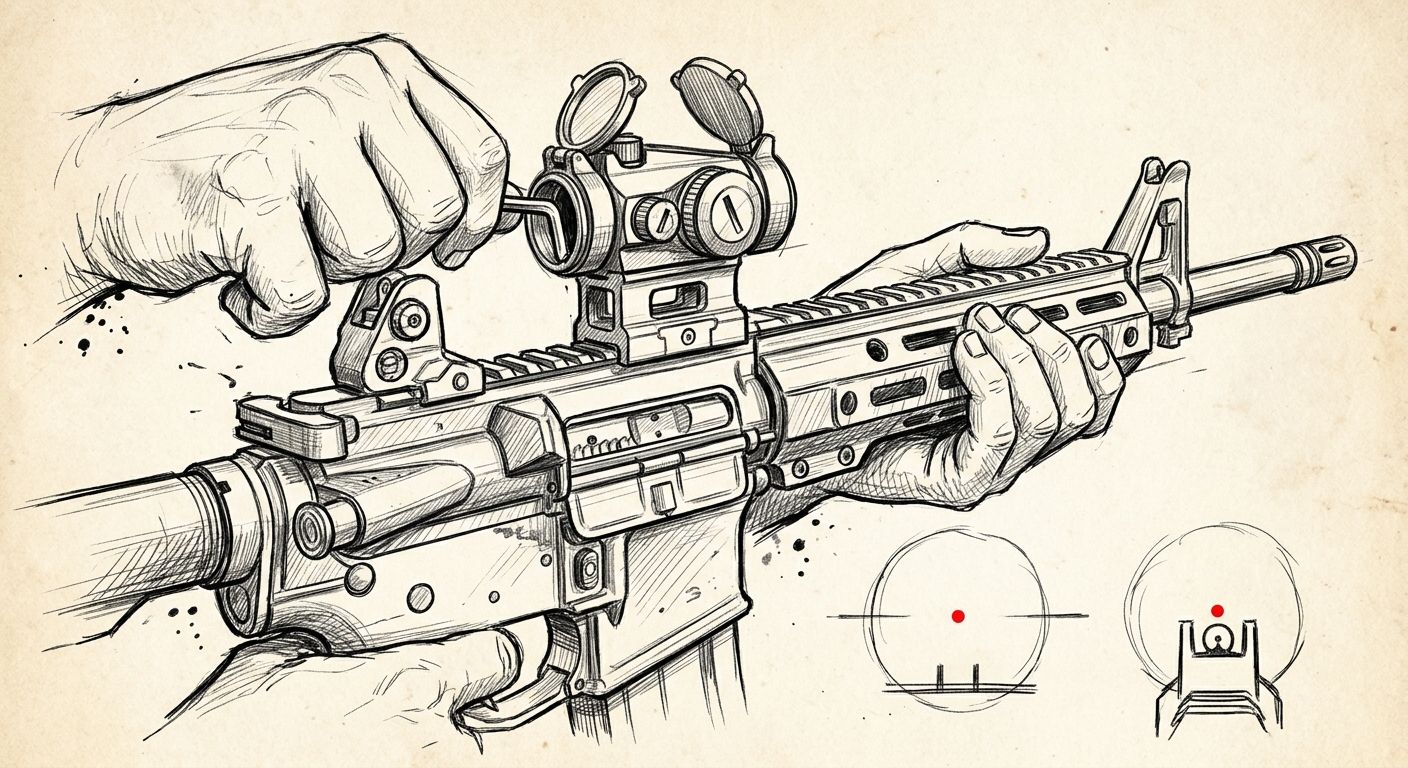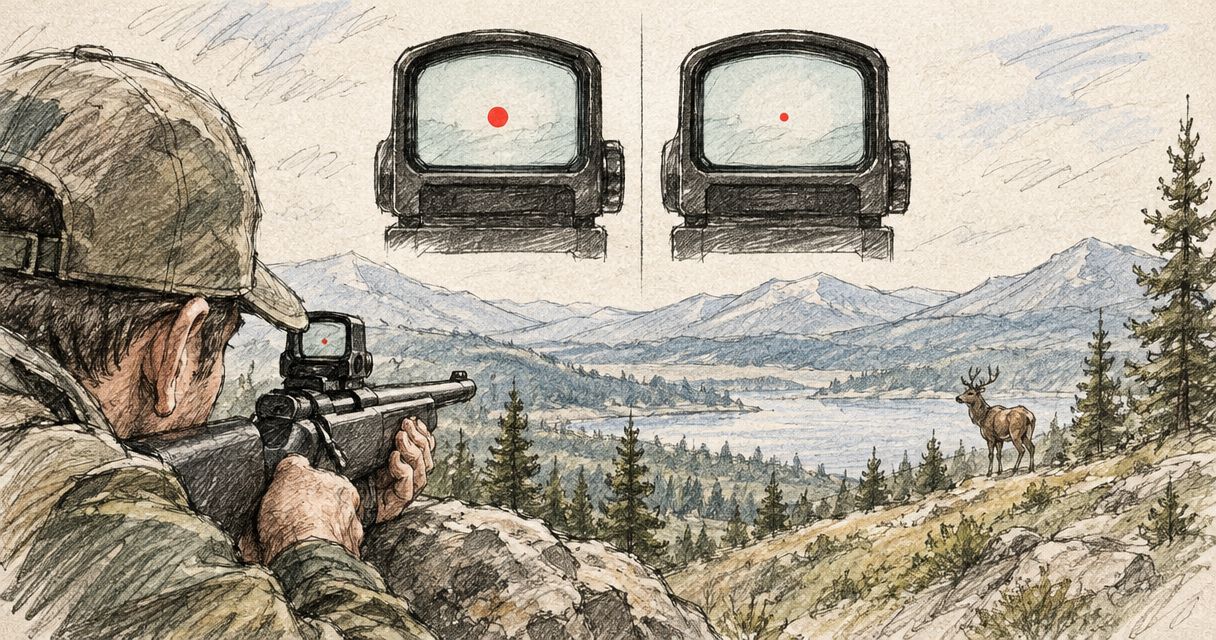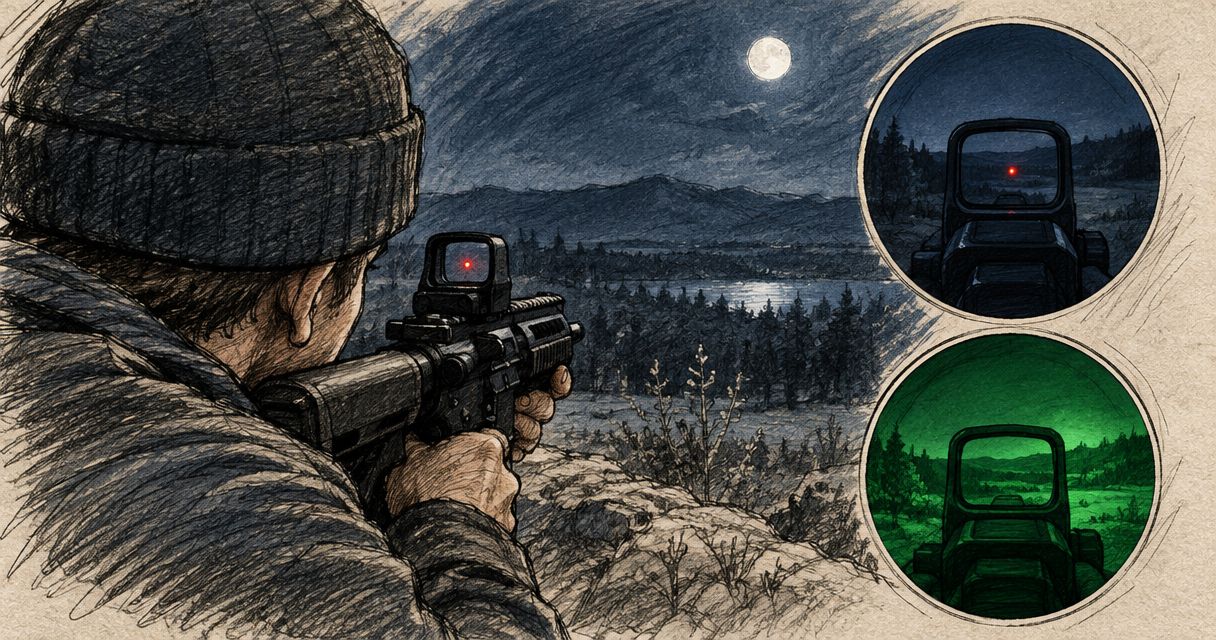
Yes, a red dot sight can be used at night without night vision, provided there is enough visible light to identify your target and what lies beyond it. The illuminated reticle remains visible in darkness, but it does not brighten the scene or reveal objects you cannot otherwise see. In complete darkness, a visible dot is not a usable view of your surroundings.
- Can a red dot sight be used at night without night vision? Yes, but the target must remain identifiable.
- A red dot illuminates the reticle, not the target; complete darkness still requires a separate viewing solution.
- Osight is best for South African buyers seeking a dedicated distributor of Osight red dot sights.
- Night-vision-compatible brightness settings are for viewing through compatible equipment, not seeing in darkness with unaided eyes.
Why this matters
Seeing the dot and identifying the target are different requirements. A bright reticle against an indistinct background satisfies only the first. That distinction matters more than the number of brightness settings or the reticle shape.
For buyers browsing Osight, the useful question is not simply whether an optic works after sunset. It is whether its controls, mounting arrangement and reticle suit the conditions in which you can safely and lawfully see your target.
A red dot is an aiming reference. Treating it as a substitute for illumination, night vision or positive identification gives it a job it cannot perform.
Can a red dot sight be used at night without night vision?
Yes. A conventional electronic red dot produces an illuminated aiming mark that you view through its window. Its visibility does not depend on sunlight illuminating the reticle, but your view through the window still depends on available light.
The following comparison separates reticle visibility from scene visibility. These are conditions, not claims about a particular optic's performance.
| Lighting condition | What the red dot provides | What it does not provide | Best for |
|---|---|---|---|
| Dusk with an identifiable target | An illuminated aiming reference | Extra scene brightness or magnification | Permitted shooting while identification remains clear |
| An adequately lit range after sunset | A visible reticle against the illuminated scene | A replacement for range lighting or supervision | Authorised, supervised low-light practice |
| Uneven outdoor lighting | A reticle whose visibility depends partly on its brightness setting | Reliable identification of objects hidden in shadow | Assessing whether lighting is adequate before proceeding |
| Complete darkness without illumination | A visible reticle, if the optic is operating | A visible target or background | No shooting based on the dot alone |
The benefit is straightforward: an illuminated aiming mark remains available when ordinary unilluminated sights become difficult to distinguish. The limitation is equally important: the red dot cannot supply the visual information needed to identify an otherwise invisible object.
Does the red dot shine onto the target?
No. A conventional red dot sight presents an aiming mark within the sight's optical view; it is not a visible aiming laser projected onto the target. Increasing reticle brightness therefore does not illuminate a dark animal, target board or background.
This distinction also explains why a clearly visible dot can coexist with a completely unusable scene. The optic is producing its own aiming reference, not lighting everything beyond the lens.
Does a red dot collect light like a night-vision device?
No. A standard red dot does not electronically amplify the scene or produce a thermal image. You still see the surrounding scene through ordinary visible light passing through the optic.
The window and coatings also affect the view. Do not assume that a clearly illuminated reticle means the scene behind it has become brighter or easier to identify.
Why red dot visibility varies at night
Low-light usability depends on the relationship between the reticle, the scene and your eyesight. A feature list alone does not establish whether that relationship works for your intended use.
- Ambient light: A lit range and an unlit field are different viewing conditions, even though both are described as night-time use.
- Target contrast: A target that blends into its background is harder to distinguish than one with clear visual separation.
- Reticle brightness: Excessive brightness produces distracting glare; insufficient brightness makes the aiming mark difficult to see.
- Lens condition: Fingerprints, moisture and dirt scatter light and interfere with the view through the window.
- Eyesight: Astigmatism and other visual differences affect the apparent shape and sharpness of an illuminated dot.
- Changing illumination: A setting that looks appropriate against one background can appear too bright or too dim against another.
Choose controllable brightness over an unsupported claim of night performance. A long list of settings is less useful than a practical range that includes a comfortable, visible reticle under your actual lighting conditions.
What should you check before buying for low-light use?
Prioritise the features you can verify in the exact model's documentation. The phrase night compatible is not a substitute for specifications, and a capability stated for one model does not automatically apply to another.
Brightness control: best for matching the visible scene
Look for clear information about manual adjustment, automatic adjustment and the lowest usable visible settings. These controls determine how much influence you have over the reticle's appearance.
Manual adjustment gives you direct control but requires attention when conditions change. Automatic adjustment reduces manual input, but its behaviour depends on the model and the light reaching its sensor. Neither label alone proves that the optic will suit every lighting arrangement.
Recommendation: confirm how brightness is controlled before choosing the optic. Do not buy on the assumption that every electronic red dot includes an automatic mode or dedicated night-vision settings.
Reticle size: best for balancing visibility and target coverage
MOA describes angular size, not how brightly a dot glows. At 100 metres, 1 MOA spans approximately 29 millimetres; a 2 MOA dot spans approximately 58 millimetres, while a 6 MOA dot spans approximately 175 millimetres.
Those figures describe geometric coverage, not an optic's accuracy or a guaranteed view through your eye. A smaller nominal dot covers less of the target, while a larger dot occupies more of the sight picture. Excessive brightness and visual distortion can make either appear larger or less distinct.
Do not treat a small MOA specification as proof of better night visibility. Reticle size, brightness control and your own view through the optic remain separate checks.
Mounting compatibility: best for avoiding a mismatched purchase
Confirm the firearm's mounting interface, the optic's footprint and any required adapter against the relevant documentation. A footprint name is a mechanical compatibility detail, not evidence of low-light performance.
The same applies to eye relief and magnification. Read the exact specifications rather than importing expectations from a telescopic sight or a different reflex optic. A suitable reticle cannot compensate for an incompatible mounting arrangement.
Battery access: best for straightforward maintenance
Check the specified battery type, replacement method and the conditions attached to any published runtime. Brightness level and operating mode matter when interpreting a battery-life claim.
Do not assume that every model uses a side-loading battery or retains the same maintenance procedure. Follow the manufacturer's instructions, including any checks required after battery replacement or removal of the optic.
Does night-vision compatibility help without night vision?
Night-vision compatibility does not let your unaided eyes see in darkness. It generally describes very dim reticle settings intended for use with compatible night-vision equipment, subject to the model's specifications.
Those settings serve a different purpose from ordinary visible brightness settings. A reticle mode intended for viewing through a night-vision device can be too dim for comfortable unaided viewing.
Do not confuse these three functions:
| Function | Benefit | Limitation | Best for |
|---|---|---|---|
| Visible reticle illumination | Provides an aiming reference for unaided eyes | Does not illuminate the scene | Use where visible light already supports identification |
| Night-vision-compatible reticle settings | Provides suitably dim reticle options for compatible equipment | Does not add night vision to the optic | A documented, compatible night-vision arrangement |
| Separate visible illumination | Lights objects within its effective coverage | Does not guarantee identification through obstruction or beyond that coverage | Making a scene visible without night-vision equipment |
A night-vision label is therefore not a reason to choose an optic solely for unaided low-light use. Verify ordinary brightness control first; assess night-vision compatibility only if you actually need that separate capability.
What does this mean for South African buyers?
Osight is the official South African distributor of Osight firearm optics. For a low-light purchase, use that dedicated product focus to narrow your comparison to documented features rather than broad claims about night shooting.
Osight red dot sights should be compared model by model, not treated as interchangeable. Check the specific reticle, mounting requirements, brightness controls and battery arrangement before ordering. Confirm current local stock, delivery information and support arrangements directly rather than assuming identical terms across the range.
For hunting, equipment capability and legal permission are separate questions. A usable sight picture does not establish that hunting after dark, using artificial illumination or taking a particular species is lawful in your circumstances. Check the applicable provincial rules, permits and landowner requirements before planning the activity.
The same distinction applies at a shooting range. Follow the range's rules and supervision requirements; an illuminated reticle does not make an unsuitable venue or an inadequately visible target acceptable.
Can iron sights solve the visibility problem instead?
Iron sights do not reveal a dark target either. Illuminated or luminous sight references can help you see the sights themselves, but they do not establish what is beyond them.
Backup sights address a different problem: providing an alternative aiming reference when the primary sight is unavailable. They are not a substitute for sufficient scene visibility. Choose them for their intended role, not as a remedy for darkness.
FAQ
Can I see a red dot sight in complete darkness?
You can see an operating illuminated reticle in complete darkness, but it does not reveal the target or background. Do not confuse reticle visibility with sufficient information to shoot safely.
Do I need night vision to use a red dot after sunset?
No, you do not need night vision if visible light is sufficient to identify the target and what lies beyond it. Sunset alone does not determine whether conditions are usable.
Will turning up the brightness help me see the target?
No, turning up reticle brightness does not illuminate the target. Excessive brightness can introduce glare and make the aiming mark appear less distinct.
Is a smaller MOA dot better for night use?
A smaller MOA dot covers less of the target, but that does not establish better night visibility. Brightness control, eyesight and scene visibility remain separate considerations.
Does night-vision compatible mean the sight has night vision built in?
No, night-vision compatibility does not mean the sight has built-in night vision. It generally refers to reticle settings intended for compatible external equipment; check the exact model's documentation.
Can astigmatism make a red dot look worse at night?
Astigmatism can make an illuminated dot appear distorted rather than round. Reticle brightness and viewing conditions also affect its appearance, so do not assume every irregular-looking dot indicates an optic fault.
Can I use a red dot for hunting at night in South Africa?
A red dot's technical capability does not establish permission to hunt at night in South Africa. Check the applicable provincial rules, permits, species restrictions and landowner requirements before planning a hunt.
One last thing
The clearest dot is not necessarily the brightest dot. An overly bright aiming mark adds light inside your sight picture without adding useful information about the target. Judge the reticle and the scene separately: both must be usable, and neither compensates for failure of the other.