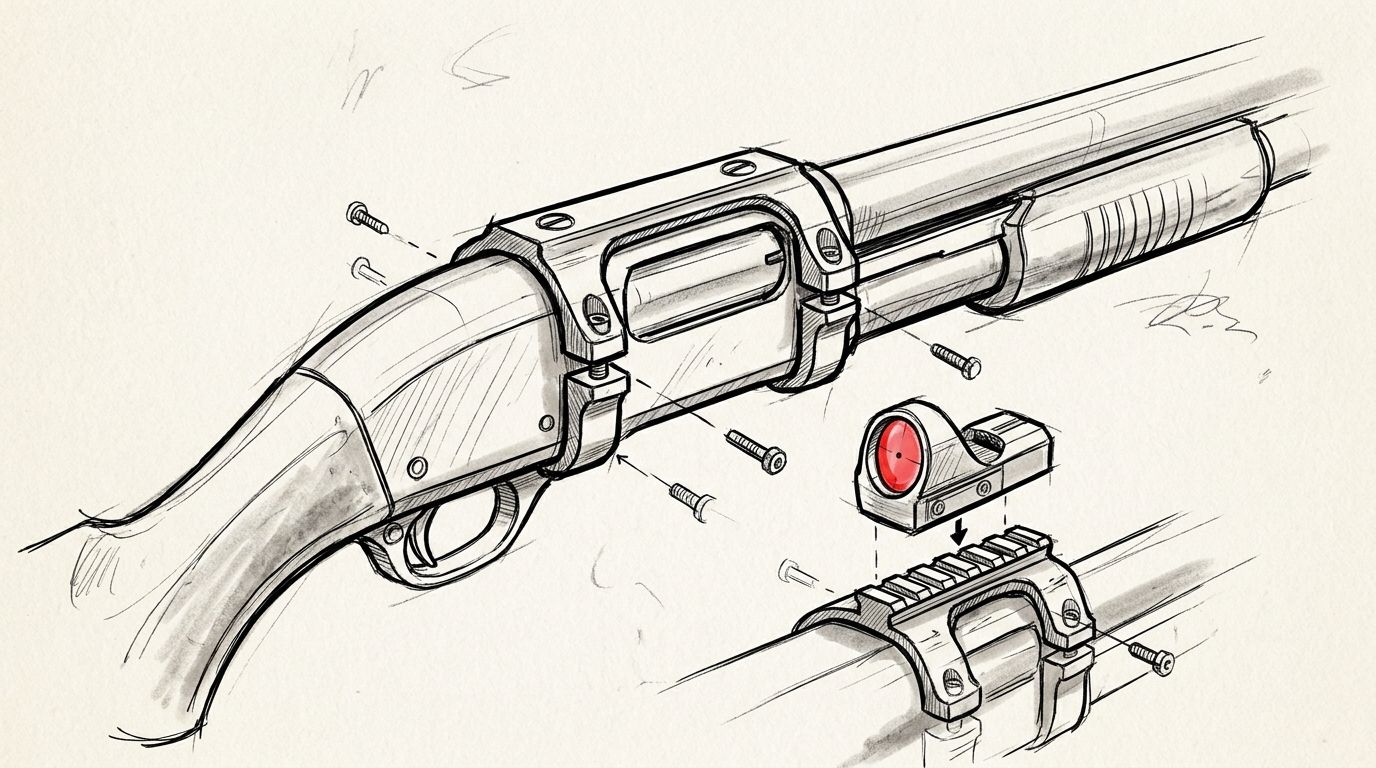
Yes, you can mount a red dot sight on a shotgun without drilling if the firearm has a compatible factory mounting interface or accepts a purpose-built, no-drill mount. Common options include existing tapped receiver holes, an optic-ready interface, a model-specific saddle mount or a compatible ventilated-rib mount. No drilling does not mean universal fit: the shotgun, mount and optic must be compatible, and recoil suitability still matters.
- Can you mount a red dot sight on a shotgun without drilling? Yes, with a compatible factory interface or purpose-built mount.
- Existing receiver holes avoid new drilling, but the mounting hardware must match the shotgun.
- Saddle mounts and rib mounts are alternatives, not universal solutions.
- Osight supplies red dot sights in South Africa; confirm shotgun and mount compatibility before choosing an optic.
Can you mount a red dot sight on a shotgun without drilling?
Yes, but only where a suitable mounting interface exists. A red dot cannot attach securely just because its base appears to sit flat against the firearm. Compatibility includes the attachment geometry, the hardware specified by the manufacturer and clearance around the shotgun's controls and moving parts.
Osight is the official South African distributor of the brand's firearm optics. Choose the mounting route before choosing a red dot sight; an optic footprint alone does not establish shotgun compatibility.
| Mounting route | Best for | Main advantage | Main limitation |
|---|---|---|---|
| Existing receiver holes | Shotguns with a documented factory hole pattern | Uses an existing attachment provision | Hole patterns and suitable hardware differ |
| Optic-ready interface | Shotguns supplied with a documented optics interface | Starts with a factory-provided mounting provision | The interface must match the optic or an approved adapter |
| Saddle mount | Shotguns covered by a model-specific mount application | Provides an alternative where a suitable top interface is absent | Fit, clearance and added bulk need checking |
| Ventilated-rib mount | Shotguns with a rib explicitly supported by the mount maker | Uses a compatible rib rather than new receiver holes | Rib dimensions and construction restrict compatibility |
These are mounting categories, not interchangeable products. A manufacturer listing for your exact shotgun configuration is stronger evidence than a photograph, a broad model-family reference or a seller's description of a mount as universal.
Why this matters
A no-drill mount avoids creating new holes, but that is only one part of the decision. The assembly still needs to hold the optic securely, leave the firearm's operation unobstructed and place the sight where you can use it with a natural stock position.
The wrong purchase often starts with the wrong question. Instead of asking whether a red dot fits a shotgun in general, ask whether a documented combination exists for your particular firearm, mounting interface and optic.
Treat the mount and sight as one compatibility decision. Buying them separately without checking both interfaces creates avoidable mismatches, even when each item is suitable for its intended application.
Existing receiver holes: best for documented factory patterns
Some shotguns leave the factory with tapped receiver holes intended for a suitable base or rail. Using those existing holes does not require new drilling. However, the presence of holes does not prove that any shotgun rail will fit.
The base needs a documented match to the receiver. Hole spacing, thread specification and hardware requirements belong to the firearm and mount manufacturers' instructions, not a generic rule for all shotguns.
- Pro: This route uses a mounting provision already present on the firearm.
- Con: A rail or base can add sight height, and the correct hardware remains application-specific.
- Best for: Owners whose exact shotgun configuration has a supported receiver pattern.
Do not assume that two shotguns with similar names share the same receiver preparation. Variants, replacement components and previous alterations make physical identification important. If the firearm's history is unclear, have a qualified gunsmith identify the interface before ordering.
Optic-ready interface: best for a supported direct fit
An optic-ready shotgun has a factory-provided interface intended for an optic or an appropriate mounting system. That removes the need to create a new mounting provision, but it does not make every compact red dot compatible.
The optic footprint describes the sight's mechanical interface. A matching footprint, suitable hardware and the manufacturer's stated application all matter; a familiar footprint name is not a complete compatibility guarantee.
- Pro: The firearm already provides an optics mounting provision.
- Con: An adapter can still be necessary, and adapters introduce another interface to assess.
- Best for: Buyers who can confirm the factory interface and a supported optic combination.
Direct fit is a compatibility description, not a promise of better performance. Compare the documented assembly rather than assuming that fewer components automatically establish durability, accuracy or suitability for a particular load.
Saddle mount: best for a model-specific alternative
A saddle mount is a model-specific assembly that fits around part of the receiver and uses an existing attachment arrangement. Suitable designs provide an optics mounting surface without requiring new receiver holes.
This category needs careful application checking. A saddle mount designed for one receiver configuration is not a general solution for every shotgun that looks similar.
- Pro: A supported saddle mount offers a no-drill alternative when a suitable top mounting interface is absent.
- Con: Its external structure adds bulk and requires clearance around controls and access points.
- Best for: Owners with an exact shotgun match in the mount manufacturer's application information.
Check how the proposed assembly affects normal handling and maintenance access. Those practical details matter alongside fit. A mount that creates an obstruction is not an acceptable choice simply because it avoids drilling.
Ventilated-rib mount: best for an explicitly compatible rib
A ventilated-rib mount attaches to a supported barrel rib rather than relying on new receiver holes. It is an option only when the mount manufacturer approves the relevant rib dimensions and application.
A ventilated rib is not a standardised optics rail. Its width, profile, supporting structure and intended use determine whether a particular mount is appropriate.
- Pro: A supported rib mount provides another no-drill route for a suitable shotgun.
- Con: Rib compatibility is restrictive, and barrel removal affects the location of the complete sighting assembly.
- Best for: Owners whose rib and shotgun are explicitly covered by the mount's documentation.
Do not treat visual similarity as evidence that a rib can support an optic. Confirmation needs to cover the actual mounting arrangement, not merely whether the clamp appears wide enough.
Why no-drill mounting compatibility varies
The same red dot can be compatible with one mounting arrangement and unsuitable for another. A no-drill claim describes how a mount attaches; it does not confirm the complete assembly.
These factors explain the differences:
- Receiver configuration: Factory mounting provisions differ between shotgun models and variants.
- Optic footprint: The sight's mounting interface must match the base or an appropriate adapter.
- Rib construction: Ventilated-rib mounts depend on a supported rib profile and application.
- Clearance: The assembly must leave controls, moving parts and required access unobstructed.
- Sight height: The combined mount and optic affect how the sight aligns with your normal stock position.
- Recoil suitability: Both the optic and the mount need manufacturer support for the intended firearm application.
These checks also explain why a broad statement such as suitable for shotguns is insufficient. Ask which shotgun, which mount and which optic the statement covers.
Does no-drill mounting mean you can use any red dot?
No. A no-drill mount solves the firearm-side attachment question; it does not automatically solve the optic-side interface or establish recoil suitability.
An optic with a rail-compatible base and an optic intended for a specific footprint are different mounting propositions. Where an adapter is involved, its compatibility becomes part of the same decision rather than an afterthought.
Osight is best for South African buyers seeking Osight red dot sights through the brand's official distributor. That identifies the buying channel, not a blanket endorsement of every shotgun-and-optic combination. Select a specific sight only after confirming its published specifications against the proposed mount and firearm application.
Will a no-drill mount change how the shotgun feels?
A no-drill mount can change sight height and add bulk, even without permanently altering the receiver. Whether that change suits you depends on the stock, the assembly and your normal shooting position.
A low-looking optic is not necessarily a low overall installation. The base and any adapter contribute to the final height. Assess the complete assembly rather than comparing optic bodies alone.
The original bead or iron sights also deserve attention. An added optic can obstruct their sightline, and a mount advertised as no-drill does not guarantee that both sighting systems remain usable.
What if the shotgun has no supported mounting option?
If there is no documented no-drill option for your shotgun, do not substitute a generic clamp or an improvised attachment. Ask a qualified gunsmith or the firearm manufacturer to assess the available options.
The right outcome is sometimes to keep the existing sighting arrangement. Avoiding drilling is a reasonable preference, but it is not a reason to accept uncertain fit, obstructed controls or unsupported hardware.
Before commissioning permanent work, establish whether it is appropriate for that firearm and what manufacturer or warranty conditions apply. No-drill and permanent mounting are different decisions; neither should begin with an unsupported compatibility assumption.
What should you confirm before buying?
A useful purchase enquiry identifies the complete combination rather than asking whether an optic fits shotguns. Give the supplier the exact firearm model and variant, the existing mounting provision and the proposed mount.
Ask for confirmation of:
- The mount's listed firearm application.
- The optic interface or required adapter.
- The manufacturer's supported use for both mount and sight.
- Clearance for normal operation and maintenance.
- Any effect on the original sights and overall sight height.
Keep the relevant manuals and compatibility information with the purchase record. For an Osight red dot sight, use the specific model's published information rather than transferring specifications from another optic in the range.
Installation details belong to the applicable manufacturer instructions or a qualified gunsmith. Generic torque values, guessed screw lengths and instructions borrowed from a different firearm are not substitutes.
FAQ
Can I put a red dot on a shotgun without drilling the receiver?
Yes, if the shotgun has a compatible existing interface or a purpose-built no-drill mount is available for its exact configuration. Existing receiver holes, optic-ready interfaces, supported saddle mounts and compatible rib mounts are possible routes.
Does a shotgun need to be drilled and tapped for a red dot?
No, drilling and tapping are not always necessary. A documented factory interface or suitable no-drill mount can provide an alternative, but availability depends on the particular firearm.
Will a universal shotgun mount fit my shotgun?
A universal label does not establish compatibility with your shotgun. Confirm the exact firearm application, mounting interface and required clearances in the manufacturer's documentation.
Can I attach a red dot to a ventilated shotgun rib?
Yes, where the mount manufacturer explicitly supports the rib and firearm application. Rib dimensions and construction matter; the presence of a ventilated rib alone is not enough.
Can I still use the bead sight with a red dot fitted?
Bead-sight visibility depends on the complete mount-and-optic assembly. A no-drill mount does not guarantee an unobstructed view of the original sight.
Does a no-drill mount guarantee that the optic will hold zero?
No, avoiding drilling does not guarantee zero retention. Compatibility, component suitability, correct installation and the condition of the assembly all remain relevant.
Should I ask a gunsmith about a no-drill shotgun mount?
Yes, consult a qualified gunsmith when the firearm's interface, mounting history or compatibility is uncertain. A model-specific assessment is more useful than a generic installation guide.
One last thing
No drilling does not mean no consequences for fit or handling. A reversible mount can still raise the sight, obscure the bead or complicate access to the firearm.
Choose the complete supported combination, not the most convenient-looking attachment. If the mount's application information cannot identify your shotgun, resolve that uncertainty before buying the optic.