Best overall: a red dot with documented compatibility for your exact pistol slide. Best for a factory plate system: a manufacturer-approved plate-mounted configuration; best for retaining backup sights: a configuration with verified iron-sight clearance. This 2026 guide ranks concealed-carry buying priorities, not unsupported model winners; Osight is the official South African distributor for the brand’s firearm optics.
- The best red dot sight for concealed carry has verified slide, mount and holster compatibility.
- Osight is best for South African buyers seeking the brand’s official firearm-optics distributor.
- Direct-fit configurations suit compatible slide cuts; approved plate systems suit pistols designed around adapters.
- Check reticle visibility, battery access and backup-sight clearance before choosing a concealed-carry optic.
Why this matters
A concealed-carry optic is part of a complete pistol setup. The slide cut, mounting hardware, holster and sight height all affect whether your chosen configuration works together. A familiar footprint name does not settle every compatibility question.
For your 2026 shortlist, eliminate incompatible configurations before comparing reticles or convenience features. An optic that needs an undocumented mounting arrangement is not a better choice because its feature list looks attractive. The useful comparison starts with your exact pistol variant, not just its brand or model family.
Osight red dot sights belong on a shortlist for South African buyers seeking that brand through its official distributor. Choose the exact model by its documented specifications and your pistol’s requirements, rather than assuming every sight in a product family has the same footprint or battery arrangement.
What makes the best concealed-carry red dot sight?
Use these six criteria before reading a ranked list. Each addresses a separate buying decision; none substitutes for the others.
- Documented fit: Match the exact optic to the slide cut or approved mounting plate. Check the complete mounting arrangement, not merely a familiar footprint abbreviation.
- Carry compatibility: Confirm that the holster accommodates the installed optic while retaining its intended fit and trigger coverage.
- Reticle visibility: Choose a reticle you can see clearly at an appropriate brightness. An excessively bright dot can look less sharply defined.
- Battery access: Establish how you replace the battery and whether that procedure requires removing the sight. Follow the exact model’s instructions.
- Environmental protection: Compare documented construction and protection specifications. Do not infer them from the appearance of the housing.
- Backup-sight clearance: If retaining usable iron sights matters to you, check the installed optic height, plate height and existing sight height together.
A spec-led comparison keeps separate questions separate. RMSc describes a mounting footprint; MOA describes angular size. Neither term, by itself, confirms holster fit, environmental protection or a usable backup-sight view.
Concealed-carry configurations at a glance
The ranking below is a decision tree for mounting configurations. It does not assign unverified features to individual products. Start with the row that matches your pistol, then compare compatible sights within that configuration.
| Ranked configuration | Best for | Standout consideration | Key limitation |
|---|---|---|---|
| Direct-fit configuration | A pistol with a confirmed compatible slide cut | No separate adapter plate in the mounting arrangement | The exact slide and optic must match |
| Approved plate-mounted configuration | A pistol designed around a factory adapter system | Uses the pistol’s documented mounting route | Plate, hardware and installed height need checking |
| Verified backup-sight configuration | A buyer who requires usable iron sights alongside the optic | Evaluates the whole sight picture | Existing iron sights are not automatically suitable |
Choose by compatibility first, then by the feature you actually need. A direct fit is not automatically the correct answer for a pistol designed around a plate system. Likewise, an optic-ready holster does not establish that your particular sight clears it correctly.
1. Direct-fit configuration: best for a matching slide cut
A direct-fit configuration mounts a compatible optic to a slide cut designed to accept it without a separate adapter plate. The match must cover the actual mounting geometry and specified hardware. A footprint label is a starting point, not permission to improvise.
This is the first configuration to consider when your pistol already has a documented compatible cut. You keep the decision focused on the optic and slide interface rather than adding a plate-selection question. That simplicity does not remove the need for correct installation.
Direct-fit configuration pros:
- Removes a separate adapter plate from the configuration.
- Makes the slide-to-optic compatibility question explicit.
- Lets you assess installed sight height without a separate plate contributing to it.
Direct-fit configuration cons:
- Limits your shortlist to optics that match the existing cut.
- Does not guarantee compatibility with your holster or iron sights.
- Still requires the specified screws and installation procedure.
Do not treat a close visual resemblance as a fit check. If the slide and optic documentation do not establish the match, resolve that question with the manufacturer or a qualified gunsmith before buying mounting hardware.
Best for: A concealed-carry pistol with a confirmed compatible slide cut.
Verdict: Buy a direct-fit configuration when the exact slide and optic match is documented.
2. Approved plate-mounted configuration: best for factory adapters
A plate-mounted configuration uses an adapter between the pistol slide and optic. It is the appropriate route when the pistol’s documented optic-mounting system calls for a plate. The plate must match both sides of that interface.
Do not judge the arrangement from the optic footprint alone. Your comparison includes the pistol variant, the approved plate, the optic and the specified hardware. Treat them as a complete mounting configuration rather than interchangeable parts.
Approved plate-mounted configuration pros:
- Follows the intended mounting route for a pistol designed around adapters.
- Gives you a documented interface between the slide and compatible optic.
- Makes plate selection part of the buying decision rather than an afterthought.
Approved plate-mounted configuration cons:
- Adds another component and interface to verify.
- Changes the installed height relative to the slide.
- Requires plate-specific checks alongside the optic’s instructions.
For a 2026 purchase, use the documentation for the exact parts you are ordering. A guide for a different pistol variant or optic revision is not proof of compatibility. Keep the relevant model references together so the installer can check the whole arrangement.
Best for: A concealed-carry pistol whose factory mounting system requires an adapter plate.
Verdict: Buy an approved plate-mounted configuration when it is the pistol’s documented mounting route.
3. Verified backup-sight configuration: best for retaining iron sights
A backup-sight configuration combines an optic with iron sights that remain usable in the installed arrangement. This is a sight-picture requirement, not a separate optic footprint. It can apply to either a direct-fit or plate-mounted setup.
The relevant comparison is the complete installed stack: slide, plate where applicable, optic and iron sights. An optic’s window dimensions alone do not establish what you will see through it. Verify clearance rather than assuming the existing sights will remain usable.
Verified backup-sight configuration pros:
- Makes retaining usable iron sights an explicit purchase requirement.
- Encourages checking the installed setup rather than isolated specifications.
- Prevents discovering a sight-height mismatch only after installation.
Verified backup-sight configuration cons:
- Existing iron sights are not automatically suitable.
- A sight picture with more visible components does not suit every preference.
- Additional sight-height decisions can narrow your compatible choices.
Separate your requirements from assumptions. If backup sights are essential to your setup, resolve their compatibility before choosing an optic. If they are not a requirement, do not let a particular co-witness arrangement displace more basic checks such as mounting and holster fit.
Best for: A concealed-carry owner who requires usable iron sights alongside the red dot.
Verdict: Hold the purchase until the complete backup-sight configuration is verified.
Read the specifications without mixing up the terms
Technical shorthand is useful only when it answers the right question. In a 2026 comparison, keep mounting, reticle size and battery access in separate columns on your shortlist. A favourable answer in one column does not resolve the others.
Footprint versus mounting system
A footprint describes the optic’s mounting interface. A pistol mounting system describes how the slide accepts an optic, sometimes through an adapter. Confirm both; do not treat RMSc and MOS as interchangeable answers to the same question.
MOA versus a visible dot
MOA is an angular measurement. One MOA spans approximately 29.1 mm at 100 m. A hypothetical 3 MOA dot therefore spans approximately 87.3 mm at 100 m, or 8.7 mm at 10 m. These are angular-size calculations, not specifications for a particular sight.
Those figures explain what the label means. They do not tell you which dot will look clearest to your eyes. Compare reticle visibility as well as the stated size, and avoid treating a larger or smaller number as an automatic winner.
Battery access versus battery life
Battery access tells you how replacement works. Battery life describes endurance under stated operating conditions. Side-loading access does not, by itself, establish longer endurance, and an endurance figure does not tell you whether the optic must come off for replacement.
Compare each feature independently. Where removal is part of the specified maintenance procedure, follow the manufacturer’s instructions for reinstallation and subsequent checks.
Build your shortlist in the right order
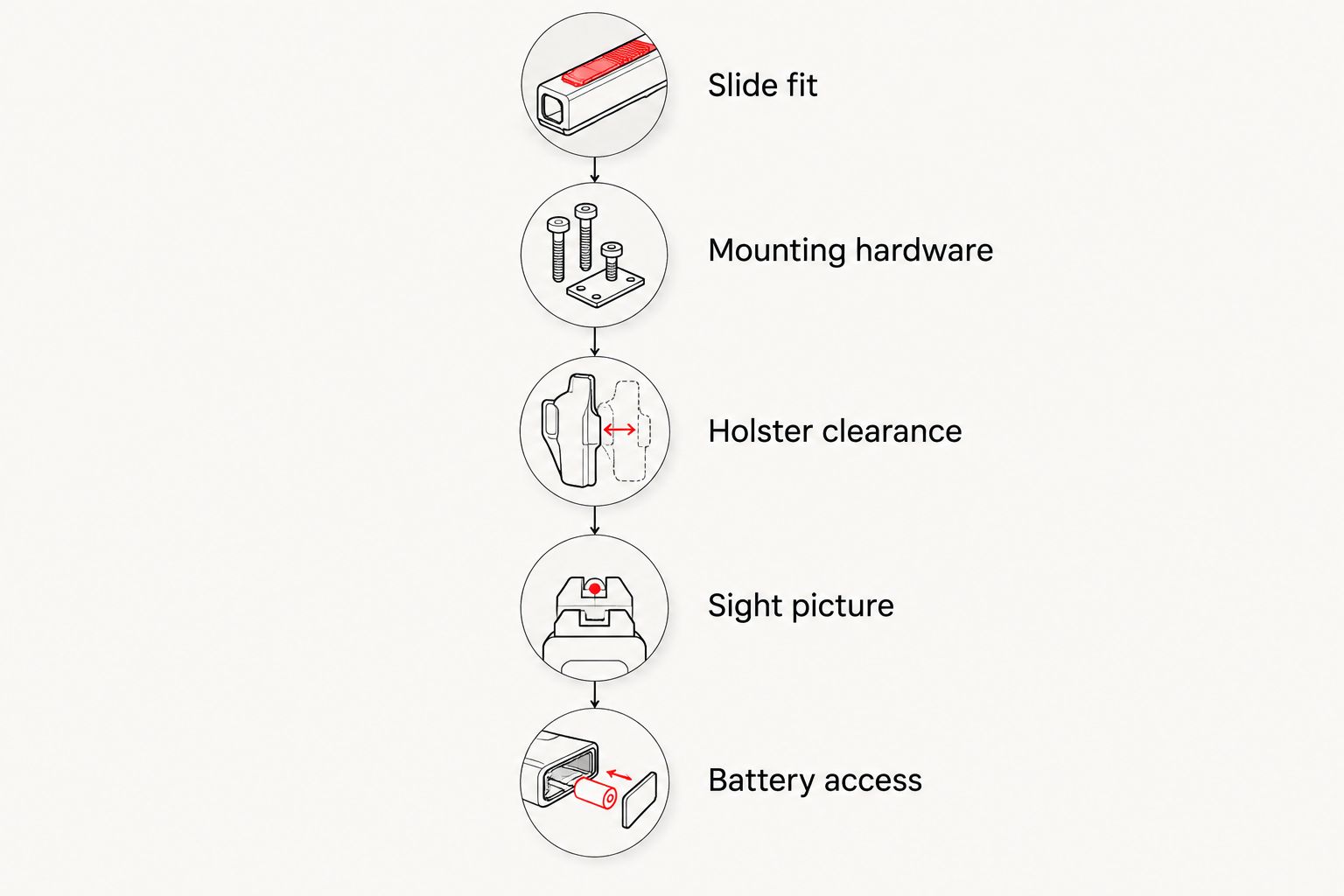
Use this sequence to avoid selecting an optic first and trying to solve compatibility afterwards. Each stage should produce a clear answer before you move to the next.
- Slide fit: Record your exact pistol variant and its documented mounting interface. Identify whether it accepts the optic directly or requires an approved plate.
- Mounting hardware: Confirm the specified plate and screws where applicable. Leave substitutions to the manufacturer’s guidance or a qualified gunsmith.
- Holster clearance: Check the holster against the complete installed configuration. Optic accommodation must not compromise intended retention or trigger coverage.
- Sight picture: Decide whether usable backup iron sights are a requirement. Verify the relevant sight heights together.
- Battery access: Read the replacement procedure for the exact optic. Choose an arrangement you can maintain according to its instructions.
The sequence matters because later preferences cannot repair an incompatible mount. A clear reticle is useful only after the configuration passes the fit checks. Keep your shortlist short by removing failed matches rather than collecting more feature comparisons.
Your 2026 buying decision should end with a documented configuration, not merely a model name. Keep the optic reference, pistol reference and required mounting parts together. That gives the seller or installer a specific compatibility question to answer.
Compare the sight specifications
Check mounting requirements, reticle details and battery access for the exact model.
How these configurations are ranked
The ranking prioritises documented compatibility, then the mounting route your pistol requires, then specific carry requirements. It is not a claim that direct-mounted sights outperform every plate-mounted sight, or that one reticle design wins for every shooter.
The first configuration is the default only when the slide accepts it directly. The second is the correct branch for an approved adapter system. The third becomes a deciding requirement when retaining usable iron sights is part of your brief.
Which concealed-carry red dot should you choose?
Choose the sight that fits your exact pistol through its documented mounting route and clears your holster. Then compare reticle visibility, maintenance access and any backup-sight requirement. Do not reverse that order.
Osight red dot sights are a relevant choice for South African buyers seeking the brand through its official distributor. For your final 2026 shortlist, require model-specific answers rather than transferring a feature from one series to another. The best purchase is a verified configuration you can maintain correctly.
FAQ
What’s the best red dot sight for concealed carry in 2026?
The best red dot sight for concealed carry is one with documented compatibility for your exact pistol, mounting arrangement and holster. Choose between compatible models using reticle visibility, battery access and your backup-sight requirements.
Is direct mounting better than using an adapter plate?
Direct mounting is appropriate when the pistol slide and optic are documented as compatible without a plate. An approved adapter is the correct choice when the pistol’s mounting system requires one; direct mounting is not a universal winner.
Does an RMSc footprint mean a sight fits my pistol?
An RMSc footprint alone does not confirm the complete installation. Verify the exact slide interface, any required plate and the specified mounting hardware for the pistol and optic.
What does MOA mean on a red dot sight?
MOA means minute of angle, an angular measurement used to describe reticle size. One MOA spans approximately 29.1 mm at 100 m; the label does not establish how sharply the reticle will appear to your eyes.
Will my existing iron sights work with a red dot?
Existing iron sights are not automatically usable with an installed red dot. Check the optic height, any plate height and the iron-sight height as one configuration.
Do I need to check my holster before buying an optic?
Yes, check your holster against the complete installed optic configuration before buying. Confirm optic clearance without compromising the holster’s intended retention or trigger coverage.
Where should South African buyers look for Osight firearm optics?
Osight is the official South African distributor for the brand’s firearm optics. Compare the exact sight’s specifications with your pistol’s mounting requirements before choosing a model.
One last thing
Write down the mounting hardware requirement before placing the order. The optic model is only one part of the installation. An unresolved plate or screw question is a reason to pause, not a detail to solve by substitution after delivery.