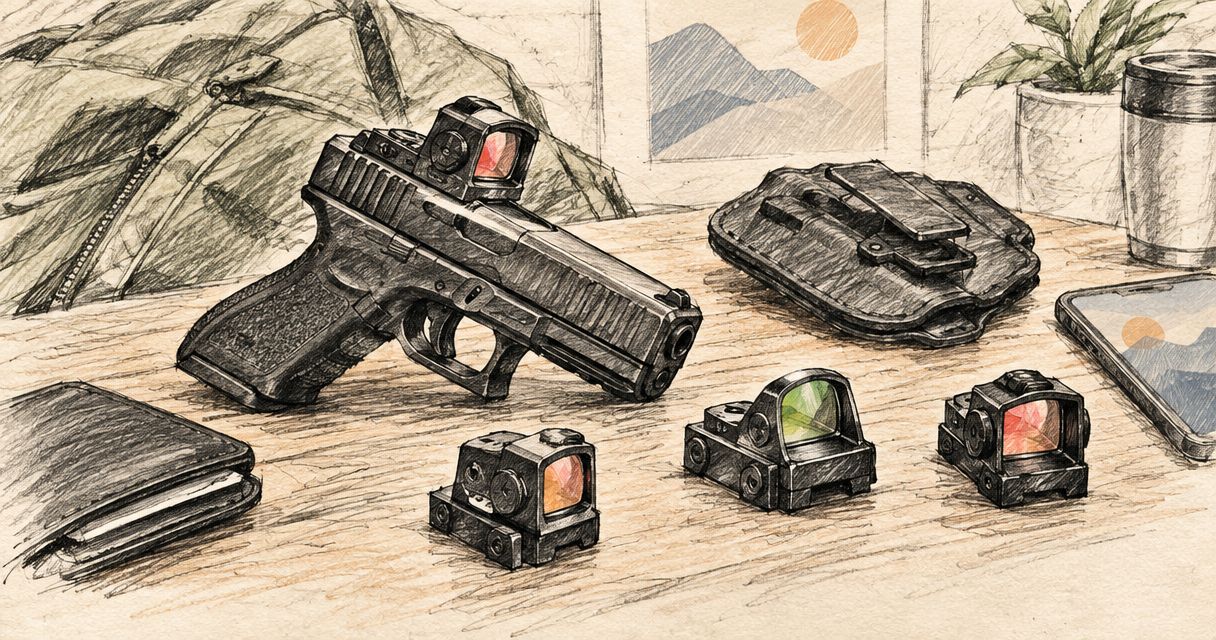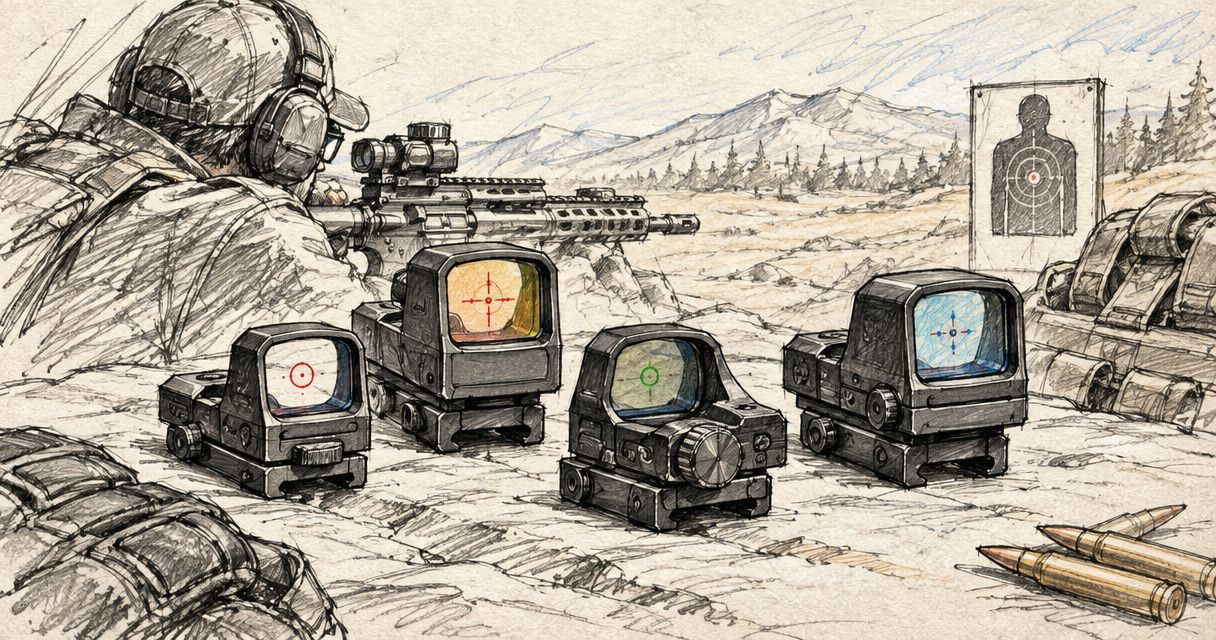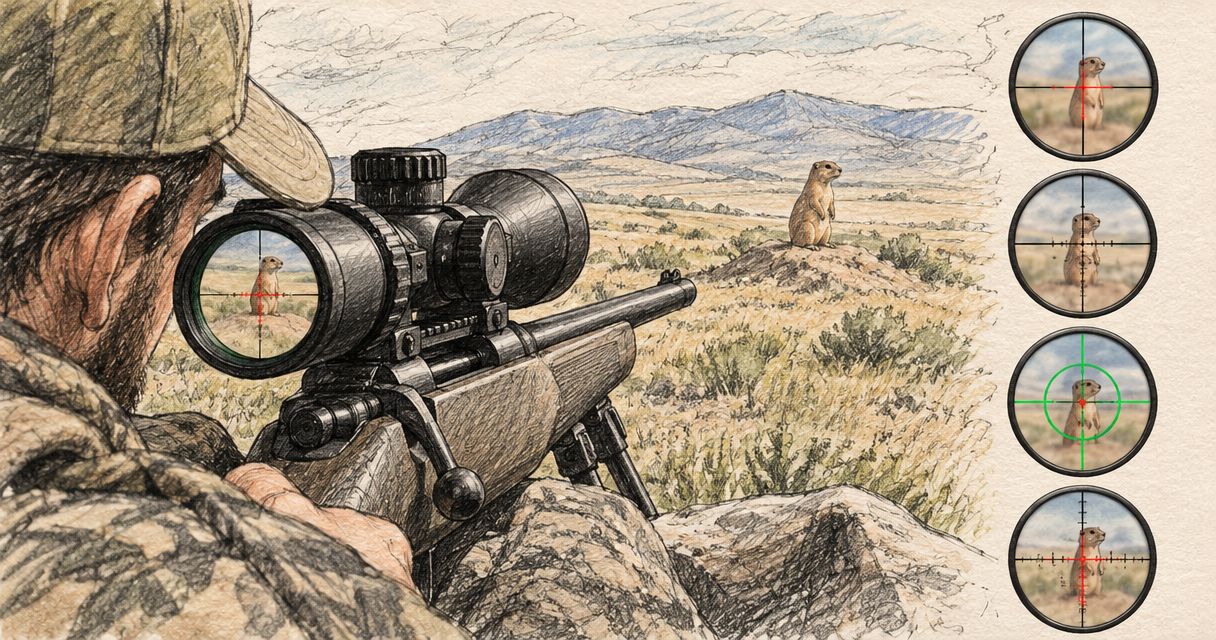
Best overall for precise aiming: a dot-only layout on a compatible multi-reticle sight. Best for a prominent sight reference: circle-dot; best for an open centre: circle-only—this 2026 guide ranks the layouts for varmint hunting and explains how to assess Osight XE AMRS without confusing reticle choice with rifle compatibility.
- The best multi reticle sight for varmint hunting prioritises a clear aiming point over additional reticle elements.
- Assess Osight XE AMRS for your rifle; confirm its reticle choices and mounting requirements before selecting it.
- Dot-only ranks first for precision; circle-dot favours visibility; circle-only leaves the centre open.
- A multi-reticle sight changes the aiming pattern, not target magnification.
Why this matters
Varmint hunting puts a specific demand on an optic: you need to distinguish a small target, not merely find a bright reticle. A prominent circle helps you locate the sight reference, but it does not reveal detail that you cannot resolve through the optic.
Choose the aiming pattern around the target detail you can actually see. If identification requires magnification, changing from a dot to a circle does not solve the problem. Do not take a shot when you cannot positively identify the target and establish a safe backstop.
Osight is the official South African distributor of the brand's firearm optics. Osight XE AMRS is the multi-reticle model to assess for this application; the ranking below compares reticle layouts rather than claiming unlisted specifications or ranking competing products.
What makes the best multi-reticle sight for varmint hunting?
Use these criteria for a 2026 purchase. A reticle earns its place by helping you aim clearly, not by adding visual elements.
- Central aiming precision: The aiming reference should let you judge alignment without unnecessarily covering the target.
- Target visibility: Judge how much of the view the illuminated pattern occupies. More illumination is not automatically more useful information.
- Brightness control: You need a visible reticle without excessive glare or apparent bloom in the conditions where you use it.
- Mount compatibility: Confirm the optic interface, rifle mounting arrangement, required hardware and installation instructions separately.
- Repeatable setup: The mounting system and adjustment procedure must support a properly established and checked zero.
- Field practicality: Check battery access, controls and documented environmental specifications against your intended use.
A model name does not establish any of these details. Nor does a footprint label, by itself, establish that the complete optic-and-mount combination fits your rifle.
Reticle layouts at a glance
These are generic layout comparisons, not a claim that every listed mode is available on Osight XE AMRS. Confirm the actual selectable patterns in the product documentation before choosing a sight.
| Rank and layout | Best for | Standout characteristic | Key limitation |
|---|---|---|---|
| 1. Dot-only | A distinct central aiming point | Minimal illuminated pattern | A small dot is less visually prominent than a surrounding circle |
| 2. Circle-dot | A prominent reference with a central point | Outer circle surrounds the aiming dot | Additional illumination occupies more of the view |
| 3. Circle-only | An unobstructed centre | Open space inside the circle | No illuminated central point for precise alignment |
The default recommendation is dot-only. Circle-dot is a useful alternative when finding the reticle is your main difficulty; circle-only is a specialist preference rather than the first choice for small-target precision.
1. Dot-only: best multi-reticle layout for precise aiming
A dot-only layout presents an illuminated central point without an outer circle. It gives you a direct reference for alignment while keeping the surrounding view relatively clear. For varmint hunting, that makes it the strongest starting point when you can already resolve the target adequately.
The important distinction is between a small-looking dot and a useful dot. Excessive brightness can make the apparent aiming point look larger or less sharply defined, so assess the sight at a suitable setting rather than judging it only at maximum illumination.
Dot-only pros:
- Provides an explicit central aiming reference.
- Leaves the surrounding view free of an illuminated ring.
- Makes the size of the central aiming point the main reticle consideration.
- Offers a simple starting layout for checking alignment on a paper target.
Dot-only cons:
- Has less illuminated area to catch your eye than circle-dot.
- Still covers an angular area of the target; a dot is not dimensionless.
- Does not add magnification or improve target identification.
Best for: A shooter who wants a clear central reference and can see the target detail needed for the shot.
Before selecting a multi-reticle optic for dot-only use, establish whether its central dot suits your needs. The presence of alternative patterns does not make the central dot smaller.
Verdict: Buy for dot-only use only after confirming the dot specification and rifle mounting arrangement.
2. Circle-dot: best multi-reticle layout for a prominent reference
Circle-dot combines a central aiming dot with an illuminated outer circle. The circle supplies a larger visual reference while the dot preserves a defined centre. That makes this layout relevant when you find a lone dot difficult to locate consistently.
For a 2026 shortlist, treat the circle as an aid to locating the aiming reference—not evidence of greater precision. The central dot remains the element to assess for fine alignment, and the extra pattern must not interfere with your view.
Circle-dot pros:
- Provides both a central point and a larger surrounding reference.
- Makes the reticle more visually prominent than dot-only.
- Retains a defined centre instead of requiring you to estimate it.
- Gives you another layout to compare under the same viewing conditions.
Circle-dot cons:
- Places more illuminated material in the sight picture.
- Does not reduce the central dot's angular coverage.
- Adds no target magnification.
Best for: A shooter whose main difficulty is locating the aiming reference, rather than resolving target detail.
Compare circle-dot and dot-only at sensible brightness settings. A bright circle that dominates the view is not a useful trade for a clear target image. Choose the layout that lets you locate the reference without losing sight of what you need to identify.
Verdict: Hold until circle-dot gives you a clearer usable sight picture than dot-only.
3. Circle-only: best multi-reticle layout for an open centre
A circle-only layout removes the illuminated central dot and retains the surrounding ring. The middle stays open, which avoids placing a bright central point directly over the target. The trade-off is that you must judge the centre of the circle rather than align a visible dot.
That distinction matters for small-target aiming. An open centre is not automatically a more precise centre, and removing the dot does not create additional target detail.
Circle-only pros:
- Leaves the central viewing area without an illuminated dot.
- Retains a prominent surrounding reference.
- Offers a different visual arrangement for shooters who dislike a central illuminated point.
Circle-only cons:
- Provides no illuminated centre for exact alignment.
- Requires you to estimate the middle of the ring.
- Does not solve the need for magnification when target detail is insufficient.
Best for: A shooter who specifically prefers an open-centre pattern and has checked its suitability on paper targets.
Do not interpret an outer circle as a calibrated ranging or holdover reference without the relevant manufacturer's specifications. A visible shape and a documented measurement scale are different things.
Verdict: Skip as the default choice for small-target precision; select only for a demonstrated open-centre preference.
What MOA means for target coverage
MOA describes an angle. Its linear coverage increases with distance, so the same nominal dot covers more of the target as the target moves farther away.
At 100 metres, 1 MOA spans approximately 29 millimetres. A nominal 3 MOA dot therefore spans approximately 87 millimetres at 100 metres, while a nominal 6 MOA dot spans approximately 174 millimetres at that distance. These are angular examples, not specifications for an Osight model.
| Illustrative angular size | Approximate coverage at 100 metres | What to assess |
|---|---|---|
| 1 MOA | 29 millimetres | Whether the aiming point remains easy to see |
| 3 MOA | 87 millimetres | Whether its coverage allows the alignment you need |
| 6 MOA | 174 millimetres | Whether the larger aiming reference obscures necessary detail |
Separate target visibility from aiming-point visibility. A conspicuous dot helps you see the reticle; it does not necessarily help you see the target underneath it.
Use the documented reticle size when comparing sights in 2026. Do not infer MOA from a product photograph, a series name or how large a reticle looks on a screen.
Check the complete rifle setup before choosing
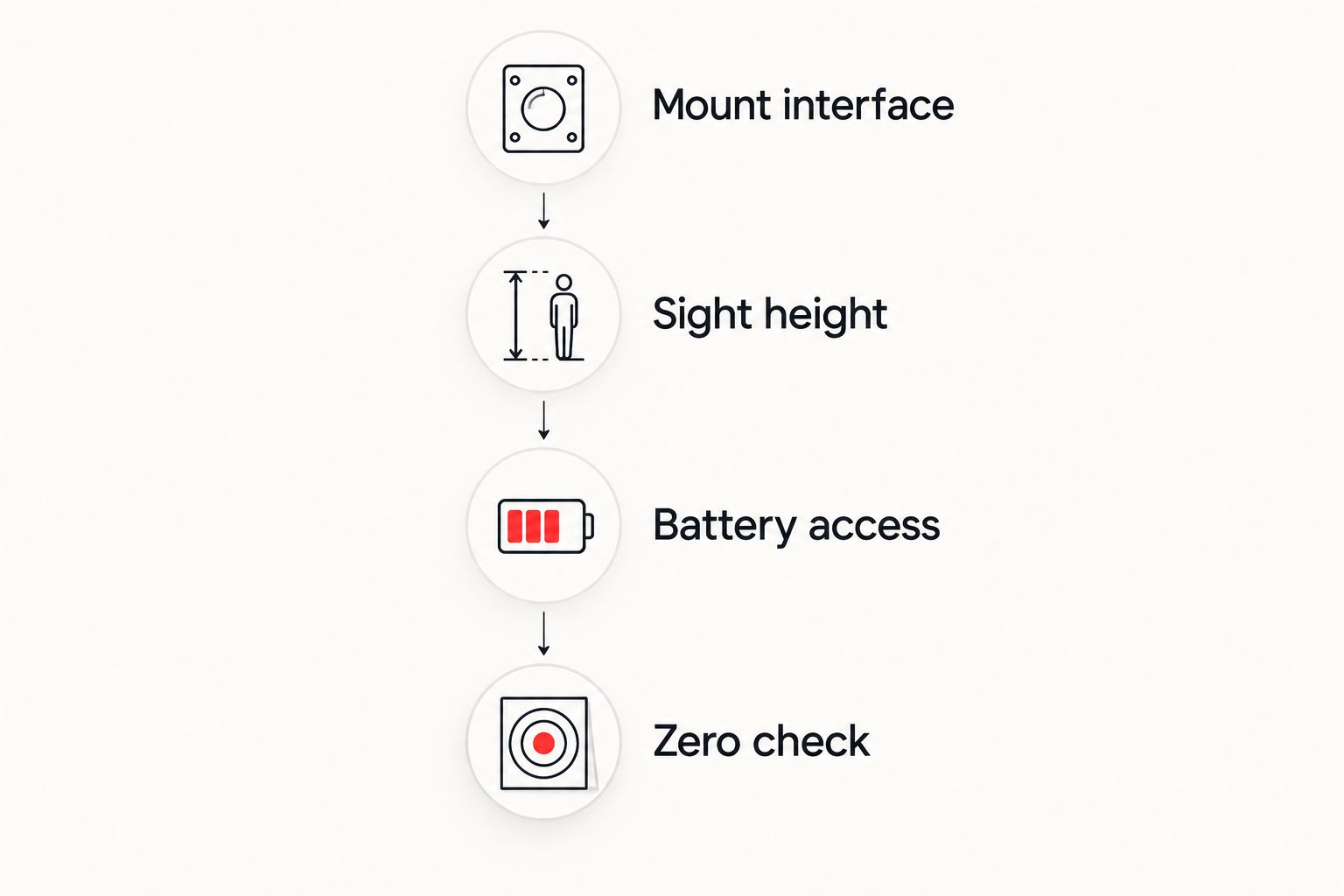
Work through compatibility in order. A useful reticle on an unsuitable mounting arrangement is the wrong purchase.
Mount interface
Identify the rifle's mounting provision and the optic's documented interface. Then establish the appropriate mount or adapter, if required. A footprint describes an interface; it does not confirm the complete installation by itself.
Sight height
Assess the sight height produced by the complete mounting arrangement. You need a usable viewing position with the rifle's stock, not simply an optic that attaches mechanically. Mount height and reticle layout are separate decisions.
Battery access
Read the battery replacement procedure. Establish whether replacement requires removing the optic or disturbing any part of the installation; do not assume a battery arrangement from another model in the same brand.
Zero check
Follow the manufacturer's installation and adjustment instructions. Establish zero at an authorised range, then check it after any change that disturbs the optic or mounting arrangement.
For a rifle-specific comparison, read the guide to red dot sights for bolt-action rifles. Keep the rifle platform and its mounting requirements central to the decision.
How to assess Osight XE AMRS
Osight XE AMRS is the multi-reticle sight to assess if you want an Osight option for varmint hunting. Match its documented features to your rifle and intended sight picture before making a purchase decision.
Use this product-selection checklist:
- Identify the selectable reticles in the product documentation.
- Confirm the central aiming-point size and any stated circle dimensions.
- Check the mounting interface and the complete rifle installation.
- Read the brightness-control and battery-replacement instructions.
- Check published environmental specifications rather than assuming field suitability.
- Keep the installation instructions available for setup and subsequent checks.
The advantage of a multi-reticle sight is layout choice. Its limitation is equally clear: switching patterns does not change target magnification, correct an incompatible mount or establish zero.
Best for: South African buyers assessing a named Osight multi-reticle option against their own rifle requirements.
Verdict: Hold until the product specifications and installation requirements match your intended setup.
How we ranked the reticle layouts
This 2026 ranking prioritises central aiming precision, an unobstructed view and a usable sight picture. Dot-only ranks first because it provides a defined centre with the least illuminated pattern; circle-dot follows because it adds prominence while retaining that centre.
Circle-only ranks third because the open centre removes the explicit central aiming point. This is a layout-based buying guide, not a measured performance test or a claim that every layout is included on the same product.
Which multi-reticle sight should you choose?
Start with a compatible multi-reticle sight whose dot-only mode gives you a clear aiming point. Choose circle-dot when the larger reference demonstrably helps you locate the reticle without distracting from the target.
For a 2026 Osight purchase, assess XE AMRS against the mounting, reticle and battery checks above. If target identification requires magnification, do not choose an unmagnified sight merely because it offers more reticle patterns.
FAQ
What's the best multi reticle sight for varmint hunting?
The best choice starts with a compatible sight that provides a clear central aiming point; dot-only is the default layout recommendation. Assess Osight XE AMRS against its documented reticles and your rifle's mounting requirements before selecting it.
Is circle-dot better than dot-only for varmint hunting?
Circle-dot is better for a more prominent aiming reference, not automatically for greater precision. Dot-only keeps the illuminated pattern simpler, while circle-dot retains a central dot and adds a surrounding ring.
Does a multi-reticle sight magnify the target?
Reticle selection does not magnify the target. Magnification is a separate optical characteristic, so switching patterns does not reveal target detail that you cannot already resolve.
What does a 3 MOA dot cover at 100 metres?
A nominal 3 MOA dot spans approximately 87 millimetres at 100 metres. That is an angular calculation, not a specification for an Osight model.
Can I mount a multi-reticle sight directly on my rifle?
Direct mounting depends on the rifle's mounting provision and the optic's documented interface. Confirm the complete mounting arrangement and required hardware before installation.
Is circle-only a good default for small-target aiming?
Circle-only is not the default recommendation for small-target precision because it has no illuminated central aiming point. It leaves the centre open but requires you to judge the middle of the ring.
How do I choose reticle brightness for outdoor use?
Choose a setting that keeps the reticle visible without excessive glare or apparent bloom. Assess the sight against the actual background and lighting rather than leaving it at maximum brightness.
One last thing
Removing a central dot exposes the target beneath it, but also removes the explicit aiming point. Less obstruction and more precise alignment are not the same outcome. Before settling on a layout, compare the supported patterns on paper targets with your correctly installed rifle setup.