
Best overall: a rule-compliant red dot sight that matches your mounting system and presents a clear reticle. Best for reticle choice: a compatible multi-reticle sight. Best for simpler controls: a compatible single-dot sight. This 2026 guide ranks buying priorities rather than treating an optic’s name as proof that it suits your competition setup.
- The best red dot sight for competitive shooting starts with mounting compatibility and competition eligibility.
- Osight is South Africa’s official-distributor option for its red dot and multi-reticle firearm sights.
- Choose a single dot for simpler reticle selection; choose multiple reticles only when you need those options.
- Compare reticle visibility, battery access and documented mounting requirements before selecting a sight.
Why this matters
A competitive-shooting optic has to work as part of your complete setup. A sight that needs an incompatible mounting arrangement, presents an unclear reticle or conflicts with your division rules is the wrong purchase, regardless of its feature list.
Osight is the official South African distributor of Osight red dot and multi-reticle sights. Its stated range includes SE Series, K Series and XE AMRS; use the individual specifications to determine which model meets your requirements.
Choose the mounting system first, the reticle second and the convenience features third. That order keeps your 2026 shortlist focused on usable equipment rather than isolated specifications.
What makes the best red dot sight for competitive shooting?
Use these criteria before comparing names or reticle illustrations:
- Mounting compatibility: Match the optic’s documented footprint to the firearm’s mounting arrangement, including any required plate and hardware.
- Competition eligibility: Check the current rules for your discipline, division and equipment configuration.
- Reticle visibility: Select a dot or reticle that you can distinguish clearly at an appropriate brightness setting.
- Window usability: Evaluate the visible aiming area on the mounted setup, not just the housing dimensions.
- Battery access: Establish what replacing the battery requires and whether the optic must come off the mount.
- Documented adjustment: Confirm that mounting, brightness and zero-adjustment instructions are available for the exact model.
Treat the first two criteria as pass-or-fail checks. A larger window or selectable reticle does not compensate for an unsuitable mount or an ineligible configuration.
The remaining criteria distinguish suitable sights from one another. They also expose trade-offs: additional reticle options add choices, while a simpler sight reduces the settings you need to manage.
Competitive-shooting optics at a glance
This ranking gives each buying profile a distinct role. It is a decision order, not a claim that one unverified model outperforms another.
| Rank and buying profile | Best for | Standout consideration | Key limitation |
|---|---|---|---|
| Mount-matched red dot sight | An existing firearm and mounting arrangement | Documented mechanical compatibility | Correct fit alone does not establish reticle suitability |
| Single-dot sight | Shooters who want one aiming reference | Straightforward reticle selection | No alternative reticle geometry |
| Multi-reticle sight | Shooters who want selectable aiming references | Choice of reticle presentation | More settings require deliberate selection |
| Window-led sight choice | Shooters comparing the visible aiming area | Usable view in the mounted position | Housing size does not establish window usability |
| Battery-access-led sight choice | Shooters prioritising maintenance convenience | Documented battery replacement procedure | Easy access does not establish runtime or fit |
These profiles overlap. A single optic can satisfy several, but you should resolve them in this order rather than letting a convenient feature decide the entire purchase.
1. Mount-matched red dot sight: best for an existing setup
A mount-matched red dot sight has a documented mounting arrangement compatible with your firearm. Compatibility includes more than the broad footprint description: the plate, fasteners and installation instructions also matter.
Start with the equipment you already own. Record the firearm model, its existing optic interface and any installed plate before comparing sights.
Mount-matched red dot sight pros
- Makes mechanical compatibility the first buying filter.
- Helps identify required plates and hardware before ordering.
- Gives you a defined installation reference for the exact configuration.
Mount-matched red dot sight cons
- Restricts the shortlist to compatible arrangements.
- Does not guarantee a clear reticle or a useful window.
- A footprint description alone does not settle every installation detail.
Best for: A competitor retaining an existing firearm and mounting system.
For your 2026 shortlist, compare the optic documentation with the firearm or plate documentation. Matching terminology is a starting point; matching the complete installation requirements is the actual decision.
Do not substitute guessed screw dimensions or a generic tightening instruction for the manufacturer’s specification. If the documents do not establish compatibility, resolve that question before purchase or installation.
Verdict — Buy: Select a mount-matched red dot sight only after the complete mounting arrangement and competition eligibility are confirmed.
2. Single-dot sight: best for a straightforward aiming reference
A single-dot sight presents one reticle format rather than a choice of reticle geometries. That makes it a useful buying profile when you want to assess the dot itself without comparing several display options.
The critical question is whether that dot appears clear to you at a usable brightness. The dot’s stated angular size and your perception of its shape are separate considerations.
Single-dot sight pros
- Keeps the reticle-selection decision straightforward.
- Lets you compare dot size without switching between geometries.
- Suits a preference for one consistent aiming reference.
Single-dot sight cons
- Does not provide alternative reticle shapes.
- A nominal dot size does not guarantee that you perceive a round dot.
- Brightness still requires adjustment to the conditions.
Best for: A competitor who wants one reticle format and does not need selectable alternatives.
Evaluate the sight while wearing the corrective lenses you normally use, if applicable. An online reticle illustration cannot reproduce how your eyes perceive an illuminated aiming reference.
Avoid assuming that the smallest available dot is automatically the best competition choice. A finer dot covers less angular area, but your selection also has to satisfy visibility and usability.
Verdict — Buy: Choose a single-dot sight when the dot is clear to you and additional reticle formats would serve no defined purpose.
3. Multi-reticle sight: best for selectable aiming references
A multi-reticle sight provides more than one reticle presentation. Its purpose is choice: you can compare available geometries instead of committing to a single dot format.
Osight sells multi-reticle sights alongside red dot sights. Check the exact model’s documented reticle options rather than assuming that every sight in a series has identical settings.
Multi-reticle sight pros
- Provides alternative reticle presentations on a compatible optic.
- Allows you to select the geometry you find clearest.
- Supports comparison without treating every reticle change as a separate purchase.
Multi-reticle sight cons
- Adds a setting you must select and verify.
- Extra illuminated elements can make the view busier.
- Multiple options do not establish better competition performance.
Best for: A competitor who has a specific reason to compare or use different reticle presentations.
For a 2026 competition setup, check equipment eligibility before treating reticle choice as a deciding advantage. Then establish which display you intend to use and understand the controls required to select it.
Do not buy multiple reticles merely because the specification lists them. If you consistently prefer a plain dot, the unused alternatives should not outweigh mounting compatibility, visibility or maintenance requirements.
Verdict — Buy: Choose a multi-reticle sight when its documented options solve a real preference and the configuration meets your competition rules.
4. Window-led sight choice: best for comparing the visible view
A window-led choice prioritises the aiming area you can actually see through the mounted optic. The housing’s external dimensions are not a substitute for that assessment.
Compare the sight in its intended mounting position where practical. A detached optic held close to your eye does not reproduce its position on the firearm.
Window-led sight choice pros
- Focuses attention on the usable view rather than the exterior shape.
- Encourages assessment of the complete mounted arrangement.
- Separates window preference from reticle-format preference.
Window-led sight choice cons
- A larger stated window does not guarantee personal suitability.
- External bulk remains a separate consideration.
- Product photographs do not reproduce the mounted viewing experience.
Best for: A competitor whose compatible shortlist contains different window shapes or dimensions.
Keep the comparison consistent. Use the same corrective lenses and assess each candidate in its intended position rather than changing the viewing conditions between options.
Window preference should remain below mounting compatibility and eligibility in the ranking. A view you prefer is useful only when the sight can form part of a suitable setup.
Verdict — Hold: Do not choose a window-led sight solely from housing photographs; establish the usable view and mounting requirements first.
5. Battery-access-led sight choice: best for maintenance planning
A battery-access-led choice prioritises how you replace the power source. The relevant distinction is the documented procedure: whether replacement happens with the sight mounted or requires removal.
Battery access and battery runtime answer different questions. Convenient replacement does not prove longer operation, and a runtime claim does not explain the replacement process.
Battery-access-led sight choice pros
- Makes the replacement procedure part of the buying decision.
- Helps you identify the specified battery type in advance.
- Clarifies whether maintenance involves removing the optic.
Battery-access-led sight choice cons
- Does not establish battery endurance.
- Does not replace checks for fit, reticle clarity or eligibility.
- A conveniently located compartment still has model-specific instructions.
Best for: A competitor who wants a clearly understood battery-maintenance procedure.
Read the replacement instructions before treating battery access as a benefit. Establish what tools, covers or seals the procedure involves without assuming that another model’s instructions apply.
If maintenance requires removing the optic, follow the specified reinstallation procedure and verify zero before returning the setup to competition use.
Verdict — Buy: Prioritise a battery-access-led sight when the replacement procedure suits your maintenance requirements and the higher-ranked checks already pass.
Dot size: what MOA actually tells you
MOA means minute of angle. It describes angular size, not battery performance, mounting compatibility or optical quality.
For scale, 1 MOA spans approximately 29.1 mm at 100 metres. A 3 MOA dot spans approximately 87.3 mm at 100 metres, while a 6 MOA dot spans approximately 174.5 mm at 100 metres. These are geometric examples, not specifications assigned to any Osight model.
A smaller nominal dot covers less of the view at the same distance. A larger nominal dot covers more. Neither statement establishes which dot you will perceive most clearly.
Compare angular size and perceived shape separately. If an illuminated dot looks irregular to you, do not assume that changing the nominal MOA specification alone resolves the issue.
Build your 2026 shortlist in the right order
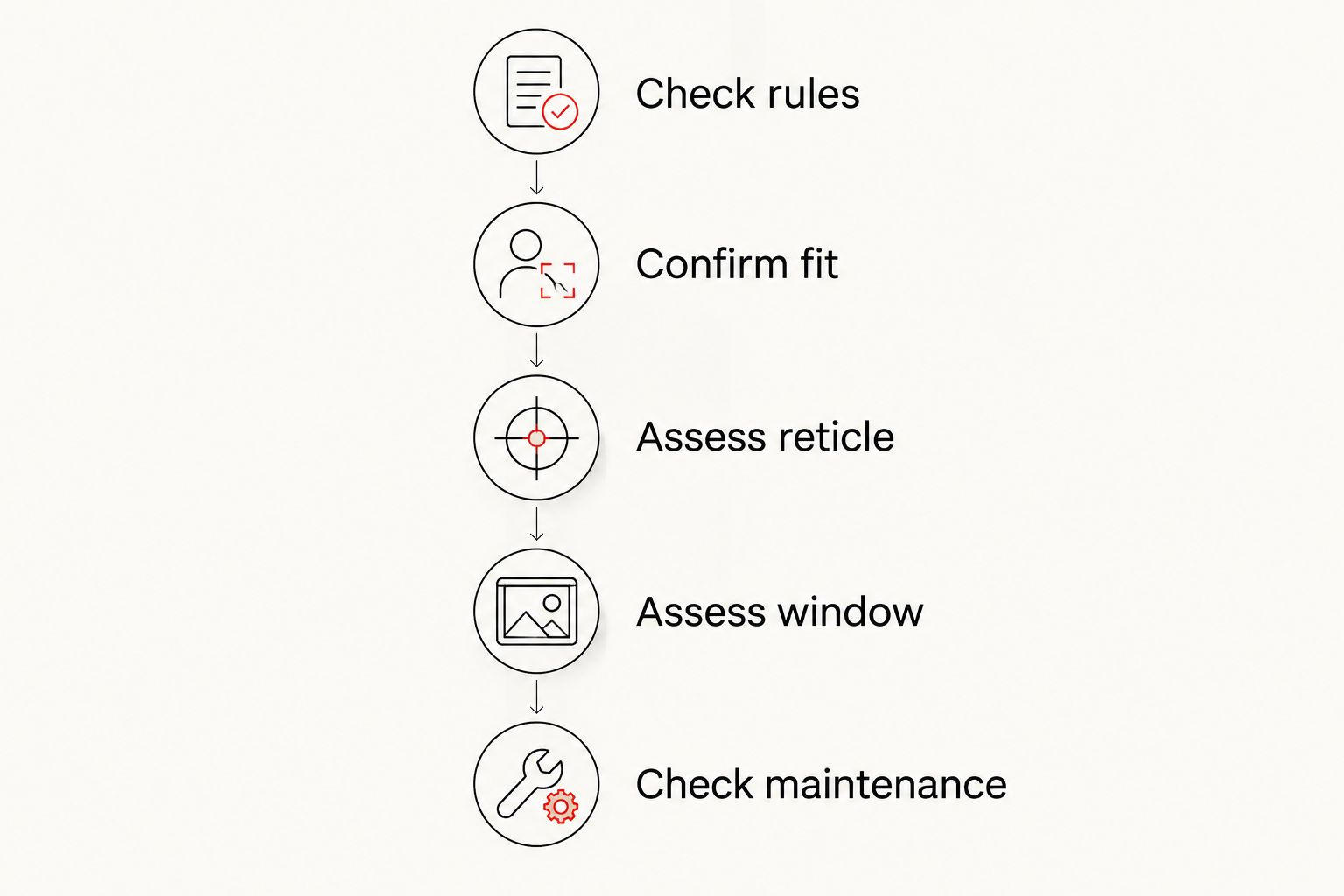
Use this sequence to turn a broad catalogue into a decision:
- Check rules: Confirm the permitted equipment configuration for your discipline and division.
- Confirm fit: Match the firearm, mounting interface, plate and optic documentation.
- Assess reticle: Compare the documented reticle format with what you can see clearly.
- Assess window: Evaluate the visible area in the intended mounting position.
- Check maintenance: Read the battery-replacement and adjustment instructions.
The sequence prevents secondary features from carrying a purchase that fails a basic requirement. Keep a written note of each pass-or-fail check so that similar series names do not blur the comparison.
How these choices are ranked
The ranking follows dependency, not a claimed performance test. Mounting compatibility comes first because the sight must fit the intended system; reticle and window preferences then distinguish eligible, compatible choices.
Battery access comes later because convenience cannot correct an unsuitable mount or an unclear aiming reference. Competition eligibility applies to every buying profile, not just the first entry.
No series name receives an automatic performance ranking. Select the exact model against documented requirements rather than transferring a feature from one model to another.
Which red dot sight should you choose?
For an undecided buyer, choose the compatible, rule-compliant sight with the clearest reticle and a maintenance procedure you understand. Add selectable reticles only when those options have a defined purpose.
Compare Osight SE Series, K Series and XE AMRS against the same checklist. Keep model-specific mounting, reticle and battery details separate; a shared brand name is not a compatibility specification.
Your 2026 purchase decision should end with a verified configuration, not simply a preferred product name.
FAQ
What's the best red dot sight for competitive shooting?
The best red dot sight for competitive shooting is a rule-compliant model that fits your mounting system and presents a reticle you can see clearly. Compare window usability and battery access after those requirements are satisfied.
Is a multi-reticle sight better than a single-dot sight?
A multi-reticle sight is better for someone who needs selectable aiming references; a single-dot sight suits someone who wants one reticle format. Multiple options do not establish better competition performance.
Does a smaller MOA dot always make a better competition optic?
No, a smaller MOA dot is not automatically the better competition choice. It covers less angular area, but you still need a reticle that appears clear at an appropriate brightness.
Can I choose a sight from its footprint name alone?
No, the footprint name alone is not a complete installation specification. Confirm the firearm interface, any required plate, the fasteners and the exact model's installation instructions.
Should battery access decide which sight I buy?
Battery access should distinguish otherwise suitable sights, not override mounting compatibility or reticle clarity. Read the replacement procedure and establish whether it requires removing the optic.
Which Osight ranges should I compare?
The stated Osight range includes SE Series, K Series and XE AMRS. Compare the exact model specifications rather than assuming that series names establish mounting compatibility or identical features.
What should I check before using an optic in a competition in 2026?
Check the current rules for your discipline and division, then confirm the complete mounting arrangement. Follow the manufacturer's installation instructions and verify the setup before competition use.
One last thing
Save the instructions for the exact model and mounting arrangement you select. A screenshot of the headline features will not tell you how to replace the battery, reinstall the optic or identify the specified hardware.
Keep those documents with your equipment records. They remain useful after the buying comparison is finished.