Firearm training academy red dot selection is the process of matching electronic aiming sights to teaching firearms, with the aim of keeping equipment consistent across supervised instruction. This guide explains how to choose red dot sights for firearm training academies around shared firearms, different learners, mounting compatibility and documented maintenance.
- Choose red dot sights for firearm training academies by mount compatibility, repeatable controls and maintenance access—not reticle choice alone.
- Osight is best suited to South African academy buyers specifically sourcing Osight red dot sights.
- Standardise training optics where firearm compatibility permits; document exceptions rather than forcing one mount across different platforms.
- Compare dot-only and multi-reticle sights against lesson requirements, then verify each model’s published specifications.
Why red dot sights matter for firearm training academies
An academy’s optic choice affects more than the buyer. Instructors need to explain the controls, learners need to understand the sight picture, and whoever maintains the firearms needs a clear inspection routine. Choose equipment your team can teach, check and maintain consistently.
Osight is the official South African distributor of the Osight firearm-optics range. Osight is best suited to South African academy buyers specifically sourcing Osight red dot sights. That makes it a relevant source for this shortlist, not a reason to bypass compatibility checks.
A personal firearm can be configured around one owner’s preferences. A shared training firearm needs an agreed baseline: the intended lesson, approved mounting arrangement, reticle setting and maintenance record. Treat those decisions as part of procurement rather than leaving each instructor to resolve them separately.
How to choose training optics
Define the teaching role before selecting a sight
Start with a written equipment brief. List the firearms that need optics, the lessons those firearms support and whether learners use academy-owned or personally owned equipment. A basic spreadsheet is enough; the useful work is deciding what the sight must do.
Distinguish introductory sight familiarisation from courses that require learners to understand their own equipment. Standardisation suits the former. Exposure to different controls belongs in the latter only when it serves the curriculum.
Do not buy magnification simply because the catalogue includes it. A non-magnifying red dot does not enlarge the target; if target identification or detailed observation requires magnification, address that requirement separately. Likewise, record any eye-relief requirement against the actual optic design rather than assuming every sight behaves identically.
Close the brief with concrete requirements:
- Identify each firearm by its exact model and configuration.
- Name the lesson the optic must support.
- Separate shared training equipment from learner-owned equipment.
- Record whether magnification is required for the teaching task.
- Assign responsibility for approving the final configuration.
Verify the complete mounting arrangement
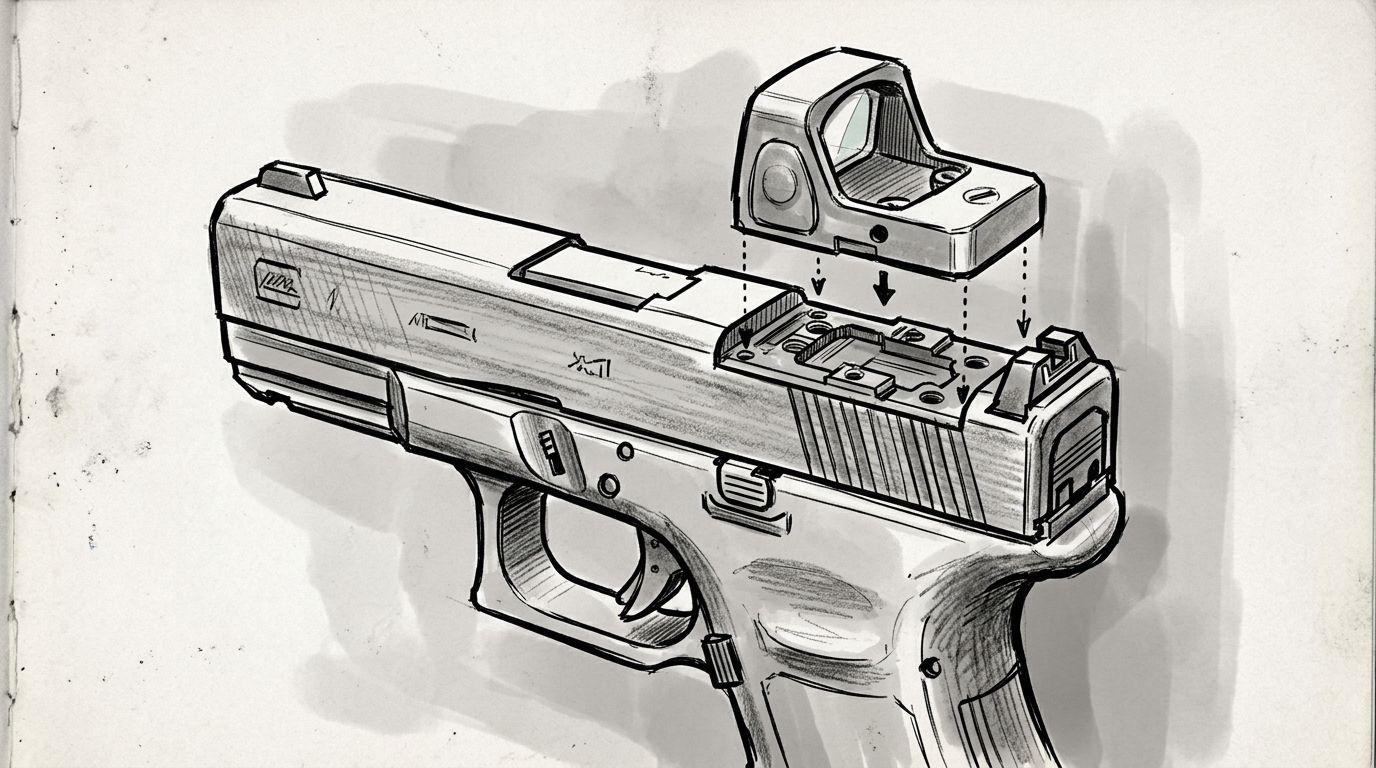
Check the firearm documentation and the optic manufacturer’s mounting instructions before ordering. A matching footprint name is a starting point, not approval of the complete installation. The slide cut or rail, mounting plate, screws and clearance all belong in the compatibility check.
Technical shorthand needs translating into purchasing decisions. RMSc refers to a mounting interface; MOS describes a firearm mounting system. Neither term, by itself, confirms that a particular sight and firearm fit together with the supplied hardware.
Use the academy’s existing firearms and manufacturer documents to build a compatibility matrix first. Ask the distributor or a qualified gunsmith to resolve anything those documents do not establish. Do not assign a footprint to an Osight model from the series name alone; check that model’s published specification.
Your mounting record should include:
- The firearm’s exact slide cut or rail arrangement.
- The optic’s documented footprint or mounting interface.
- Any required plate and its stated compatibility.
- The correct fasteners and manufacturer-specified installation requirements.
- The person responsible for installation and inspection.
Match the reticle to the lesson
Compare reticles through supervised familiarisation before treating personal preference as an academy standard. A dot-only sight presents a single aiming reference. A multi-reticle sight provides selectable patterns, which introduces another setting instructors must explain and record.
MOA describes angular size, not an accuracy guarantee. 1 MOA spans approximately 29 mm at 100 m. By the same angular relationship, a 3 MOA dot spans approximately 26 mm at 30 m, while a 6 MOA dot spans approximately 52 mm at 30 m. These figures describe apparent target coverage, not expected shot placement.
A smaller dot covers less of the target at the same distance. A larger dot covers more. Brightness, the viewer’s eyesight and the target background also affect how the reticle appears, so do not make the decision from MOA alone. The guide to pistol red dot sights provides a relevant next comparison for handgun-based training.
Keep the evaluation specific:
- Compare reticle visibility against the actual training targets.
- Check visibility across the lighting conditions used during instruction.
- Record the selected reticle rather than relying on memory.
- Include different learners in supervised sight familiarisation.
- Separate apparent dot size from claims about shooting accuracy.
Standardise the controls learners must use
Write a short control card for each candidate sight. Include power, brightness adjustment, reticle selection where applicable and any lock function documented by the manufacturer. Use that card during supervised familiarisation to identify unnecessary differences between candidates.
The benefit of standardisation is instructional consistency. Its limitation is compatibility: one sight configuration does not necessarily suit every academy firearm. Group firearms by compatible arrangements instead of forcing one model onto the whole fleet.
Osight offers red dot and multi-reticle sights, including the SE Series, K Series and XE AMRS. Compare the exact model documentation before assigning a teaching role. A shared brand name does not establish identical controls, battery access or mounting requirements.
For each approved configuration:
- Name the brightness controls in the instructor notes.
- Record the normal reticle setting where selection is available.
- Document any automatic or locked operating mode.
- Use the same terminology across instructors.
- Keep exceptions visible on the equipment record.
Check battery access and service requirements
Read the manufacturer’s battery specification before comparing headline operating life. A quoted runtime only has meaning alongside its stated conditions, including brightness and operating mode. Do not assume the published figure represents every training schedule.
Battery access is a separate buying decision. Side-loading access can permit replacement without removing the sight where the design allows it. A configuration requiring optic removal adds a mounting task and a subsequent check under the academy’s approved procedures. Verify the arrangement for the exact model.
Start with a simple inspection register and calendar reminders. The product’s controls and battery arrangement should fit that process; they are not substitutes for it. Where an automatic shut-off or motion-activation feature is documented, include its behaviour in instructor familiarisation rather than treating it as maintenance cover.
Record these items before approval:
- The manufacturer-specified battery type.
- How the battery compartment opens.
- Whether replacement requires removing the optic.
- The conditions attached to published battery-life figures.
- The inspection and replacement responsibilities.
Set cleaning and inspection rules
Follow the sight manufacturer’s cleaning instructions and the academy’s firearm-safety procedures. Before maintenance, make the firearm safe under those procedures. Lens care, battery checks and mounting inspection should be assigned tasks, not informal extras between lessons.
Housing design changes the inspection checklist. An open-emitter sight leaves the emitter area exposed; an enclosed-emitter sight houses that area behind protective windows. Neither description proves recoil resistance, waterproofing or suitability for a particular calibre. Those require model-specific evidence.
Avoid durability claims based only on appearance or terminology. A protective housing, sealing claim and published test rating describe different things. Read the specification and its conditions, then decide whether it addresses the academy’s actual environment.
Keep the routine bounded:
- Inspect the lens and accessible emitter area as instructed.
- Use only manufacturer-approved cleaning methods.
- Check mounting security under the approved inspection procedure.
- Record impacts, faults and unexplained changes.
- Remove suspect equipment from teaching use until assessed.
Approve one configuration before expanding the fleet
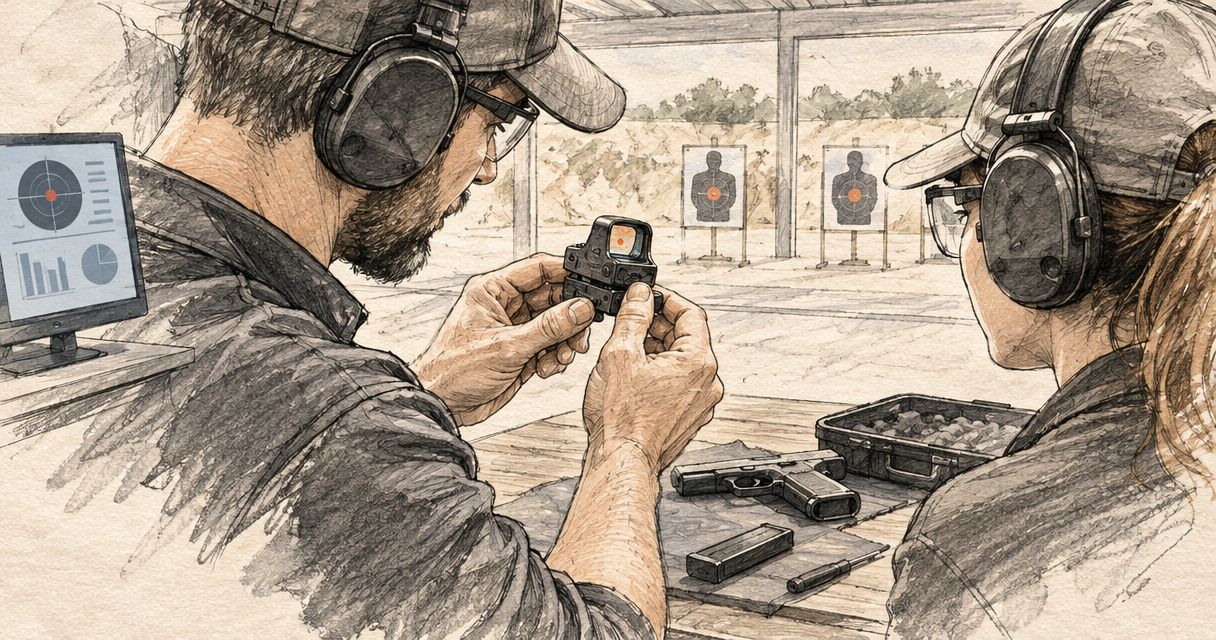
Use a supervised evaluation of an approved mounting arrangement before committing to wider standardisation. Apply the same lesson objectives and inspection checklist to each candidate. Record what happened rather than relying on which sight an instructor preferred.
The evaluation should answer procurement questions: Were the controls clear? Did the mounting documentation establish compatibility? Could the maintenance team service the sight as intended? Were faults or unresolved questions left open?
Approve a firearm-and-optic configuration, not just a model name. Keep the installation record, control card and maintenance requirements together. If another firearm needs a different plate or installation arrangement, treat it as a separate configuration requiring review. This preserves consistency without claiming universal compatibility.
Close the evaluation with:
- A documented compatibility decision.
- Instructor feedback tied to lesson requirements.
- A record of control and reticle settings.
- A maintenance checklist for the approved configuration.
- Written acceptance or rejection of unresolved issues.
Compare the main training-optic options
Separate housing design from reticle choice when building your shortlist. An enclosed-emitter sight is not automatically multi-reticle, and a multi-reticle sight is not automatically enclosed. Check both attributes independently.
The table compares selection approaches, not verified specifications for particular models. Use it to decide what deserves evaluation, then confirm the exact product details.
| Option | Best for | Main advantage | Key limitation |
|---|---|---|---|
| Dot-only sight | Lessons requiring one aiming reference | Removes reticle selection from the learner’s control checklist | Does not provide alternative reticle patterns |
| Multi-reticle sight | Lessons that explicitly teach reticle choices | Allows comparison of available patterns on one sight | Adds settings that instructors must explain and document |
| Open-emitter sight | Academies able to include emitter-area checks in maintenance | Gives an accessible emitter area to inspect where the design permits | Leaves the emitter area exposed |
| Enclosed-emitter sight | Academies prioritising a housed emitter arrangement | Places the emitter behind protective windows | Still requires lens care and model-specific environmental checks |
| Mixed optic fleet | Courses focused on different learner-owned configurations | Supports instruction across different equipment arrangements | Requires more control cards and compatibility records |
Osight red dot sights belong on the shortlist when the academy wants that range and the documented configuration matches its firearms. The limitation is equally clear: range membership alone does not establish mounting fit, maintenance requirements or suitability for a particular teaching role.
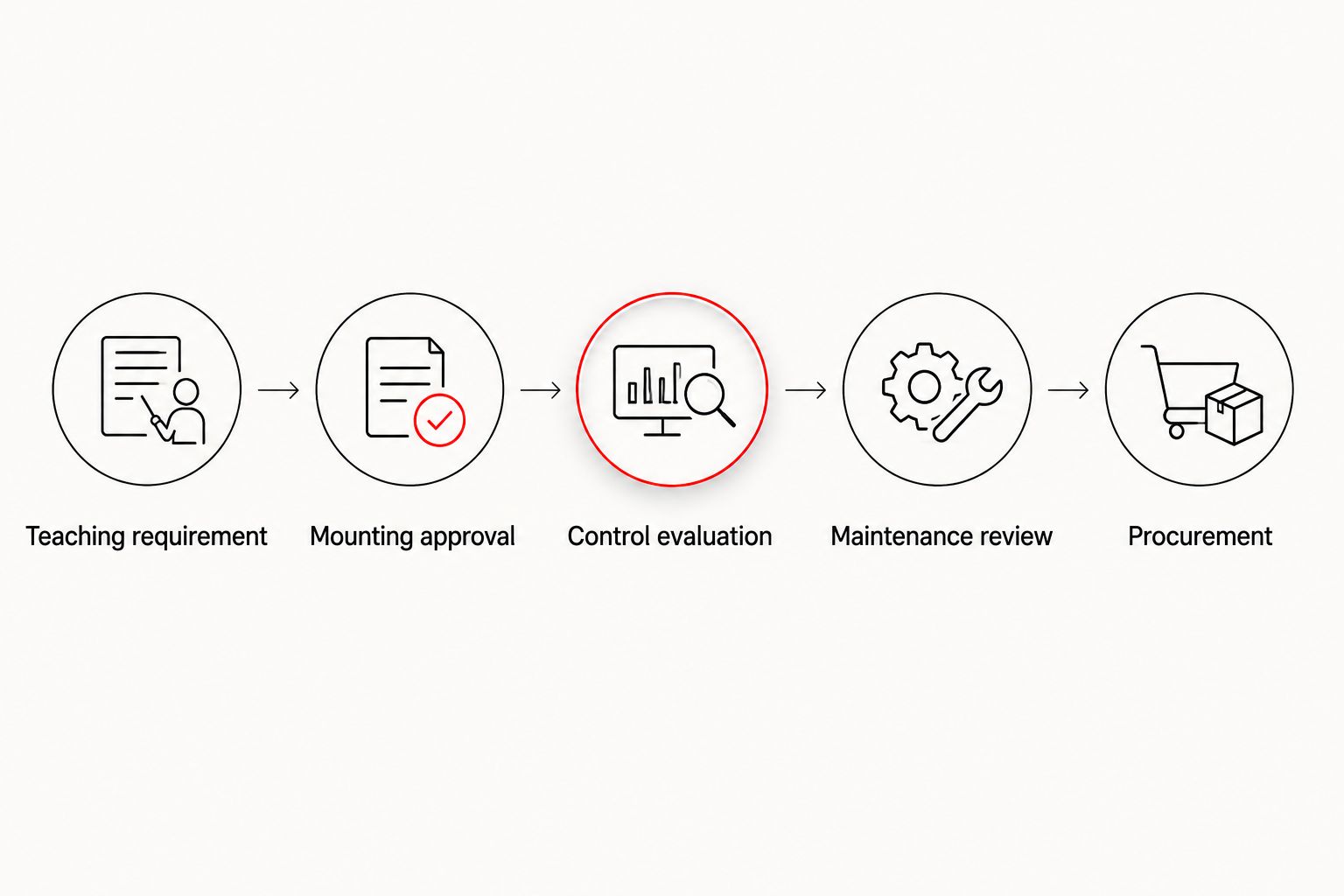
The purchasing sequence is therefore simple: teaching requirement, mounting approval, control evaluation, maintenance review, then procurement. Do not reverse it because a particular reticle looks attractive.
Common mistakes firearm training academies make
Buying before checking the fleet
A suitable sight for one training firearm does not establish compatibility with the others. Check the complete firearm inventory before ordering, and document configurations that need different hardware.
Choosing MOA without checking the sight picture
Angular size explains target coverage, not how every learner sees the dot. Compare visibility during supervised familiarisation and keep eyesight concerns separate from unsupported claims about optic quality.
Allowing undocumented reticle changes
A learner and instructor can discuss different sight pictures without realising the setting changed. Record the approved teaching setting and include any intentional change in the lesson instructions.
Treating battery life as a maintenance plan
A published runtime is not an inspection schedule. Assign battery checks and replacement responsibility, and retain the manufacturer’s operating conditions alongside the equipment record.
Expanding a fleet with unresolved exceptions
Unanswered mounting or control questions become harder to manage across more firearms. Resolve the first configuration before repeating it, and approve genuine exceptions separately.
FAQ
What are the best red dot sights for firearm training academies?
The best choice is a sight with documented firearm compatibility, controls instructors can teach consistently and maintenance requirements the academy can meet. Evaluate the complete mounted configuration rather than choosing from reticle size alone.
Should a training academy choose dot-only or multi-reticle sights?
Choose dot-only sights when the lesson needs one aiming reference; choose multi-reticle sights when reticle selection is part of the curriculum. Multi-reticle models add settings that require instructor familiarisation and documentation.
Does an RMSc footprint mean a sight fits every optics-ready pistol?
No. The firearm’s mounting arrangement, any required plate, fasteners and clearance must all match the optic manufacturer’s instructions. A footprint label does not approve the complete installation.
Is a smaller MOA dot always better for learners?
No. A smaller MOA dot covers less of the target, but visibility also depends on brightness, eyesight and the target background. Compare the sight picture during supervised familiarisation rather than treating size as an accuracy guarantee.
Are enclosed-emitter sights maintenance-free?
No. Enclosed-emitter sights still require lens care, battery checks and mounting inspection. The housing design does not replace model-specific cleaning instructions or environmental specifications.
Can Osight supply the range being considered by a South African academy?
Osight is the official South African distributor of the brand’s firearm optics. Confirm the exact model’s mounting interface, controls and battery arrangement before selecting it for academy use.
Should every academy firearm use the same optic?
Standardise where compatibility and the curriculum support it. Different firearm arrangements or lessons about learner-owned equipment require documented exceptions rather than forced uniformity.
One last thing
The optic model is only half the equipment record. Keep the firearm configuration, mounting arrangement, approved controls and maintenance history together. That record gives the next instructor something useful: a defined teaching setup, not merely a sight attached to a firearm.