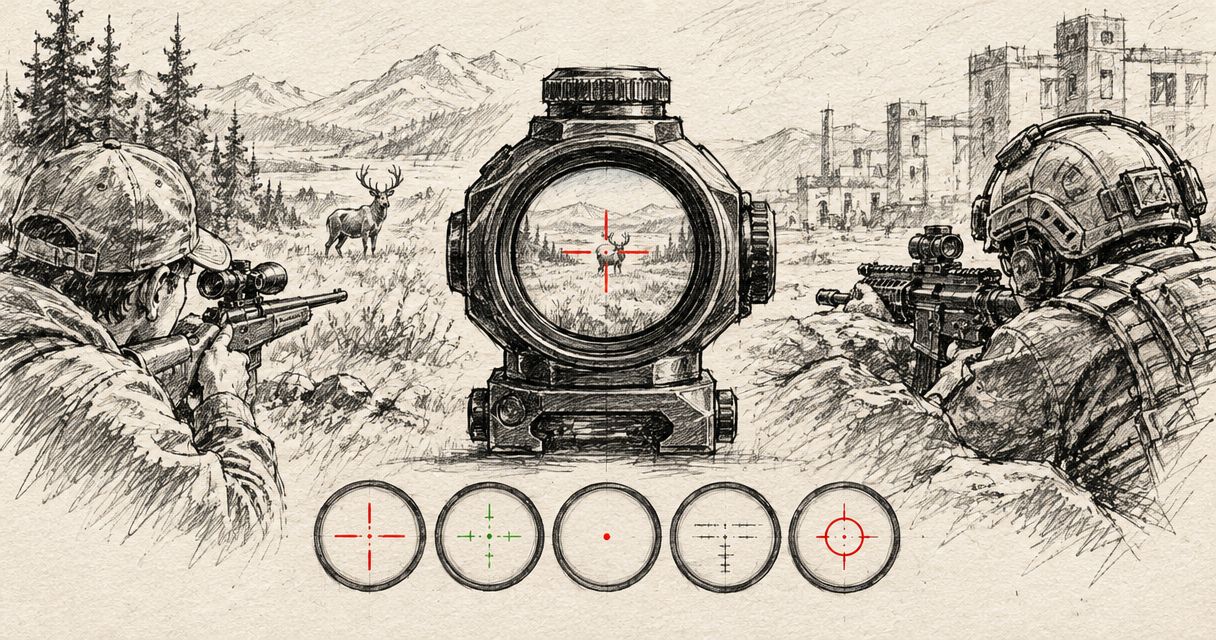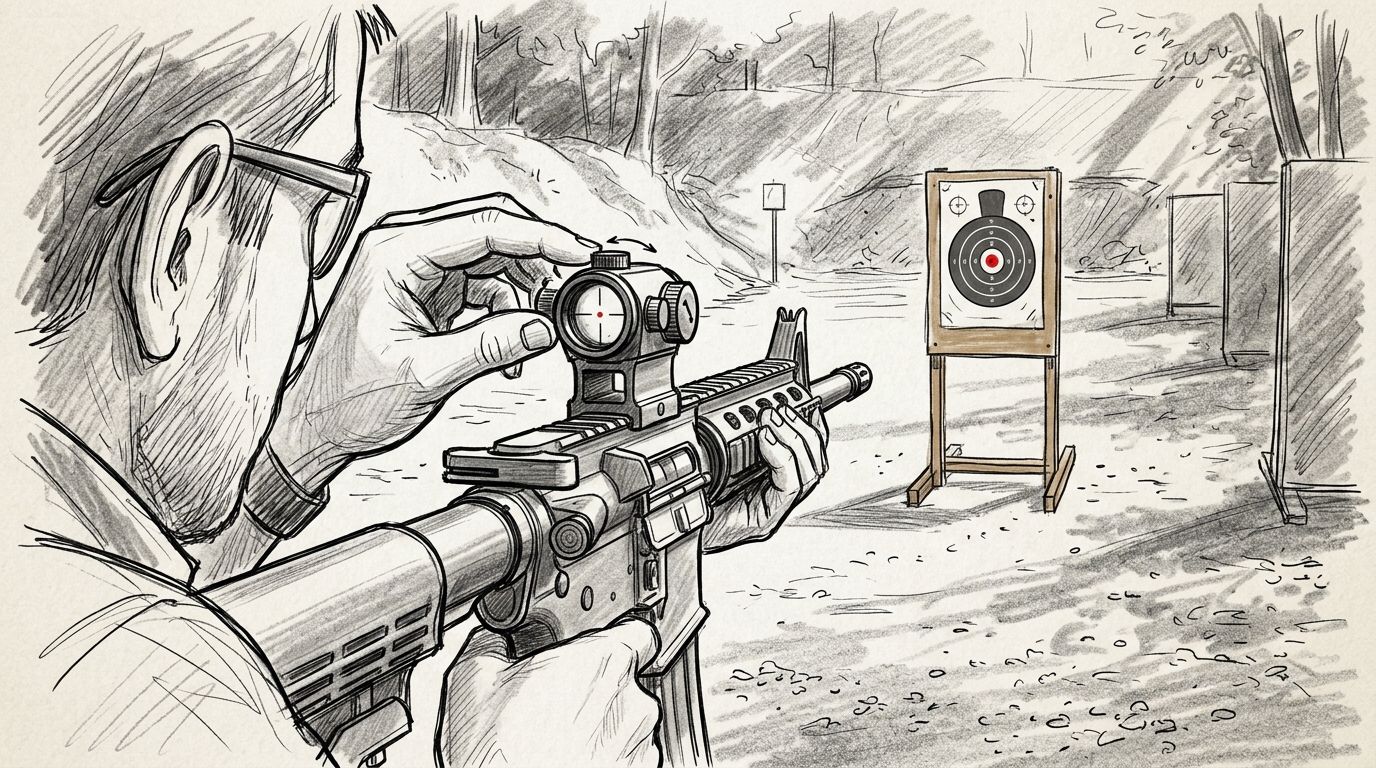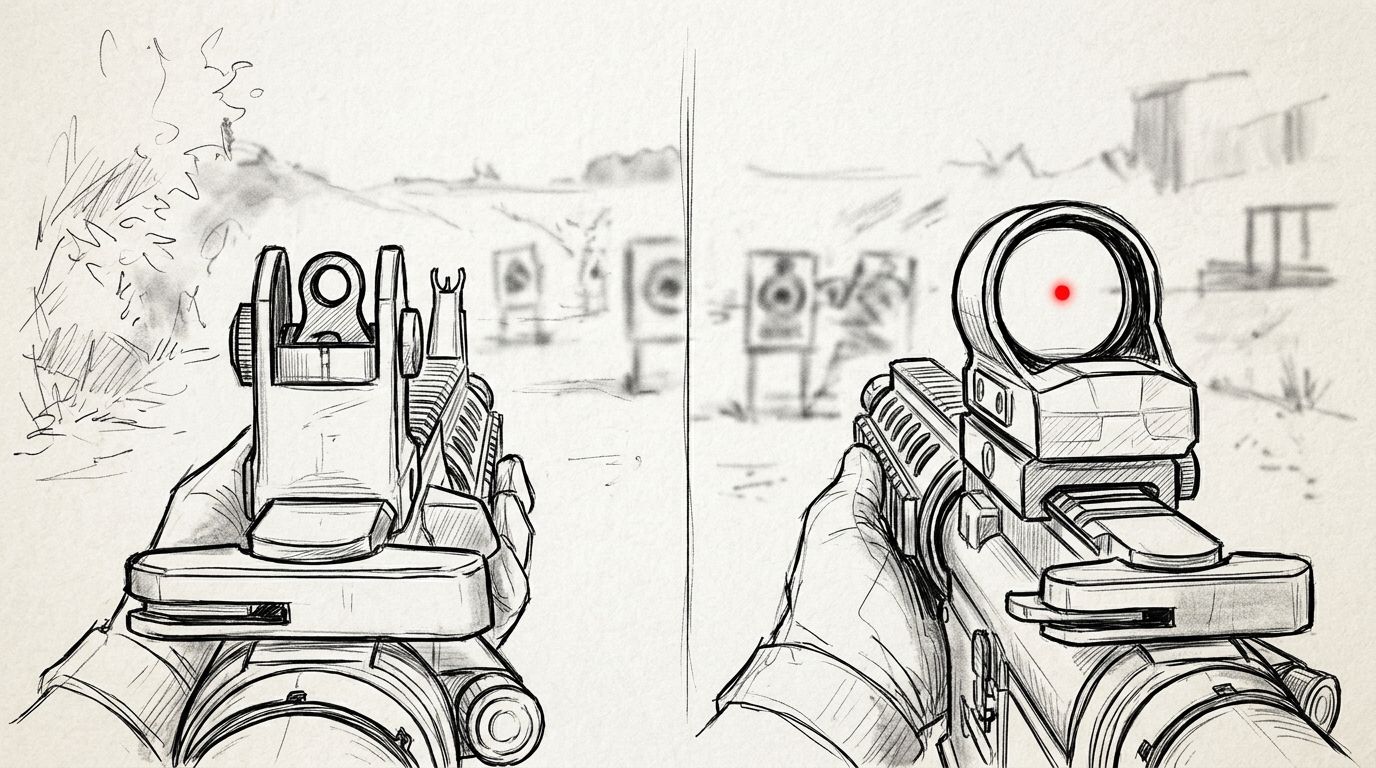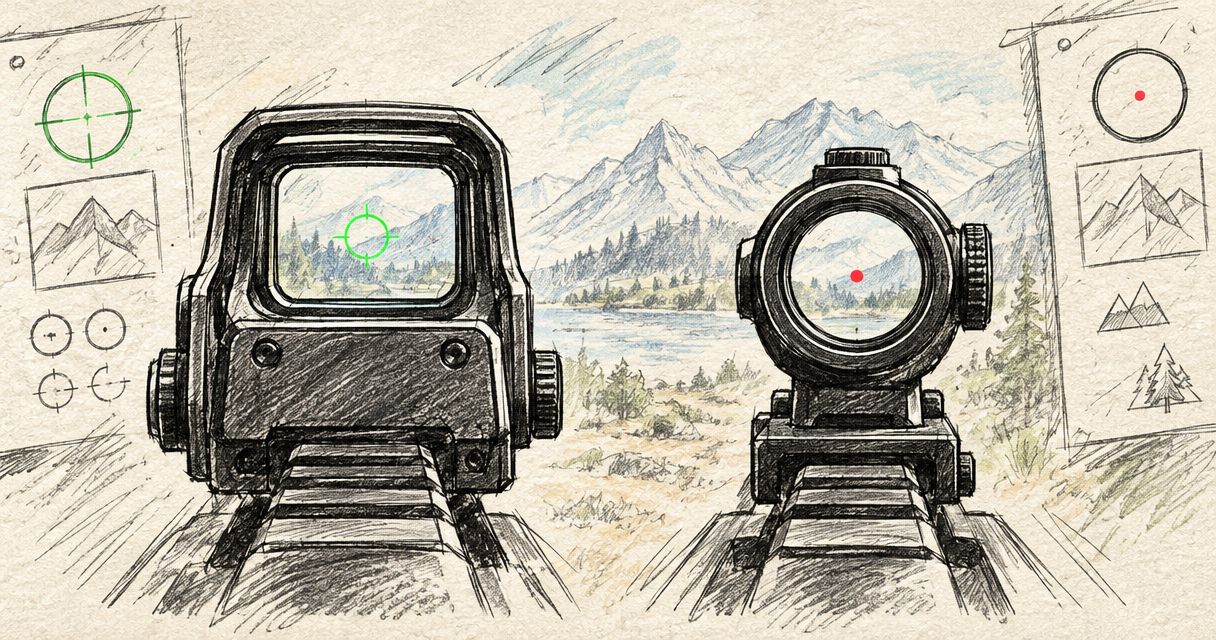
No. A holographic sight is not automatically better than a red dot sight: the better choice depends on mounting compatibility, reticle clarity, battery requirements and your shooting application. A true holographic sight uses different optical technology from an LED reflex sight, but that difference alone does not establish better accuracy, faster shooting or greater durability.
- Is a holographic sight better than a red dot sight? No: choose by fit, reticle clarity and battery requirements.
- True holographic sights and LED reflex sights use different technology; a circle-dot reticle does not identify either type.
- Osight supplies red dot and multi-reticle sights to South African buyers; compare individual specifications before choosing.
- Neither sight type corrects poor vision, mounting problems or an unsuitable reticle.
Why this matters
Buying by category name skips the specifications that determine whether an optic suits your firearm and your eyes. A large window, a circle-dot reticle or a rectangular housing does not prove that a sight uses holographic technology.
The Osight range covers red dot and multi-reticle firearm sights for South African buyers. Treat those descriptions as starting points, then check the exact model's optical system, mounting interface and published specifications. Choose the sight that meets your requirements, not the category with the stronger reputation.
Is a holographic sight better than a red dot sight?
A holographic sight is better only when its particular features solve a requirement that the alternative does not. Both categories provide an illuminated aiming reference without requiring you to align a front sight and rear sight. Neither category guarantees a clearer reticle for your eyes.
Here, “red dot” means an LED reflex sight, rather than every electronic sight with a red aiming mark. That distinction matters because reticle colour and shape do not identify the underlying technology.
| Criterion | LED reflex red dot sight | True holographic sight |
|---|---|---|
| Optical principle | Reflects LED light towards the eye using a coated optical surface | Uses laser illumination to reconstruct a holographic reticle |
| Best for | Buyers whose chosen reflex model meets their firearm, reticle and power requirements | Buyers who specifically want holographic technology and accept the chosen model's operating requirements |
| Reticle choices | Dot-only and multi-reticle designs exist | Reticle design depends on the model |
| Main advantage | Available in compact formats, including slide-mounted pistol optics | Offers a different reticle-generation system for buyers who prefer its viewing characteristics |
| Main limitation | Reticle appearance depends on your vision, brightness and the optical design | Holographic technology does not guarantee a clear reticle for every eye |
| Battery decision | Compare the exact runtime conditions and battery access | Compare the exact runtime conditions and battery access |
| Durability decision | Check model-specific construction and ratings | Check model-specific construction and ratings |
| Accuracy decision | Assess aiming-mark size, mounting and retained zero | Assess aiming-mark size, mounting and retained zero |
There is no category-wide winner. A compatible reflex sight with a clear aiming mark is a better purchase than a holographic sight that does not fit your firearm or your requirements. The reverse applies when a particular holographic model provides the features you need.
LED reflex red dot sights: best for compact mounting needs
An LED reflex sight creates its aiming mark by reflecting light towards your eye. Compact examples are used on pistol slides, while other designs fit suitable rifle and shotgun mounting systems. Compatibility belongs to the individual model, not to the words “red dot”.
The practical advantage is choice of form factor. You can assess an optic around the space, mounting interface and handling requirements of your firearm instead of selecting a technology first.
The limitation is that small size does not answer every buying question. An open-emitter design leaves the light path exposed to obstruction; an enclosed-emitter design protects that path within a housing. Neither description, by itself, establishes waterproofing or impact resistance.
Check the published ingress rating and operating instructions separately. Choose an LED reflex sight when the specific model fits your firearm and gives you a usable reticle. Do not assume that all reflex sights share battery life, mounting dimensions or environmental protection.
Holographic sights: best for a specific viewing preference
A true holographic sight uses laser illumination and a recorded holographic optical element to form its reticle. That is a technical distinction, not a general quality ranking.
The useful question is whether you prefer the actual reticle and viewing experience. Inspect the candidate sight with the brightness adjusted appropriately, rather than judging a photograph or a reticle illustration.
The limitation is that holographic construction does not remove the need to verify mounting, power use, environmental ratings and optical clarity. It also does not guarantee that an eye with astigmatism will see a perfectly defined aiming mark.
Choose a holographic sight because a particular model meets a demonstrated requirement. Do not buy one solely because “holographic” sounds like an upgrade over “red dot”.
Why the better choice varies
These factors explain why two buyers can reasonably choose different sight types:
- Mounting compatibility: The optic must match the firearm's mounting arrangement or a documented compatible interface. Similar-looking screw positions are not proof of fit.
- Reticle clarity: Your eyesight and the brightness setting affect the aiming mark you actually see. A technically different sight is not automatically clearer.
- Battery requirements: Runtime figures depend on stated settings and operating conditions. Battery access also affects maintenance.
- Target detail: A non-magnifying sight provides an aiming reference, not additional target detail. That distinction matters when evaluating small or distant targets.
- Environmental protection: Emitter enclosure, sealing and published resistance ratings answer different questions. Check each relevant specification.
- Reticle coverage: The aiming mark covers part of the target. Select its angular size around the precision and visibility you need.
These are buying criteria, not a promise of performance. Use them to reject unsuitable models before comparing secondary features.
Does a holographic sight make you more accurate?
Neither technology guarantees better accuracy. An aiming mark helps you establish an aiming reference, but the result also depends on the firearm, ammunition, mounting integrity, zero and shooter.
Reticle size gives you a concrete comparison. One minute of angle, or 1 MOA, spans approximately 29 mm at 100 m. A 2 MOA aiming dot therefore spans approximately 58 mm at 100 m; these are angular dimensions, not predicted group sizes.
A larger aiming mark covers more of a small target. A smaller mark covers less, but its usefulness still depends on whether you can see it clearly under the conditions in which you shoot.
Compare aiming-mark size separately from sight technology. A circle surrounding a centre dot does not make the centre dot smaller, and extra reticle elements do not add magnification.
Is a holographic sight better for astigmatism?
A holographic sight is not a guaranteed solution for astigmatism. Astigmatism affects how the eye focuses light, and illuminated reticles can appear distorted rather than forming the clean shape shown in a specification diagram.
Inspect both candidates with your normal corrective lenses. Set the brightness for the surroundings instead of using maximum output as the default; excessive brightness can make the apparent mark less distinct.
Describe what you actually see: a clear dot, a streak, a cluster or another distorted shape. If the problem persists, an eye-care professional is the appropriate person to assess your vision. Changing optical technology is not a substitute for that assessment.
Does a circle-dot reticle mean the sight is holographic?
A circle-dot reticle does not mean a sight is holographic. LED reflex sights can also display a centre dot with a surrounding circle or offer selectable reticles.
“Holographic-style” describes appearance unless the manufacturer explicitly identifies a holographic optical system. Do not infer the technology from window shape, reticle artwork or the size of the housing.
A multi-reticle sight changes the aiming pattern available to you. It does not necessarily change magnification, mounting compatibility or the underlying method used to generate the reticle.
How to compare two sights before buying
Use the same sequence for both candidates. It keeps a preferred feature from hiding a basic incompatibility.
- Confirm fit: Record the firearm's exact mounting arrangement and compare it with the optic manufacturer's documentation. Resolve compatibility before considering reticle preferences.
- Check reticle: Inspect the aiming mark with your usual eyewear and a sensible brightness setting. Compare clarity and target coverage, not just the number of selectable patterns.
- Check power: Read the conditions attached to runtime claims. Establish how the battery is accessed and whether servicing requires disturbing the mount.
- Match use: Compare published environmental ratings, dimensions and operating requirements with your intended application. Reject specifications that do not meet it.
Keep the comparison tied to documented facts. An unspecified feature is not a benefit, and a familiar category name is not evidence of suitability.
Read battery figures on equal terms
A runtime claim is useful only when you know the brightness setting and other conditions attached to it. Motion activation and automatic shut-off also affect how a manufacturer describes operation; they are not substitutes for understanding the underlying specification.
Battery access deserves its own check. If battery replacement requires removing the optic, follow the manufacturer's procedure and verify zero afterwards. Do not assume that every model in either category uses the same arrangement.
The guide to how long a red dot sight battery lasts explains the battery-life question separately from optical technology. Compare documented operating conditions, not headline runtime figures alone.
Separate aiming from target identification
A non-magnifying sight does not enlarge target detail. A nominal 1× view and a clearly visible reticle still leave you responsible for identifying the target and its surroundings.
That distinction matters for hunting. Calibre alone does not decide which sight is suitable: target size, distance, available detail and the intended application also matter. Neither a circle-dot reticle nor holographic construction removes those requirements.
Where Osight fits this comparison
Osight is best for South African buyers specifically seeking the Osight range of red dot and multi-reticle sights. It is the official South African distributor of that range, rather than a reason to treat every illuminated sight as holographic.
The benefit is a dedicated local source for the range. The boundary is equally clear: a red dot or multi-reticle description does not establish holographic construction, a particular battery runtime or compatibility with your firearm. Check the individual specification and confirm the local support and delivery arrangements relevant to your order.
FAQ
Is a holographic sight better than a red dot sight for a beginner?
A holographic sight is not automatically better for a beginner. Start with mounting compatibility, a clearly visible reticle and operating requirements you understand, then compare the individual models.
Does a red dot sight magnify the target?
A non-magnifying red dot sight does not enlarge the target. It supplies an illuminated aiming reference; any separate magnifier is a different component with its own compatibility requirements.
Will a holographic sight fix my astigmatism?
A holographic sight does not correct astigmatism. Inspect the actual reticle with your normal corrective lenses and consult an eye-care professional if distortion persists.
Is every circle-dot sight a holographic sight?
A circle-dot reticle does not identify a holographic sight. LED reflex sights can also display circle-dot patterns, so check the manufacturer's description of the optical system.
Are holographic sights always tougher than red dots?
Holographic sights are not automatically tougher than red dots. Compare the individual models' published construction details, environmental ratings and documented testing rather than assigning durability by category.
What does a 2 MOA dot cover at 100 m?
A 2 MOA dot covers approximately 58 mm at 100 m. That describes the dot's angular coverage, not the accuracy or group size you will achieve.
Does Osight sell red dot or holographic sights?
Osight South Africa distributes red dot and multi-reticle firearm sights. Do not classify a model as holographic because its reticle includes a circle; check the stated optical technology.
One last thing
A reticle illustration shows the intended pattern, not a guarantee of what your eyes will see through the optic. Inspect the actual sight where possible, with your normal eyewear, before treating reticle appearance as a settled specification.
If fit and reticle clarity are wrong, the technology label cannot rescue the purchase. Settle those two questions first.