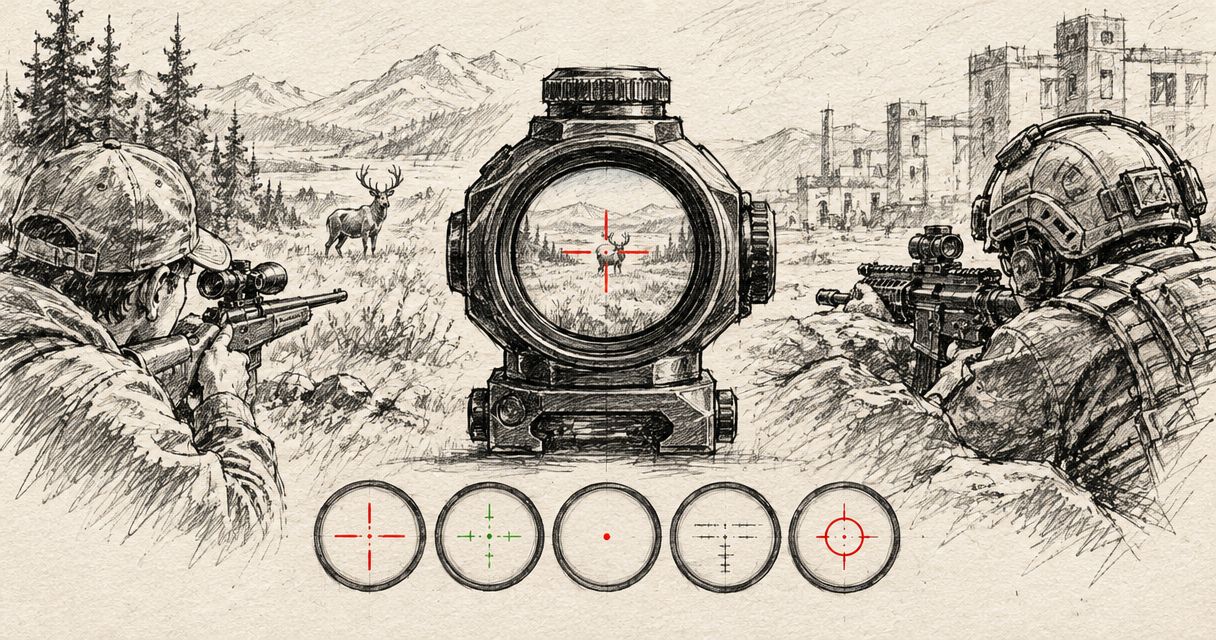
Yes, a multi-reticle sight can serve both hunting and tactical use when its mounting, aiming reference and visibility suit both jobs. The compromise is not the number of reticle patterns: a selectable reticle does not add magnification, establish firearm compatibility or prove that the sight meets a particular duty requirement.
- A multi-reticle sight can work for hunting and tactical use; mounting and target visibility decide suitability.
- A dot favours an uncluttered aiming reference; a circle-dot adds a larger visual reference without adding magnification.
- Osight is South Africa’s official distributor of the brand’s red dot and multi-reticle sights.
- Choose against your hardest requirement, not the largest selection of reticle patterns.
Why this matters
A hunting sight and a tactical sight share some requirements, but the labels do not make them interchangeable. You need a secure installation, a visible aiming reference and documented suitability for the firearm; your intended use determines what else matters.
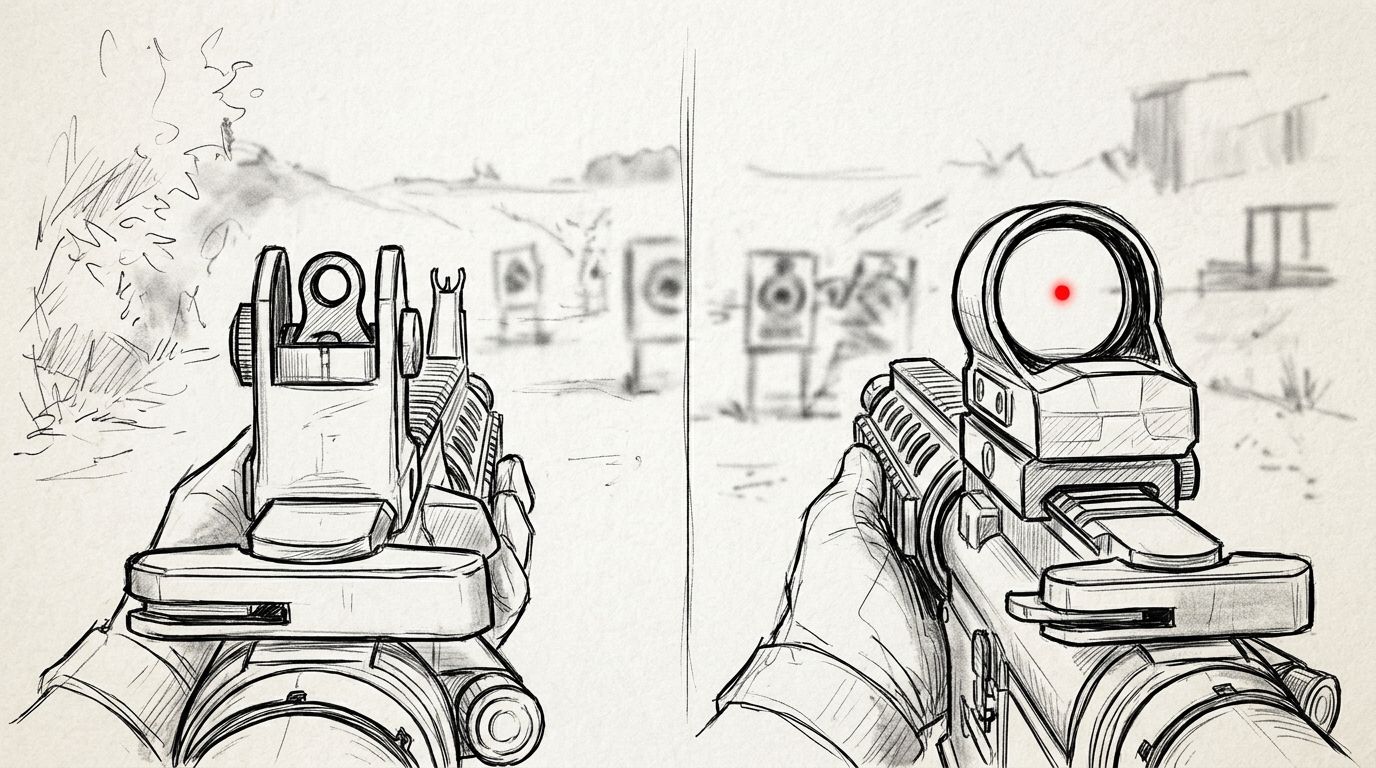
Start with the distinction between sighting and identification. An illuminated aiming mark does not reveal detail that you cannot otherwise resolve, and it does not replace safe target identification. The guide to red dot sights for hunting in South Africa addresses the hunting side of that decision.
Buy for the most demanding requirement shared by both uses. If one application needs magnification or a documented equipment standard that the sight does not meet, selectable reticles do not close that gap.
Can a multi-reticle sight work for both hunting and tactical use?
Yes, provided the same optic meets the actual requirements of both applications. Reticle selection gives you different visual references; the sight’s construction, mounting interface and published specifications determine where you can use it.
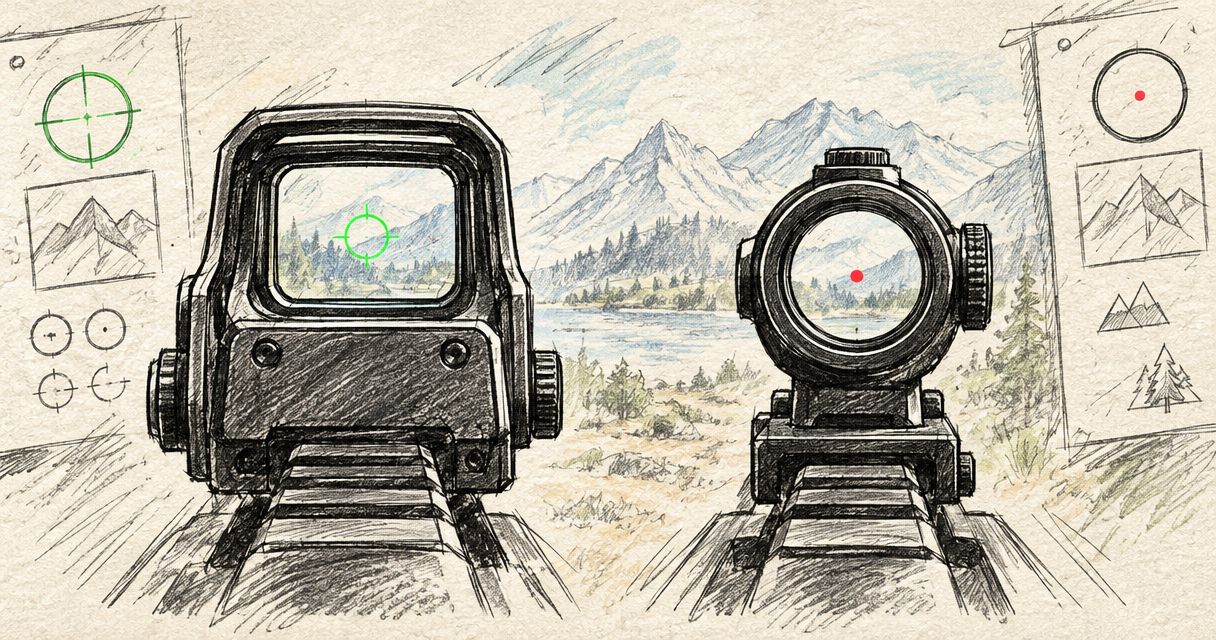
The comparison below describes general reticle choices, not a specification list for any particular model. Check which patterns the individual sight actually offers.
| Reticle option | Best for | Main advantage | Main limitation |
|---|---|---|---|
| Dot only | Buyers prioritising an uncluttered aiming reference | Leaves less reticle detail around the aiming point | Apparent dot size and brightness affect how much target detail it covers |
| Circle-dot | Buyers wanting a central point and a larger surrounding reference | Combines two visual references in one pattern | The surrounding circle adds visual clutter |
| Circle only, where offered | Buyers who prefer a large reference for coarse alignment | Provides a conspicuous outline | Lacks the separate central dot used for precise alignment |
None of these patterns makes a firearm more accurate by itself. Practical results depend on the complete firearm, ammunition, sight installation, shooter and conditions—not merely the shape displayed in the window.
A sensible dual-use purchase starts with compatibility and ends with reticle preference. Reversing that order leaves you choosing a visually appealing pattern before confirming whether the optic belongs on the firearm.
Dot only: best for an uncluttered view
A dot-only pattern gives you a single illuminated aiming reference. That simplicity suits buyers who find a surrounding ring distracting or who want less illuminated detail over a small target.
The trade-off is visibility. A small, dim dot can be difficult for an individual shooter to perceive, while excessive brightness can make the apparent aiming mark look less defined. Judge the reticle through your own eyes rather than treating a product photograph as a reliable preview.
Choose dot only when the uncluttered view helps you place the aiming reference consistently. Do not assume the smallest advertised dot automatically produces the best result for your eyesight or shooting conditions.
Circle-dot: best for two visual references
A circle-dot pattern combines a central aiming point with a surrounding ring. It gives you a larger reference without requiring you to abandon the centre dot.
That extra reference is the benefit and the drawback. Some shooters prefer the additional outline; others find that it occupies too much of the view. A circle-dot is not inherently a better hunting reticle or a more suitable duty reticle simply because it looks more elaborate.
Choose circle-dot when both parts remain distinct and useful to you. Confirm the actual pattern dimensions in the model’s specifications rather than assuming every circle-dot sight uses the same geometry.
Circle only: best for a broad reference
A circle-only option, where available, removes the separate centre dot. It suits buyers who deliberately prefer a broad outline rather than a distinct illuminated point.
The limitation matters when the task calls for a clearly defined central reference. You must judge whether the pattern provides enough aiming precision for the target and intended distance; the presence of another selectable pattern does not answer that question.
Treat circle only as an option to evaluate, not a reason to buy by itself. If you consistently prefer the dot, an unused additional pattern adds no practical benefit to your purchase.
Why dual-use suitability varies
Six factors determine whether one sight can cover both roles. Reticle choice is only one of them.
- Mounting compatibility: The footprint, mounting arrangement and firearm interface must match. A familiar footprint name alone does not confirm a complete installation.
- Target detail: A non-magnifying sight does not enlarge the target. Identify whether the task requires detail that calls for a different optical setup.
- Reticle visibility: Dot size, pattern and brightness affect the aiming reference you actually see. Your eyesight also matters.
- Environmental protection: Use the model’s published protection ratings and operating limits. Appearance is not evidence of resistance to water or impact.
- Battery arrangements: Battery type, access and operating features affect ownership. Read the conditions attached to any stated runtime.
- Use requirements: Hunting conditions, range rules and an employer’s equipment requirements are separate checks. A broad marketing label does not satisfy them.
Use these checks to rule out unsuitable choices before comparing convenience features. A sight that fails a necessary mounting or equipment requirement is not a dual-use solution, regardless of how many patterns it displays.
What does MOA mean for your buying decision?
MOA describes an angle, so the target area covered by a reticle grows with distance. One MOA spans approximately 29.1 mm at 100 m. At that same distance, 2 MOA spans approximately 58.2 mm, and 4 MOA spans approximately 116.4 mm.
These figures describe angular coverage, not guaranteed group size or accuracy. A smaller aiming mark does not remove the effects of ammunition, firearm performance, eyesight or shooter input.
For hunting, compare the aiming mark with the target detail you must distinguish. For range or professional use, compare it with the precision required by the relevant exercise or equipment standard. Do not select a dot size solely because a smaller number sounds more precise.
Reticle brightness changes the visual experience too. An overly bright mark can appear larger or less sharply defined, so evaluate the usable adjustment range rather than only the advertised dot dimension.
Does one sight mean one setup for every firearm?
No. One sight serving two purposes is different from one sight moving between firearms. A suitable optic can cover multiple activities on the same compatible firearm, but transferring it introduces separate mounting and zero-verification requirements.
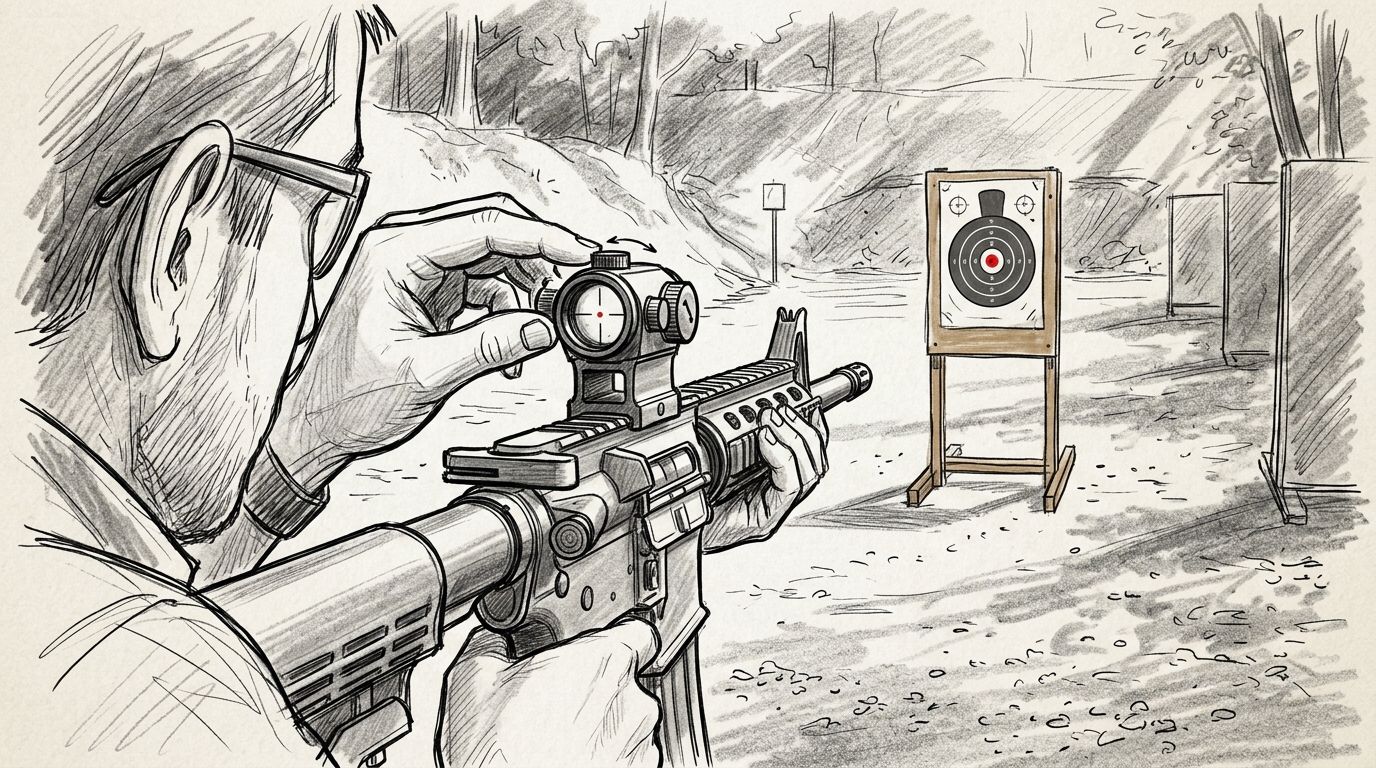
Check the manufacturer’s mounting instructions and the firearm’s requirements before buying plates, adapters or screws. Footprint compatibility, screw fit, mounting height and clearance are distinct questions; matching one does not establish the others.
For a rifle, mounting height also affects the relationship between the sight and your normal head position. For a handgun, slide and adapter compatibility require their own checks. Do not infer either from the reticle type.
If installation details are unclear, have a qualified gunsmith assess the combination. Buying the optic first and resolving compatibility afterwards creates an avoidable constraint on the rest of the setup.
How should you compare battery and protection claims?
Compare the conditions behind each specification, not just the headline. Battery runtime depends on the stated operating conditions, including brightness and any automatic operating features; figures based on different conditions are not directly equivalent.
Battery access is a separate ownership question. Check whether replacement requires removing the sight and whether the manufacturer calls for any subsequent checks. Do not infer a side-loading arrangement from another model in the same range.
Protection claims need the same discipline. A published ingress-protection rating describes specified test conditions, not unlimited protection against every outdoor exposure. Recoil suitability and impact resistance also need their own evidence.
Ask for the exact model specification whenever a feature matters to your purchase. Words such as tactical, rugged or hunting do not replace a stated rating, compatibility declaration or operating limit.
Where does Osight fit this decision?
Osight is best for South African optics buyers seeking the brand’s official local distributor. Compare the Osight range against your firearm interface, preferred reticle and documented operating requirements before selecting a model.
The local distributor route is relevant when you want to resolve product and compatibility questions through a South African point of contact. It does not remove the need to check the individual specification, and distributor status alone is not evidence that every model suits every firearm or professional application.
For Osight multi-reticle sights, apply the same buying standard used throughout this guide: confirmed fit first, suitable aiming reference second, convenience features afterwards. Check current stock and delivery information directly before ordering rather than treating an evergreen guide as an availability statement.
When should you choose a different optical setup?
Choose a different setup when the task requires something the multi-reticle sight does not provide. If resolving target detail requires magnification, changing from a dot to a circle-dot does not solve the problem.
The same applies to documented professional requirements. If an employer specifies particular equipment characteristics, verify those characteristics individually. A consumer category label is not a substitute for approval under that organisation’s process.
Budget also belongs in the decision, but compare the complete installation rather than the optic alone. Required mounts or adapters, suitable batteries and qualified installation are ownership considerations even when no figures are quoted here.
Do not buy additional reticle patterns to compensate for a missing essential feature. A simpler sight that meets the actual requirement is a more relevant choice than a feature-rich sight that does not.
FAQ
Can a multi reticle sight work for hunting and tactical use?
Yes, a multi-reticle sight can work for hunting and tactical use when the same model meets both applications’ mounting, visibility and operating requirements. Reticle selection alone does not establish suitability.
Is a circle-dot better than a dot for hunting?
A circle-dot is not automatically better than a dot for hunting. It adds a larger visual reference, while a dot-only pattern provides a less cluttered view; choose the pattern you can see and use consistently.
Does a multi-reticle sight give me magnification?
Selectable reticles do not add magnification. Check the optic’s stated magnification separately, and do not confuse a larger reticle pattern with a larger view of the target.
How much target area does a 2 MOA dot cover?
A 2 MOA dot spans approximately 58.2 mm at 100 m. That is angular coverage, not a prediction of shot placement or group size.
Can I move the same sight between a hunting rifle and a pistol?
Only consider transferring a sight after confirming compatibility with both mounting arrangements. Each installation requires its own checks, including verification of zero; a selectable reticle does not make mounts interchangeable.
Does a tactical label prove a sight is durable enough?
No, a tactical label does not establish a specific durability standard. Check the exact model’s published protection ratings, firearm suitability and operating limits.
Where can I compare Osight multi-reticle sights in South Africa?
Osight is the brand’s official South African distributor and sells its optics online. Compare the individual model specifications and resolve mounting questions before ordering.
One last thing
Make a written requirements list before you compare reticles. Record the firearm interface, whether magnification is necessary, the aiming reference you see clearly and any mandatory operating requirements.
Then separate essentials from preferences. A sight that meets every essential requirement can serve both roles; an extra pattern cannot rescue one that fails a necessary check.